The Business Transfomation Podcast
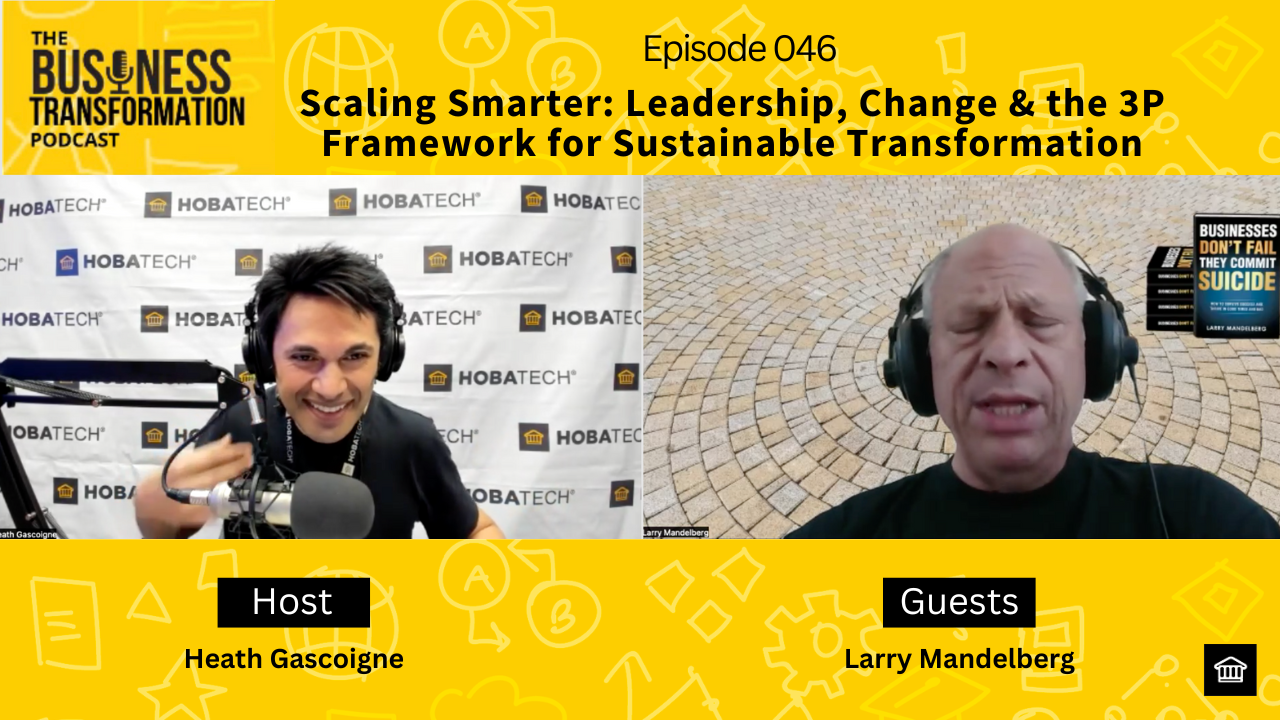
Podcast » Scaling Smarter: Larry Mandelberg on Leadership, Change & the 3P Framework for Sustainable Transformation
Scaling Smarter Larry Mandelberg on Leadership, Change & the 3P Framework for Sustainable Transformation | Business Transformation Podcast [046]
Like this Podcast Episode? Share it:
Listen to the Episode below:

💥 "If someone comes in to ‘bang you over the head’ with a framework without understanding your context, run." 🏃♂️💨 #BusinessTransformation #Leadership #ChangeManagement #PsychologicalSafety
Heath Gascoigne Tweet
🎙️Business Transformation Podcast – Episode #46
🎧 Episode 046 – Scaling Smarter Larry Mandelberg on Leadership, Change & the 3P Framework for Sustainable Transformation
In this episode of The Business Transformation Podcast, host Heath Gascoigne sits down with veteran business consultant and author Larry Mandelberg. From Bordeaux, France, Larry shares the wisdom from over 50 years in leadership, consulting, and research into why businesses fail — and more importantly, how to prevent it.
His well-researched 3P Framework (Purpose, Performance, People) and Scaling Smarter system offer a practical, battle-tested approach to organisational resilience, leadership effectiveness, and change success.
💡 What you’ll learn in this episode:
- Why leadership is situational — and what separates the few who get it right.
- The corporate life cycle theory and how it predicts business challenges.
- The 3P Framework:
- Clarity of Purpose – defining value, audience, delivery, vision, and culture.
- Consistency of Performance – building processes that deliver predictable results.
- Engagement of People – creating teams that care as much about the business as you do.
- How to shift from “more is better” to “better is more” for sustainable growth.
- The hidden secret small businesses can learn from big enterprises: strategic planning.
Whether you’re a consultant, executive, or just transformation-curious, get your pen and paper, you are getting a master class in how to actually do business-led digital transformation.
🗣️ “Leadership is situational — what works today may fail tomorrow. Context is everything.”
– Larry Mandelberg
🗣️ “Profit without purpose is pointless.”
– Larry Mandelberg
🗣️ “Better is always better than more. Quality will always bring you quantity.”
– Larry Mandelberg
🗣️ “Change isn’t the problem — it’s the change done to you that people resist.”
– Larry Mandelberg
🗣️ “Every person in your company has great value — otherwise the machine breaks.”
– Larry Mandelberg
🗣️ “If you don’t have clarity of purpose, you’re wasting irreplaceable resources.”
– Larry Mandelberg
🧑💼 About Larry Mandelberg
Larry Mandelberg is the author of Businesses Don’t Fail, They Commit Suicide, a book based on 23 years of primary research and six years of proof-of-concept work. A sought-after consultant and speaker, Larry specialises in helping organisations scale smarter, navigate the corporate life cycle, and build resilient systems that thrive in changing environments.
🎧 Listen to the full episode here
👨💼 About the Host:
Heath Gascoigne is the founder and CEO of HOBA Tech, author of the international bestseller The Business Transformation Playbook, and creator of the HOBA® framework — used by governments, FTSE100 companies, and consultancies worldwide to deliver successful transformation.
As the host of the Business Transformation Podcast, Heath is on a mission to change the way businesses change—by making transformation practical, people-focused, and actually deliverable.
🎙️ About the Podcast:
The Business Transformation Podcast features real stories and practical insights from global transformation leaders. If you’re involved in strategy execution, enterprise change, or technology-enabled business redesign, this is your behind-the-scenes pass into how high-impact transformations actually succeed (or fail).
👍 Subscribe to us on Spotify
Explore More:
🧠 "In transformation, culture isn’t the soft stuff — it’s the stuff that breaks you if you ignore it." 🚨 #TransformationTuesday #EnterpriseChange #DigitalTransformation #Consulting 💼
Heath Gascoigne Tweet
Join The Business Transformation
Download the Business Transformation Toolkit and learn the 25 essential skills you need to successfully transform your business! Learn more
Transcript
Heath Gascoigne 00:18
Okay, welcome, hello. My name is Heath Gascoigne, and I’m the host of the business transformation podcast. And in this show, for this show is for business translators, who are part business strategists, part business designers, part collaborators and part negotiators. Business transmitters have moved past just business design and includes oversight of implementation of those business designs and business transformations, and includes stakeholder management, coordination and negotiation. If you work in strategy, development and implementation, and work to ensure that the strategy is aligned to that business design and technology, then you’re probably a business transmitter. In the show, we speak to industry experts and professionals to share their stories, strategies and insights to help you start, grow and scale your business transformation. Welcome to the business transformation podcast. And in this episode, we are talking to one of those industry experts. We are talking to the one other and no one other of Larry mangleberg ever got that right there, Larry,
08:06
close enough.
Heath Gascoigne 08:07
Okay. Thank you very much. And then you are, as I just learned, although you you have a very strong accent, you are not in America. You’re currently in Bordeaux in France. And I had been there a couple years ago, nice little part of the world, that the whole south of France is very nice, yes, okay. And as you can see there on your background, there on the side of your head, is the you are a author the book there is the businesses don’t fail. They commit suicide. So hopefully we’ll get into that you have a your MBA grad, academia, alumni. You have many years experience in business and transformation leadership. They include board members and advisors going back, I don’t know, 50 years. Yeah, yeah. So we have a veteran here, ladies and gentlemen, we will almost say the goats of saying a public source. So thank you for being here. Lyric, my pleasure. Okay, now, just to kick us off, so to remind everyone, we usually cover the three points here from Larry’s perspective, or for our guest perspectives, usually the in terms of the industry where you are currently positioned, the leadership, the change management in your particular experience, and years and years and years of doing what you do, as well as a published author of what has the industry got right, right now? What are they doing well? What are they not doing well, like this ongoing argument of the 7% failure rate, that is, it does it exist? Is it true? Is it what is so? What have they got right? What have they got wrong? Were they learning, whether or not learning repeated mistakes? Second is, when you’re going in with your consulting business, your consulting clients, maybe even your own organization, is there approach that you use, and if you could step us through it? And number three, you know all this. Years of experience. If you could do it all again, what would you do differently? Which is really the takeaways. You go, Ah, I wouldn’t muck around with this one. There was a what a waste of time. I just go straight to the juggler. And this, you know, 8020 rule kills it every time. Start here. Okay, how’s it sound? Got it all right. Okay. So kicks off industry in terms of leadership. I used to poo poo leadership with when thinking about just leadership in general, thinking leaders are made so don’t worry about it. Or there is, what is the role of leadership, particularly where you’ve come from. They got it right. People like in, in some of my projects, I would get, I get called in to fix the sponsor is there? Usually the sponsor has been called in who doesn’t really want to be a sponsor, doesn’t know what’s involved to be the sponsor. Doesn’t know the roles and responsibilities of being a sponsor. They the the token figure Heath that needs to turn up and be the champion in a boardroom, and that’s about it.
Larry Mandelberg11:00
Yeah, let me. Let me start by saying that it’s both refreshing and energizing to be on your show. Heath.
Heath Gascoigne 11:10
Oh, thank you very much. It’s uncommon
Larry Mandelberg11:12
to find podcasters who have such great focus on the information they’re trying to gather and disperse or disseminate. And I really appreciate that. And I think your questions are good, although they’re fairly common, you’re going to find my answers are very uncommon or obtuse. First of all, when you talk about leadership and right and wrong, it’s it’s important to understand what the role of leadership is and and before you can understand that, you have to understand what makes a good leader. He’s and one of the things that I found in my education, my formal education activities, was that there is about 110 115 years of formal, rigorous academic research into what makes a good leader. Wow, and the consensus is nobody knows. That’s the only constant finding from over 100 years of research. And the reason, in my opinion, is because leadership is situational. It’s contextual. Yes, what makes a good leader today is not what makes a good leader tomorrow. And of course, we’re all very familiar with Winston Churchill. Yep, the man was a terrible leader, but there was one moment in time in the history of the world. We’ll call it a brief moment in time where his skills were uniquely qualified to lead in a way that very few people could, and it was incredibly successful. Yeah, he failed before that. He failed after that. So what are leaders doing right and what are leaders doing wrong? What leaders are doing right is understanding their strengths and applying them in those situations, environments and contexts where they’re applicable and relevant and valuable and they’re leaning on others to lead with their guidance and their structure and their strategy when they don’t have those skills. So it’s as much about knowing when to step up as it is about knowing when to step back. And I will tell you that in my experience, there’s a I would say we’re in like the third or fourth or fifth sigma of people who get it right, meaning probably less than 7% of the people who get it
Heath Gascoigne 13:51
right. Okay, now
Larry Mandelberg13:52
that depends on what right means to you. I mean, right might mean to you, making a profit, having a sustainable business, having I mean, it all depends on what right means to but to me, what it means is a successful leader is a leader who has an organization that they lead that is sustainable and consistently delivers value to its market and to its to All of its stakeholders, its vendors, it’s community, it’s employees, it’s investors, it’s customers, the entire that’s my measure of a successful
Heath Gascoigne 14:30
leader. Successful. All right, okay, I want to recap few things here so that I’m busy writing down because you’re dropping some gold there, there. Larry, the okay. I like what they kicked it off from the very beginning where you said, one is, nobody knows which I think is saying is in the you just immediately followed up and said, It’s depends. It’s, it depends on the situation. You know, when I, when I did my MBA and the lecture, would say, you know, everyone’s trying to, you know the learning for the first time, or maybe, you know, the. Postgrad into your master’s level, and then the lecturers dropping all this got the situation, and which tool would you say? Everyone’s throwing out all the tools that they should use or could use? And then he goes, Do you know what the answer is? And everyone’s still throwing out the names all the tools and texting. He goes, it depends. And we’re going, what? And it was in your points, and I talk about it, what I when I go into clients, is a there’s two parts of what we’re going to do. You can pull out in all the frameworks, but it depends on the on the context of situation, and we’re gonna apply it two ways, appropriately and proportionately for the situation. Yeah, some people find out I wrote a book. And I say, yeah, all they wouldn’t know. And, and then I don’t know, you probably get the same thing. And then I go, they think that you’re going to come in here and, you know, pick out your book and bang them over the head. Now I say that. I say, so what’s the what? How are we going to do this? Heath? I said, Well, you know that book that I wrote? Well, I’m going to bring it in here, and I’m going to, literally, I’m going to bring it in and I’m going to go and bang you over the head until you’re blue in the face. And they go, really? And I go, No, I said, If anyone comes in here with any book or any framework and want to bang over the head with it and make it do word for word, line by line, you gotta run because they haven’t understood what you just said from the very beginning, the context. And so ladies and gentlemen, if you get that someone want to bang you over here for book or any other tool and technique and haven’t understood the context, you got to ask yourself, are you going to be up for a massive bill and get no transformation? Or you better to say, hey, hey buddy, let’s just assess the situation. So that’s the first point. And then you went on to, I like applicable. So the plane to the good things is your so I think this is like the litmus test for wannabe leaders, or current leaders, is to say, are you doing these things? The good things that you’re doing is you said it’s applicable, the relevant and valuable. They’re applying their strengths. But where they also understand is those two things you said to step up or step back. So the skills that they’ve got, they know they’re applying them to the degree that they can in that situation, and where they’re not, they go, Hey, I don’t know, and or I, I’m aware of my own weaknesses. And then, so we’re going to pull in the resources that are stronger or better positioned to handle this. So that’s it. That’s a good part. So if you’ve got leaders out there, want to be leaders, or you’re running a program right now, and you’re going, Oh, I don’t know, hey, that’s all right. But if you don’t call it out, and you might maybe try to fudge it, it’s like, well, you know, fake it till you make it to a degree. But if there comes a point, if you don’t know, then there’s not a weakness to put your hand up. Okay, another thing you said sustainable, that those are good leaders of success. And I think that’s a, it’s a that’s a that ties into that 7% failure rate, is that, then we had a guest on there a couple weeks ago, and he was talking about, when I say, fail, is it talking outright failure, or is it failure not achieving the full degree of the vision they were aiming for, or full degree of the benefits they were after. Yep,
Larry Mandelberg18:06
let me. Let me speak to that for just a minute. I want to put it in the context of change initiatives.
Heath Gascoigne 18:15
Yep,
Larry Mandelberg18:17
85% of all change initiatives fail, dot, dot, dot, yeah, to achieve their primary objective. They they achieve benefit. But 85% of all change initiatives failed to achieve their primary objective. So you were talking about, you know, partial success. If you’re going to do something, there’s got to be a primary objective, yeah. And if you don’t achieve that primary objective, you’re wasting races. That’s got to be your focus.
Heath Gascoigne 18:53
Yes, yeah, absolutely. And I think probably that’s the part, well, I’ve done a few probably like yourself, is that you call them the transformations. And one, one thing, I never forget it. They had, they had a couple of, I don’t want to put point fingers, but the big four, there’s a couple of them, and they were in the room there, and they had 120 OKRs. And they’ll bang on about these OKRs. And I go, so what’s your vision? What we got 120 OKRs, and we reckon we need 21 initiatives to realize this business transformation. I thought, what I said, What’s the vision? Where do you want to end up? We don’t have one, but we’ve got 120 OKRs. I said, well, then you know why you don’t have a vision, because you can create 120 OKRs, and then you’re going to create 21 objectives or initiatives to achieve your 100 but you’re never going to get to the vision, because you’re never defined it. Have you ever had that?
Larry Mandelberg19:55
Oh, constantly we haven’t gone into my model, but my model. So, so what I have is I have what I call a system, and I have a framework, nice one. So the framework is called the three Ps. Three PS, the system is called Scaling smarter, and the framework gives you the structural integrity to build what it is you’re trying to build without being rigid, but being durable, right? And the system teaches you how to construct the framework and apply it. So there, there’s two pieces to this, so there’s this. So the book, basically is my book. It’s like, this is the this is the framework, and this is the system, how you implement it, yep, but, but when you get into the nuts and bolts, it’s all very high level. It’s got to be situational. He’s the the framework is, again, I call it the three Ps, it’s, it’s clarity of purpose, consistency of performance and engagement of people. Purpose, performance people. If you don’t have clarity of purpose, you have no idea where you’re going or what you’re doing, yeah, who you should be doing it with. Yep, and there are five parts to the clarity of purpose. There’s several. This all breaks down, right? There’s, there’s, there’s lots of pieces here that gives every organization the flexibility to build their own model with integrity and structural resilience. Resilience is a big word for me, because every business is constantly facing change. Right? Change is the eternal conflict. The eternal conflict since the first caveman bartered with his neighbor products for services. Yep, the world has been changing, and those those cavemen didn’t want anything to change, yeah, nobody wants anything to change. They want stasis. I know what I’m doing. Don’t make it change, yep. And the only thing that happens is change happens faster every freaking day, yeah, the eternal conflict every organization exists in a world where change is accelerating every day and all they want is for it to stop. Yeah, it’s like, it ain’t gonna happen, so you gotta be resilient. And
Heath Gascoigne 22:32
was it? The oxymoron is it? Would that be? Yeah,
Larry Mandelberg22:37
it’s, it’s a, it’s close, it’s, it’s more, I think of it more as a problem with an elegant yet non linear solution.
Heath Gascoigne 22:51
Okay, yeah, problem non linear. Well, this is true, yep, the um, that’s like saying I used to have a friend I love it to death. Would say I don’t want to be rich because I don’t be fat. What? Because all rich men are fat, and I like what? So, so you don’t want to be rich because you think you’re going to be fat. So I want change, but I don’t want to change,
23:17
right?
Heath Gascoigne 23:19
How does that work?
Larry Mandelberg23:21
So So let me give you something because I think you’re you and your audience will get a kick out of this. Every time I do a public presentation, I open it exactly. I’ve been opening it the same way for 20 plus years, yep, depending on the size of the audience. Of course, I always start with how many of you, generally speaking, believe people like change. And of course, the larger the audience, the more hands I’ll get at but even with 500 people, you’ll get 10 hands, right? You don’t get a lot of people raising their hands, yeah. And then I say, How many of you, generally speaking, think people don’t like change? And of course, everybody raises Yeah. And I say, you’re all wrong. Every one of you that’s raising your hand right now is wrong. Every single human being on the planet absolutely loves change. Change is not the problem. What they love, what they hate is the change others do unto them, yeah, what they love is the change they do unto others. So the secret is figuring out how you can own the change and be the one executing it, doing it unto others, not having it done unto you. Yeah, get away from it. Yeah, it’s it’s not going away.
Heath Gascoigne 24:38
No, hell. No Hell, no way, no, hell. Okay, so in terms of what the industry is doing, leadership and change and transformation, the because I want to get into you, we’re going to get to the next question. You’re dropping a little hint there about the 3p and the scaling smarter is the is the. That the leaders, the leaders that are leaders they are, they are aware of their strengths and weaknesses. They are playing to the, excuse me, they are playing to the strengths. And when they are not, or they’re probably not, their repertoire or their weaknesses, they put their hand up and say, Hey, I need some help here. So that’s, that’s the current synopsis. And to the probably a step back from that. I think you said some of the words is that it’s situational that there is, you know, this is, there’s a, maybe my words, there is a large school or pool of tools and techniques to pull from. But as to your words, it’s situational that there are, you apply them for the context so leaders, or want to be leaders. If you’re going in there banging people over the heat of books, don’t do that. If you’ve got an approach, then we’re going to get into Larry’s one in a minute. You might want to borrow that follow it. And if you’ve got weaknesses, then you can quite easily say, don’t, maybe fake it till you make it. But it’s not a weakness to put your hand up and say, Look, I don’t know. I need some help. I’m going to call in some some resources here. Okay, so And now, please, your approach. You teasing us there that you’ve there’s a method that you follow, the the framework, the 3p in the scaling smarter. So I’m going to ask you, so is the approach that you follow when you go into a client? And I’m assuming this is the one. There may be tools and text eggs and others, but could you walk us through how, how you do this? Maybe not. No enough that we can cover, give some takeaways to the audience and go, Oh, Larry’s got it all covered here. This is what we need, perfect for this situation we’re in.
Larry Mandelberg26:40
Of course, I can no modesty there. So I spent 23 years of primary research looking for the answer to the question, why do businesses fail? Yep. And then I so I developed a i i developed a hypothesis, I built a construct, I ran the hypothesis through the construct for 23 years, ended up with a theory, and then I spent six years doing proof of concept on the theory. Wow. So that well researched. This is well researched. And what I’ll say is that 70% of the book is data presented in an entertaining way. 20% of the book is, let’s call it my interpretation of how to apply the data, and 10% of it is my own personal wisdom, which I’ve gotten over the years, yep, through, you know, the school of hard knocks, practical experience, right? Yep. So one of the things that came up in the 80s was a concept called corporate life cycle theory, and it’s the study of how organizations age and die. And there’s a half a dozen corporate theorists, and they’re pretty it’s pretty stunning, because it is so precise and so accurate and so detailed and so consistent. It’s kind of hard to believe when you look at it, yeah, but it’s just, it’s just immutable. It’s an immutable fact, right? We’re, we’re not. We are not born as old people. We’re born as babies. We’re not born with adult teeth. We’re baby teeth. We all go through the same thing as humans. Yeah, every organization is made up of humans, and every organization ages in a very predictable manner. So based on that, I found some good foundational material that was grounded in what I call organizational maturity. It’s not an experience or it’s, it’s, it’s not expertise, it’s not knowledge, it’s not skill, it’s first hand, direct experience. So youth, there are three stages of organization, maturity, youth, adolescence and adulthood. In youth, experience is narrow and shallow. We haven’t gotten far outside our field of expertise, and we haven’t gotten very deep into it. Adolescence is still narrow, but it’s deep. We’re well within our boundaries of of knowledge and expertise, our experience, but we’ve got a lot of it. We’ve been through it a lot. We’ve seen a lot of the of how it works. Adulthood is where you broaden that experience. So now in adulthood, you have broad and deep experience. Yep, youth, adolescence and adulthood. When you start in youth, you. So if you don’t have clarity of purpose, you are wasting irreplaceable resources. Every organization has three resources, it’s people, time and money. If you have your people moving in different directions towards different targets. Something’s not being as efficient as it needs to be, yeah, and either you’re wasting time, you’re wasting money, or you’re wasting people’s efforts. So the beginning of the journey is you have to have clarity of purpose. Clarity of purpose involves five things. It’s first, what is the value we deliver? Don’t get any. Don’t get any more complicated than that, why is this valuable? What makes what we do valuable? The second is, who values it? Yep, and don’t be blindsided by industry boundaries, right? Don’t be blindsided by that, because your competition are not your direct competitors. They’re the people who would if they don’t spend money on you, where would they spend their money? Alternatives. Yep, exactly. So that’s the second thing. The third thing is, how do I deliver that value? Because delivery, without delivery of value, it’s useless, right? Yep, if I know what it is and I know you want it, now, I gotta find a way to get it to you in a way that’s valuable to you and usable. That’s the third thing. The fourth thing is what you called Vision. It’s when we grow up, what do we want to be? What is our goal? What is our big, hairy, audacious goal? And it has to be something bigger than any one person. This is big. This is very, very important. Heath, if you don’t have a goal that’s bigger than one person, you don’t have a vision. And if you don’t have a goal that’s bigger than one person, you don’t have a need for a company. And the fifth thing is, how do we want our organization to behave? What is our culture? What are our ethics, what are our values? And part of why that’s important is because as an organization grows, it becomes more complex. As you increase complexity, you have to have rules. Yes, to ensure things are properly handled, they’re too complex, right? Yep, the more rules you have, the more time it takes to make decisions. Am I in line with the rules? Am I on the line? Am I over the line? Am I close to the line? Do I want to ask permission? Do I want to ask forgiveness? What am I supposed to do? All of that stuff takes time and energy. When you create the right kind of culture, you minimize those rules, and you create an operational environment that starts with my employees. All have the same values. We all have the same culture, and we all have the same goals. So I trust my people to make the right decision. So I don’t need to have rules for every single thing. Yeah, you know the right thing to do, do it, which reduces those that overhead on tools. So you’ve got clarity of purpose. If you don’t have that, you got nothing standpoint. Lovely, yep, the way you progress through youth is what I call the arc of
Heath Gascoigne 33:59
success. Arc of success.
Larry Mandelberg34:04
Arc, the arc of success. And every organization goes through this over and over and over. It starts with an idea. And if the idea is successful, it creates growth. Growth creates complexity. Complexity creates the need for rules. Rules create a loss of flexibility. So what you’ve just done is transition from, hey, I have an idea. Think of a painter’s blank canvas with no paint on it yet, and at the end, you’ve got this rigid structure with rules and guidelines and boundaries, and that creates a cultural change in the organization. And if you don’t have people who are prepared to deal with that, you’re going to lose people. One of my. Favorite stories is an organization I was involved with, and they had grown. They were in that process of moving. They were large. By the way, these levels of maturity have nothing to do with the number of employees or the amount of revenue. You can be a billion dollar business in youth. You can be $100,000 business in adulthood. Has nothing to do with money. It has nothing to do with industry. I’ve done this in politics, education, non profit, government, for profit, construction, retail, everything. So, okay, all that stuff doesn’t matter. This is human beings trying to achieve a common goal. Okay, yep, so they had just grown to the point where they were moving from youth to adolescence, and they were struggling with all these rules, right? It’s the shift from more is better to better is more. In order to stop saying, I’ll take all the business I can get, it’s I want the right customers, right? From more is better to better is more. Better is what you want. Better is always better than more. You don’t need more if you have better, better will always bring you more. Don’t you want to work with a better company? Of course, you do. Don’t? You want to work with better people? Of course you do much more attractive than just somebody who does lots and lots so they were transitioning in for 50 staff in the office, 550 employees, company wide, three locations, and the office staff rebelled and said, I’ve been buying my own office supplies since I’ve been in this company for 35 years, and I am not putting up with having to go through a purchaser. If I want copy paper, I’m buying my copy paper. I don’t want to hear about it. If you put me through those rules, I’m just going to disobey Him. So there was a rebellion, and they were really it was ugly. And I went in and I talked to him, and I said, I explained all this to them, and I told them about the arc of success, and then I said, if you don’t like these rules, quit and find another job, because you are the reason these rules in place. You are the reason that this organization was successful. You are the reason it grew. You were the reason rules needed to be put in place, not because of your failure, but because of size and the ability to manage it. And if you can’t deal with that, leave go to another small company. Help them get started and grow. Otherwise, shut up and get on board and be part of the next stage of growth and success. And they all went, oh my god, he just told me to quit my job. And I said, this is your fault. This is not management’s fault. If you hadn’t done a good job, this wouldn’t be happening. And it was over in three hours.
Heath Gascoigne 37:56
So they decided to pull the heat in and go look, this is a there’s a we’re on a growth curve for the word growing, and a part of growing, we’re going to go through these stages and the guardrails and these things now will come in place because we need them, because, as you see it, as numbers.
Larry Mandelberg38:14
Okay, so let me take you back to my let me take you back to the framework. The three P’s, the second P is consistency of performance. Once everybody’s focused on their value, their customer, how they deliver it, their long term goals and their culture, every decision is now made based upon does it? Does it move us closer to that vision? Does it fulfill our mission? Does it satisfy our stakeholders? Does it hold with our behavior? So the decisions become easy now the next thing is getting people to work in sync. We need consistency of performance. We need to know that every time we do something, you’re going to get the same result. We need our customers to know that we’re dependable. We may make a commitment, we’re going to fill fulfill it. This means no duplication of effort, no duplication of work, no wasted time. Things don’t fall through the cracks. We all support each other. We’re a solid wall, moving together, forward together. We have plans. They’re written, they’re executed. They’re aligned with our purpose. That’s the second. The third is engagement of people. So purpose, performance, people, people, okay. Third, if you ask 15 human resources, people, what engagement means, you’ll get 20 answers, because they don’t know,
Heath Gascoigne 39:44
they don’t know what difference, yeah,
Larry Mandelberg39:46
yeah. They all think they know what it means. It sounds good, but they don’t know what it means. But let me see what engagement means for me and for my clients. It means you care about this business as much as I do. Mm. That’s what it means, and you’re valued just as much as I am. So what engagement involves is two things. The first is everyone has to understand their value and how they fit into the organization, otherwise they feel like they’re doing busy work. And my favorite story about this is the receptionist, right? Everybody thinks the receptionist is a blow off, right? It’s, yeah, it’s a receptionist who cares. Get somebody, get some good looking gal cheap, right? Or at least used to be maybe not so much in these days. But here’s the problem, that’s your director of first impressions,
Heath Gascoigne 40:49
yes, yeah, exactly.
Larry Mandelberg40:51
Who’s the first person that they see when they come to your company? Yeah? Or talk to do you really want somebody that’s the cheapest, easiest to hire, least important person feeling like they’re just there to answer the phone or greet people when they come in the door, that’s insane. Every single person in your organization has great value. Otherwise the machine breaks and everybody needs to understand that I don’t care what you’re doing. I I deal with this by saying, Don’t give people tasks, give people roles and goals. In other words, don’t tell somebody to take out the trash, tell them to keep the office clean. Big difference.
Heath Gascoigne 41:38
Yes, right. Okay, like they’re gonna play there, but I’m gonna play all back to you, in case I’ve got it. Okay,
Larry Mandelberg41:45
so, so I’m going to almost done here. So that piece about what’s important is anybody else in this organization creates that sense of I’m important. I’m a contributor. I’m going to take pride in what I’m doing, because not only is is the achievement of this goal that we all share on my shoulders, but it’s on my coworkers shoulders, and the coworker who sends a work product to me and the coworker I send work product to. So now I want to know what he’s doing and what she’s doing, and if she needs help with something, she can say, if I need help with something, I can go to her and say, if you could do this a little different, it’d make my life easier. And she might say something like, I can’t. Or she might say, hell, I’ve been busting my butt to do this for you. It will be so much easier if I didn’t have to. Right? Yeah. So suddenly you begin to grease the skids of all the interactions that occur in the organization. That’s the other piece is communication. And again, it’s a very simple, complex that’s extremely complex to implement. It’s it’s creating a system where anybody that needs information knows where to go to get it, and it’s there. And anybody with information to share has a mechanism to put it into the communication system and share it with all the people that it’s important to. And when you are in an organization, and those two things are true. I need information. I know where to get it, and it’s going to be good, and it’s going to answer my question, or I have information that’s important, and I need people to know about it, and I know how to get it to them. Think about how powerful that is. That is like, knock me off my feet. Powerful. So again, the framework, the integrity, the structural framework is clarity, consistency of performance, engagement of people, the system right. Scaling smarter is the process of how to glue those pieces together, how to make those come into reality.
Heath Gascoigne 44:06
Okay, the system being so just recap that one back there. I’m taking notes like a madman here. So they’re scaling, smiling. Scaling smarter is the execution of the of the three piece. Yep. Okay, so on.
Larry Mandelberg44:21
It’s it’s the implement. It’s the taking that structure, the 3p structural framework, and building it inside your organization without changing your company for the better or for the worse. We’re not trying to change what you do. We’re trying to make what you do more effective, more sustainable, more resilient.
Heath Gascoigne 44:42
I think there, for the audience, where I’m picking up from, that is the key component, although it did come third, is not, let’s say the order of priority, or less importance, is the, you know, the purpose, performance and people, and that the people being, maybe, to. To woven. It isn’t to woven the whole thing. But the importance is, especially what I see from the business transformation. Even that name is a bit misleading, is, well, it’s misuse or multiple uses. It means different things to different people. Is that people, whether you’re doing a technology implementation, replacement, enhancement, whatever you’re doing with has the technology element to it. The key to your business transformation is the people part. And then that is the one that probably is the most overlooked. But I think if anything, from what I’m picking up is that the three piece is really stressing on the people elements, the you said from the very beginning, the clarity of purpose. So if you’ve got that right, it’s going to help with the people are well, used the three resources, people their time and money. Otherwise, it’s inefficient and you’re wasting the time on any effort. Okay, so well, that was a master class there, there. Thank you. Larry, geez, I don’t know if I could do it justice. Trying to repeat that back to you, I’m gonna have to put it all in the show notes, that is for sure, as well as the link to the book. But in summary, the So, the original starting point, ladies and gentlemen, and I like that it, I think there’s two parts there. You probably not you talked that. There’s years of experience, years of research that has gone into that. But I think that the part that maybe you might have skimmed over, but I don’t want it to be lost, is that it’s not just the research. It is that you’re a practitioner. So this is the hands on actual This is someone that’s in the weed has done the work, as
Larry Mandelberg46:37
opposed I’ve committed business suicide.
Heath Gascoigne 46:40
Yes, I think I might have done that on a couple of startups myself back in the day, too. Yeah. So I love the concepts, I think, and I’m gonna have to get my hands I’ll go do your trade, sign a copy for your copy, the life cycle. We call it. You called it the corporate life cycle. Is it the life cycle, life cycle theory, the corporate lifestyle theory, life cycle theory, okay, dating back to somewhere in the 1980s so this
Larry Mandelberg47:09
is, it was first developed in the 80s, and then it was started to be written about and proliferated in the early 90s. It didn’t really get out into the world until the 90s.
Heath Gascoigne 47:20
I think there’s some gold there, and it’s good to see there that Larry, you’ve picked up the bat and I would say, and now charging forward. So the three parts of that life cycle, youth, adolescence and adulthood. I think that the takeaway there, the lessons for the audience, is to understand. And I think what you’ve said is that organizations are made up of people, and then they go through this change. But what
47:46
transformation?
Heath Gascoigne 47:49
There? We give it that absolutely it is a transformation. And there’s of these different phases. I think what you’re saying is that they’ve got common elements to it. You hit the five things that you’re asking, the five questions. Maybe the the value, what? What are we? What are we delivering? Who? Number two, the WHO IS, finds it of value. Three is, how are we delivering that value? The number four is the vision, or my word, the vision. But what do we want to be in the future? And then number five is, how do we behave? And this is the culture, and I think, and from my perspective, which I see, is really good. See Heath, it’s called out as culture is a massive part of these transformation projects that gets overlooked. You’ll see consultants will come in the business, or they were speaking a different language. The business doesn’t quite understand it. The business themselves will have a little sideways conversation. Go, do you understand what they’re saying? And they go, No, got no idea. And then, so, okay, look at your watch, and they’ll say, Well, they’re going to be here for another couple of months. We’ll just play nice. And when they leave, we’ll just go back to how it was before. And so that there’s the culture, you know, the the unwritten rules, the things that aren’t written down, the way they behave, why they behave that way? And you called it out up front and center. So the so the audience there is, if you don’t listen to your culture or understand your culture, that could be the one that breaks your whole change and transformation. Okay, so those are five questions, and then we went into how you that. Said the key part about that is independent. Of this framework, this methodology, is applicable to any business of any size. It’s not dependent on the revenue, nor people, nor industry, as you said, or age, or age, oh, age. Okay, I’ll add that one in there, age. And this is, yeah, I like the the key point there, I’ll stress this, but I’m going to quote you on it. This is the shift from moving from more is better to better is more so if the audience, if you missed it, what that means is, is basically volume versus quality, is that you want to get more customers at any price, and then they become a pain. That you know what to maintain support the complaint. To go. You know what that’s more is better. How about now? Let’s go for better quality clients that you know, maybe less headache to manage, or easier to manage, less resources they take up. So it’s a shift from going from, let’s try going from market share. And that plays to your at your life cycle of the the youth knows very narrow information, no depth. Adolescence moves into the narrow end depth, and when you move to adulthood, you get the broadness and the depth. And so when you are moving through these stages, first, you’re trying to chase everything, probably like a young buck in a bar of young girls, and they’re chasing everything. You know what? I’ve had my fun, and maybe it’s the other way around as well. And so you get Okay? And now I want to get more concentrated now and get better clients or better quality customers. Am I on the right track so far?
50:53
Absolute job.
Heath Gascoigne 50:57
Let’s do a collaboration. All right, okay, so let me get into the the second one, the consistency of performance. And I think if you were talking business process improvement, you’ve come down to maybe elimination. If you talk about process improvement, that the four stages, eliminate, standardize, optimize and automate, eliminate, sorry, eliminate those. I think I said that eliminate, then stand, standardizing, optimizing automation. So you talked about the consistency. There’s no duplication. There is. It’s well documented. Which is a major part of good process management is that if you can’t cannot improve if you cannot measure it. And definitely you cannot measure it if you’ve never written it down. And so that’s a key part. So again, being consistent in our performance. And number three was our the people engagement part. And with your engagement, you said, and I like your definition of engagement, so I want to quote you on this one too. Is quote you on a hell of a lot, is that you care about this business as much as I do, I think that is that is like that analogy. You see that little picture of, like modern people business, and it’s got the boat on one end, and it’s got stakeholders at one end, and other people down the bottom of the boat digging out the water. And they go, we’re in the same boat together, but the people down the bottom are digging them out to water and that. So that is like saying, Well, we’re in the same boat, at the same level, doing the same thing, going the same direction. You know, you care about this business as much as I do, like, man, that’s like, this level, the playing fields, it’s like we’re going the same direction. This is not I’m going to I’m going to beat you for your objectives. Yours is going to be in a worse position, because now I’m going to prioritize mine of yours. No, you know, we’ll come together, work out, prioritize and trade offs, etc. So nice one. Now the other part now, if I miss whatever Miss are the the tasks are like if you want to get is it the commit or the culture part. Am I missing two things? The, well,
Larry Mandelberg53:04
there’s the communication, it’s it’s that sense of value, and the communication, the ability to get information and to deliver information.
Heath Gascoigne 53:14
Yeah. So, so you actually there’s a part just before they want to say about how don’t give them tasks, give them
Larry Mandelberg53:21
roles and goals, and goals, not tasks that,
Heath Gascoigne 53:25
yeah, not. I love that. That’s great, because it then that plays into the culture part, which are playing like ladies and gentlemen. If you’re missing the culture part, you’re, you’re, you’re probably shooting yourself in the foot. Here. Culture is a major part. Okay? So you don’t give them tasks, give them roles and goals. And so it’s basically saying you’ve got these boundaries that to work within. You know, empowered, trust, go and do it. You know what to do. You know, work within those boundaries, as opposed to micromanaging this activity. You’re only going to get, you know what you measures, what you’re going to you’re going to get nothing else other than that, okay? And then the communication you see is that create a system where they know where to get the information. They know it’s good information. And then if they got something to contribute to then they know how to provide to it. So the the knowledge base, then is like enriched and accessible and can be updated at any time. Like, lovely, great stuff, okay? And then we got to the system, was about the implementation, alright? So we covered a lot, a lot there. Yes, okay. Thank you very much there. Larry, now, the the third, third part of the now, the now this, we just said, like from the very beginning, which Larry kicked off, he said, How many years of research? There’s a few years of research has gone into here, that that Larry, that one, has done himself, also the the corporate life cycle, the. Going back into the 80s, originally developed. So we’re talking a few half a century here. So and then this is the actual implementation. So you’ve got this years of experience of research and a practitioner doing in the weeds, doing the stuff, doing delivery. If you could do it all again, what would you do differently?
55:25
You’re not going to like my answer.
Heath Gascoigne 55:28
You’ll be a fisherman.
55:30
I wouldn’t do anything
Heath Gascoigne 55:32
different, nice one,
Larry Mandelberg55:35
anything different. I have no desire to live a life other than the life I’m living. I wouldn’t want wouldn’t change a thing. My competitive advantage is that I was working when I was eight years old in a business that supported me. I developed a work ethic. I learned how to balance play work and education and I have about 10 to 15 years of firsthand experience, more than every single human being my age, which gives me an incredible competitive advantage. Yeah, think about that 10 to 15 years of firsthand experience in a leadership role in an organization where you’re the owner and the right kind of mentorship and support, my failures have been incredibly valuable lessons. I haven’t screwed up twice, the same way, same way, yep, hope I never will. The best days of my life, or the days when I humiliated myself or embarrassed myself, because they were the most powerful learning experiences. I learned my weaknesses. I learned my blind spots. I’ve been with, you know, I met my wife on Wednesday, July 23 1980 she and I’ve been together since then. We went out to dinner on that Friday. So we were one day apart. We went out to dinner that Friday, and literally, she never left. She stayed Friday night, she stayed Saturday night and Sunday she moved in. We got married two years later. We’ve been together for 45 years.
Heath Gascoigne 57:16
Congratulations, yeah. Why would I change anything? Yeah. I
Larry Mandelberg57:20
mean, I work when I want, I live where I want, I drink what I want, I eat what I want, I play when I want, and I get to teach people how to do this. I’m not in this for money anymore. This is not about money for me. This is about changing the way the world works.
Heath Gascoigne 57:37
Love it. I think that part where it’s not about money, it is. I’ve always learned that maybe some time ago, you know, income follows assets, and you build that the asset, and then it will come and if you’re lucky, it has it has impact, and others find it a value, and so and so and so on. But I love what you said is that there’s no mistakes. It’s all lessons, essentially, the the I like the the work, your plan down the education, the work found out the balance. I think that’s a you have a very, as I say, colorful but very impressive background. And for others to look at Larry’s profile on LinkedIn, you’ll see he’s been there, done that. He’s got, you know, he’s got the shirt, he’s got the badge, and so to hear what Larry just said, there is like, it’s no regrets, you know, it’s all lessons and humbling ones I’ve been in those situations is that, you know, those are, as you said, it’s those are the ones where you maybe not the most enjoyable at the time, but it’s probably the most ones where you’re going to learn the most and grow the most is certainly valuable. Yeah, yeah. No, fantastic. So, Larry, we’ll wrap it up there, but I want to one. Oh, you’re in the south of France, which is not too far from from where I am. I’ll get your details after here, and I will send you a copy. If you, if you do me a favor and send me a copy. Oh, I love, I love. I would love to read that book.
Larry Mandelberg59:20
Yeah, let me share. Let me share two things with you before you sign off. Yep, you alluded to it a little bit in your summary. There. The phrase that I live by, or that I try to get my clients to understand, is that profit without purpose is pointless.
Heath Gascoigne 59:36
Profit without purpose is pointless. Yep,
Heath Gascoigne 59:46
pointless, for sure.
Larry Mandelberg59:49
The other thing that I want to say, and this links directly to consistency of performance, and I write about all this stuff on my blog, I do. I do. I’m all over the internet. It. So there’s a lot of information out there, but there’s a secret that big business has, that that most small and medium businesses either won’t do or don’t do, and it’s so important. It’s just so critically important, and getting them to understand how important it is, and getting them to make the time to do it is so hard, and I understand it doesn’t change the value, right? Yeah, planning. You have to plan. You have to look into the future. You have to think with critical thinking. You have to be strategic, and you have to document your plans and execute them and learn from that is the secret of big business. That’s what they do. They plan forever, and then they measure, they study, they adjust, they react, and that’s how they are successful. And you can do that as a small to medium business as well.
Heath Gascoigne 1:01:02
Awesome. There was Larry was just dropping the final piece of gold there. Ladies and gentlemen, the big secret of big business for small businesses is planning. This is the who would say that not Jim Rohn, expect to plan, plan, to plan, or something along those lines, prepare to plan. Speak to plan. And there’s one other one, all about realizing planning from planning. Okay, so, Larry, I’ll put in the show notes. Thank you. I’ll put in the show notes there the How to Get a hold of you, how to get a hold of get a copy down where the book is listed. How to get the hands on a copy of that, how to get in touch with you, with your both LinkedIn and the company, and if you’ve got any talks coming up, drop me the link, and I’ll put that. There any webinars, you’re all over the internet, so I’m assuming on your website, it’s got the blogs there. So we’ll give that to the audience. So Larry, thank you from joining all the way from Bordeaux, France, you must be now enjoying the good summer that the European summer, as opposed to the UK, is still we’re in the winter now. There was, we had a week of sun, and it’s a Oh, you’re on the wine already. I never, I got my cup of coffee here, brother, let’s Bordeaux. Oh, yes, they do. Well, you know, when I was there, we did have some of that. It’s good drop. But I’m from New Zealand, so they got a good drop too. There’s always a challenge between those two with the wines, but Eric, thank you very much. I will. I’ll ping you afterwards, and we’ll get those details in exchange, and we’ll get those books happening
Larry Mandelberg1:02:43
now see, look who Heath Thank you. I really appreciate, I really appreciate your questions. Thank
Heath Gascoigne 1:02:49
you. Oh, thank you. Thank you for your time, and thank you for dropping the Gold Absolutely. Okay, thank you, of what, of what you.
Book Recommendation
Show Notes
Recommended Podcast Episodes

Heath Gascoigne
Hi, I’m Heath, the founder of HOBA TECH and host of The Business Transformation Podcast. I help Business Transformation Consultants, Business Designers and Business Architects transform their and their clients’ business and join the 30% club that succeed. Join me on this journey.