The Business Transfomation Podcast
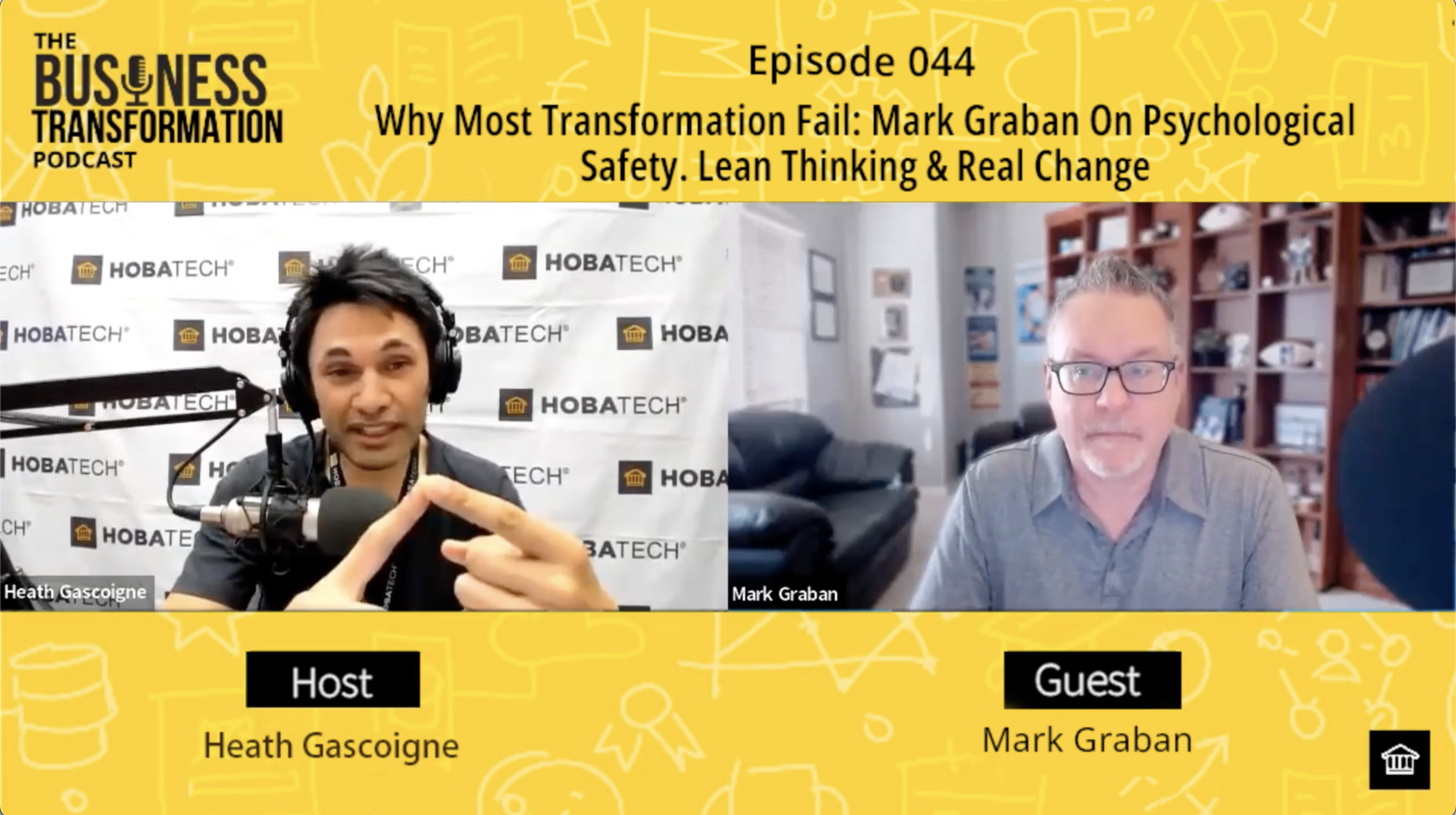
Podcast » Why Most Transformations Fail: Mark Graban on Psychological Safety, Lean Thinking & Real Change
Why Most Transformations Fail: Mark Graban on Psychological Safety, Lean Thinking & Real Change | Business Transformation Podcast [044]
Like this Podcast Episode? Share it:
Listen to the Episode below:

💥 "Stop selling change like theatre 🎭 If you want real transformation, people need real input. Not fake buy-in." #BusinessTransformation #Leadership #ChangeManagement #PsychologicalSafety
Heath Gascoigne Tweet
🎙️Business Transformation Podcast – Episode #44
🎧 Episode 044 – Why Most Transformations Fail: Mark Graban on Psychological Safety, Lean Thinking & Real Change
Why do so many business transformations fail to deliver on expectations — even with solid strategy and new tech? In this eye-opening episode, Heath sits down with Mark Graban, Lean expert and Shingo Award-winning author, to break down what organizations are still getting wrong about change.
From psychological safety to structured problem solving and the illusion of “transformation” that’s really just system replacement, Mark shares war stories, lessons learned, and powerful frameworks that shift the focus from ‘doing’ to ‘facilitating’.
If you’ve ever felt like your transformation was stuck in politics, performance theatre, or just felt “off,” this one’s for you.
💡 What you’ll learn in this episode:
- Why “psychological safety” is the secret sauce for lasting transformation
- How to create real buy-in (and avoid “change theater”)
- Why swapping out tech isn’t enough (and what truly drives change)
- The difference between doing and facilitating real improvement
- Mark’s 2 biggest lessons from 20+ years in transformation
- How to spot—and stop—fake engagement
- Must-read: The Four Stages of Psychological Safety by Timothy R. Clark
Whether you’re a consultant, executive, or just transformation-curious, get your pen and paper, you are getting a master class in how to actually do business-led digital transformation.
🗣️ “Structured problem solving is not just a methodology — it’s a mindset shift from ‘doing’ to ‘facilitating.”
– Mark Graban
🗣️ “Software alone never drives transformation. Culture, leadership, and psychological safety do.”
– Mark Graban
🗣️ “People don’t feel safe to speak up — and that’s the real reason most transformations fail.”
– Mark Graban
🗣️ “Silo transformation isn’t business transformation.”
– Mark Graban
🗣️ “Go slow to go fast. A problem well-defined is half-solved.”
– Mark Graban
🗣️ “You shouldn’t just make people feel like they had input. They should actually have input.”
– Mark Graban
🧑💼 About Mark Graban
Mark Graban is an internationally recognized author, speaker, and consultant in Lean management, continuous improvement, and healthcare transformation. He’s the author of multiple books, including Lean Hospitals, Healthcare Kaizen, and The Mistakes That Make Us. A three-time Shingo Award winner, Mark is also the host of Lean Blog Interviews and My Favorite Mistake podcasts. He helps organizations embed lasting change by making people feel safe to speak up and lead improvement from within.
🎧 Listen to the full episode here
👨💼 About the Host:
Heath Gascoigne is a global transformation advisor, author of the international best-seller The Business Transformation Playbook, and founder of HOBA TECH. With more than 20 years of experience working across the UK government, FTSE 100 firms, and disruptive startups, Heath created the HOBA® (House of Business Architecture) framework to fix the 70%+ failure rate of business transformations.
As the host of the Business Transformation Podcast, Heath is on a mission to change the way businesses change—by making transformation practical, people-focused, and actually deliverable.
🎙️ About the Podcast:
The Business Transformation Podcast features real stories and practical insights from global transformation leaders. If you’re involved in strategy execution, enterprise change, or technology-enabled business redesign, this is your behind-the-scenes pass into how high-impact transformations actually succeed (or fail).
👍 Subscribe to us on Spotify
Explore More:
🧠 "The best way to fail? Start at step 5 with no vision, no context, and no buy-in. 🚨" #TransformationTuesday #EnterpriseChange #DigitalTransformation #Consulting 💼
Heath Gascoigne Tweet
Join The Business Transformation
Download the Business Transformation Toolkit and learn the 25 essential skills you need to successfully transform your business! Learn more
Transcript
Heath Gascoigne 00:06
Hello. My name is Heath Gascoigne, and I’m the host of the business transformation podcast. And this, in this show, we talk to business transmitters, who are part business strategists, part business designers and part collaborators, collaborators and part negotiators. Business transformations have moved past just business design and includes oversight of implementation of those business designs and business transformations. And includes stakeholder management, coordination and negotiation. If you work in strategy, development and implementation and work to ensure that the strategy is aligned to the business design and technology, then you’re probably a business transformation. This is the show where we speak to industry experts and professionals to share their stories, strategies and insights to help you start turn around and grow your business transformation. Welcome to the business transformation podcast, and in this episode, we are talking to one of those industry experts we are speaking to today. Today’s guest is Mark grabin, an international recognized author, speaker and consultant in the world of Lean continuous improvement and health care transformation. He is the author of several influential books, including lean hospitals and the mistakes that make us and over two decades of experience working with leaders across industries from startups to healthcare systems, Mark brings a unique blend of operational excellence and people centric leadership. He is also the host of the popular podcast, lean blog interviews and my favorite mistake. Welcome to the show. Mark Heath, thanks for having me here. Thanks. Yeah, I’ll go. I think I was being doing you some injustice there, because you actually are the author of at least five books.
Heath Gascoigne 01:53
Is it? Is it not? And then three, you’ve won three awards for them, the shin go awards. Yeah, it should be easier to count the number of books. I mean, I’ve written three solo books,
Mark Graban 02:08
one with a co author, one that was sort of a variation. We call it the executive guide version of that book. And then there was a book practicing lean that I was the editor of. But yeah, you’re right, three of those lean hospitals, the mistakes that make us. And then healthcare Kaizen, that was co authored with Joe Schwartz, all those three were recipients of the Shingo publication award.
Heath Gascoigne 02:37
Great job. Great job. Congratulations. Well done. Thank you. Thank you and the mistakes that make us. That was very recently this year. Shingo recipient, Wow, congratulations, yeah, well, I know this that they to put out a book as was no small feat to put out too like, Wow, amazing. Congratulations. Okay, so you got a grass you gotta to the audience here to give context. Mark is in Cincinnati, in the US, which I’ve just learned is the Midwest that call it in London, UK. So the things we’ll talk about here
Heath Gascoigne 03:16
is not, let’s say, biased of one country or the other. It’s probably symptomatic of the industry itself. So as we do, as you do, for the for the audience and the topic, so we can follow along, we will cover the three points, the first one being from Mark your perspective in Lean hospitals, health care, continuous improvement, leadership, what is the industry got right? What are they doing wrong? Or they’re some continued mistakes, like this business transformation. They talk about the 7% failure rate, and no one’s learning, no one’s getting better. So for your perspective, what you seeing after all this, as a five time international published, winning author and consultant your own practice for many years, what’s industry got right and wrong. And the second point is, is there a particular approach that you follow when you go into a client or as on your consulting engagements or helping others with their transformations? What is that process? Could you step us through it? And number three is, for all this experience, if you could do it all again, what would you do differently? Usually, that’s the aha moment you go, ah, definitely wouldn’t waste my time on this one. I would just go straight to the jugular and hit this one straight away. 8020 year rule would have got all the benefits. Would do that first, right? How’s that sound? The
Mark Graban 04:36
that’s a lot to cover. And, yeah, sorry, I think that’s going to tee up that’s teeing up, really, that’ll be a good conversation.
Heath Gascoigne 04:43
Good, fantastic. Okay, so from your perspective with the industry, continuous improvement, health care, digital in there. What’s industry got right? What’s got wrong? When you come in to help a client and you go, Okay, this is why they called me in six. Same old thing, usual.
Mark Graban 05:02
Yeah. So I think one, one thing I think a lot of people get wrong, is this 70% failure rate number, yeah, you know, my understanding is that there was, there was research that that that points to, you know, business transformation, large scale change initiatives, what do we mean by failure, right? So I dig back and we look at that 70% failure rate. I think failure was was defined as the initiatives did not live up to the expectations. They did not deliver the expected benefit. So I don’t think that means 70% of the time that there was no benefit. You know, you might say complete failure. Yep, it could be that the expected benefits were unrealistic. You know, people thought, you know, transformation might be easy, or that transformation might be complete, and, and I think people have, have often sort of twisted that, that 70% failure rate number, or that, that failure rate number I’ve seen there’s, there’s some inflation like that, that number grows. And sometimes people state, you know, 90% or you know. And I think sometimes it’s stated in a self serving way where, you know, I think consultants are suggesting everybody else has a failure rate, but if you work with me, you won’t fail. Yeah. So I think we need to take that 70% failure number, you know, into perspective. And, you know, think about the lessons around well, why might business transformation efforts fail? You know, I mean, I think that that’s a healthy I think that’s a healthy discussion to have. And, you know, I think one of the reasons for failure is, I mean, I think for the talk of transfer transformation, you know, I think of like, you know, like the thing about, like, renovating a kitchen, like a kitchen, I’ve never done this, but I watch TV shows a kitchen transformation might involve, you know, just completely tearing everything out and starting starting anew. But, you know, installing, and there’s going to be British isms versus English isms. But, you know, installing a new refrigerator, I think I’ll use, I think there’s universal language there. Installing a new refrigerator is not a transformation. And I think a lot of organizations that talk about transformation are just sort of, you know, if you will, nibbling around the edges, and they’re not really transforming anything. So you know, you might say, Well, if we were a commercial kitchen in a restaurant and our business was failing because the food didn’t taste good, yeah, or the prices were too high, installing a new refrigerator wouldn’t really transform that restaurant, even though we might say, oh, that’s that’s the latest and greatest technology, and that’s the same kitchen. That’s the same restaurant, the same refrigerator. Boy, my coffee is not kicking in yet. Let me try that again. We’re going to buy the technology. Here’s here’s the refrigerator, or here’s the point of sale computer system that successful restaurants use. Buying that same technology doesn’t mean we’ve transformed our business, or that we’re going to be as successful as another business. So I think that’s, that’s one of the failure modes
Heath Gascoigne 09:00
of the elements? Yeah, I think what you’re saying there is, if technology got involved, and when I say technology, I mean technology stakeholders, that they would say, we’ve got the new shiny object, and we want to replace this system for another system. And then go to your point, is that really a transformation, or is it just a system replacement? You went from the old version to the new version, and then you’ve called the whole thing a transformation. And so the business point to the other point. You’re talking about expectation. The business heard this word transformation and going, we’re going to get a transformation. And really, the technology guys just replaced the system, old technology of the new version. And the business is going, well, didn’t really solve my problem.
Mark Graban 09:42
Yeah, and I’m not anti technology, but, you know, I mean, I work with a technology company, kinexus, that has, it’s a SaaS business enterprise platform for organizations to track their continuous improvement and operational excellence activities and. Then when we have lost a customer over the last 14 years, it’s not because our technology didn’t work, but it’s that the organization aspired to a transformation. I said, we’re going to have a culture of continuous improvement, yep. And then and they said, well, then we, if we’re going to do a lot of continuous improvement, we need a software platform to help manage and track that. But then, sadly, the organizations maybe don’t do the things from a leadership perspective or a culture perspective that help people feel safe in participating in improvement, and then they’re not doing a lot of improvement, and that cultural transformation isn’t happening. And then they question, like, Well, okay, we don’t need that software anymore. And you know, I give, I give the team at kinexus a lot of credit. They, they’ve never promised that software alone was going to create that transformation. But software can, technology can support a transformation.
Heath Gascoigne 11:01
Yep. Okay, I like what you’re saying there. I feel the same about technology. I’m not anti tech and anti AI or new systems. But the, I think what you touched on three key points there culture, leadership and safe. And then safe, as in, security wise. And I think that’s that’s an overlooked factor, that it’s one of those things, it’s not considered until on reflection, and even then, at the end of a project, and go, Why was it so hard? Why did it take so long? What did it we not get the benefits? And go, well, because you basically look, I get told when someone will find out Heath you wrote a book. And I said, Yeah, actually, my my my plan is, get here. I see, my plan is to come in here and beat you over the heat of it until you blew in the face. And they go, they go, are you serious? And I was going, of course not. I said, If anyone tells you to do that, you know you gotta run for the hills, because they’re not going to listen to you. I’m going to try and follow things by the by the word. I’ve actually had people message me. So Heath bought your book. We’re trying to follow it by the letter. I was going look, thank you. I’m honored. But there’s a word at the front that says framework, which means you need to think and apply it appropriately and proportionately for the context, right? So that’s really part of the people part, which you just basically all those three things you just said, is all about the people, culture, leadership and being safe. And, yeah, so, so are you finding that is a common thing that’s missing in the industry right now
Mark Graban 12:28
around safety and what people would call psychologically psychological safety? I would I would say, yes, that is missing far too often. I would assume, until proven otherwise, in a typical workplace, that people don’t feel safe enough to speak up, they get punished for speaking up. And psychological safety, a phrase like Lean management that sometimes gets misunderstood, psychological safety, quite simply, is a factor of how safe do you feel speaking up in the workplace, and that could include pointing out a problem, sharing an idea, disagreeing with somebody, especially disagreeing with your manager. Are you getting rewarded for speaking up, or are you being punished for speaking up. And so a lot of organizations have, you know, well intended Lean transformation initiatives, and they invest a lot of money into training people about the concepts that might be sort of, if you will, the technology, the methodologies of lean, the tools, the tactics, they may do some projects, but then it doesn’t really take off, and it certainly doesn’t scale. If you know again, like if you train people to do problem solving, and they get punished for pointing out problems, how many pro how much problem solving can we actually do? Probably very
Heath Gascoigne 14:02
little. See her,
Mark Graban 14:04
some some people, some people will speak up anyway. But you know, again, like that, that doesn’t scale to the whole organization. So I think instead of saying, Well, you all need to be brave, you need to be courageous, I think leaders need to, you you know, reduce or eliminate the level of fear.
Heath Gascoigne 14:24
Oh, okay, I like that. Yes, you’re right. So I think that’s a I’m taking notes here because you’re dropping some gold there. Mark, okay, the how safe I think, if you haven’t asked if anyone was to ask that question leadership in the boardroom, how safe do you feel about speaking up probably get crickets.
Mark Graban 14:43
Sometimes people don’t feel safe to speak up about not feeling safe. Yeah,
Heath Gascoigne 14:49
yeah. I’m helping a client right now, and there are some things that we’re told that we can say and can’t say, in particular board meetings and because. It may upset some people and send some fires off racing. It’s like, Well, did you want to did you want to change? Or did you not want to change? Because I can, you know, give you lip service and put lipstick on the pig, and it makes it look pretty, but they’re not the execution of, I think, what you were talking about before going to training, and you’ve got the methods and frameworks, but the actual implementation that they then they talk about business architecture being the gap between the design and implementations like this. Now the bridge so say, is I? Well, yes, now we’re an implementation. It seems to be, you’ve done a great job on the design, selling the story, but when the reality of the rubber hits the road, the wheels fall off the wagon,
Mark Graban 15:45
right? Yeah, and you know, if a business and organization really wants to transform, whether they frame that as a digital transformation, as has been popular, cultural transformation, business transformation, that that involves challenging the status quo and at the highest levels of psychological safety. And I often point to a framework from the book written by Timothy R Clark, a book called the four stages of psychological safety. In the fourth stage, kind of the pinnacle that we’re aiming for. He calls this challenger safety. Do you feel safe? Challenging the status quo, and without being able to do that, I think at any small level, challenging, the way we’ve always done things. If you don’t feel safe to do that, what? What transformation he really, can really happen if, in a small way, you know, people, people get punished for, you know, challenging, something they’re generally going to learn to keep quiet. Or if they get punished for for trying to be innovative, if people get punished for an attempted improvement that fails or underperforms, and instead of encouraging people to iterate through that, if they if they get if they get punished, people are only going to try things that are guaranteed to work, yes, and that’s not innovation or transformation, yeah, if people are being very, very cautious,
Heath Gascoigne 17:29
yeah, no. Innovation will happen in a few If you punish them, yeah. And all the other happens is you get this silos created where a great piece of work is done in isolation, and they’ve created a little. We call it a pod, or a little in their team or Department of unit has done really well, and others see the good example, and they go, Well, this team go, No, we’re going to incubate ourselves now, because we did such a good job. And if we share this widely, others will kill it. So let’s not and then, and then the silos get created, and then there’s no cross functional collaboration, and you’ve got parts organization are doing really well, and other parts of No, no,
Mark Graban 18:10
yeah. And silo transformation is not as powerful as business transformation, business unit or corporation or, you know, even in the context of, you know, the lean methodology in healthcare, I did have opportunity to spend some time in England, in Northampton, oh, well, working with NHS hospital there, that was, that was over 15 years ago. And obviously the British system at a very high level, the NHS is very different than the American system, and it’s also different than the Canadian system, and it’s different than the Dutch system. But when I’m coming in and looking at opportunities for transformation that’s really more on the execution of, you know, the care delivery within the context of the system. So when I work in Canada, or when I work in the when I’ve been in the UK, I have to be very sensitive to the perception of coming in as an American, where sometimes people say, Oh, no, you’re trying to privatize things. I’m like, No, not at all, not at all. We want. You know, when I was in there working with that NHS hospital, we weren’t trying to change what it was. We were trying to help it transform the way it delivered care projects that I was leading in the pathology department, was really looking at what we would call a value stream. So we were looking at not just the sub departments within the pathology department, but we were really looking at transforming what you might call the end to end flow. Yep, of a patient’s specimen. So a GP clinic drawing a tube of blood from your arm, how long does that tube of blood sit and wait before it’s delivered to the hospital? How long does it sit and wait before the blood is actually processed and tested? And how long does it wait before that test result becomes information that the doctor can use. So it’s like, it’s a very interesting flow from, you know, needle in arm, and then at some point, the product becomes information that’s used to make clinical decisions, you know, kind of helping those different silos, or breaking down. The silos breaking down, yes, is, you know. So it’s really a, you know, that was a pretty successful broad transformation. It’s not about any one person working harder or performing better, or any sub team or silo performing better, like the transformation opportunity was really, you know, being able to look more broadly, looking at how I do my work, how this part, how this little geographic space and part of the hospital basement does its job, you know, we, we aimed broader now, was that, was that a hospital transformation? No, but, you know, I think sometimes you have to start somewhere and demonstrate that, you know, Value Stream transformation is possible.
Heath Gascoigne 21:29
Yeah, okay, so the first part there I’ll play back to the audience is you. I think your awareness as a independent or consultant coming in is first you understood the cultural difference that maybe not there the UK has a, maybe a perception of the US and their culture, and so that you were, you have to probably say yourself, look, no, this is what. Because I get that myself when I go into the clients and I say, with the book or your you have a certain background, so you can apply that. So No, no, no, no, it’s understanding what you’re doing, what’s missing, and fill in the gaps. And we got a method, or, yeah, yeah, yeah, okay, so first off is
Mark Graban 22:09
on the same page, but yeah. I mean, back to your other question, of like, yeah. How do I work with organizations? I don’t come in with this magical 47 step process that’s guaranteed to work if you just follow my 47 steps, I could tell you don’t operate that way either. So I think what’s really effective, if we’re coming in trying to improve or transform something like, you know, a lot of Lean management, going back to Toyota, is really built upon a structured problem solving methodology. And so I try to use that structured problem solving methodology as the way of framing and defining the engagement, so that we’re not coming in and jumping to solutions that’s poor problem solving. So I try to teach the methodology by using the methodology of defining our problem statement, defining our goals, defining the measurable gap that we need to close, understanding the current system, understanding the causes of the performance gap. Then Then think about, well, what are we going to improve or transform or reinvent? And then work on that, and think of it as, you know, iterative improvement cycles, instead of thinking of it as a linear start to finish project. And I think that sets people up to not just run the project, but then to continuously improve. After that project phase is done, and after I’ve left, I want to set them up to not just sustain what we’ve done together, but to keep improving.
Heath Gascoigne 23:55
I like what you’re saying there, but after lift that is, I think that’s that the missing I’ll say the missing link. But for those that want to leave or embed the change to live longer than the consultants were, there is to one you’re going to lift and business architecture, they might call it competency, or capability, that you’re going to embed that so that they can change. But it’s want to go back a step where you said about the really approach that from a problem solving perspective, and that you’re doing it in a structured way, is which I find, and we good to get your thoughts on. This is that when you’re going to solve a problem for a particular for a client, is that this whole problem solving, solution development is that part of a process, and that what I think those that haven’t been experienced to successful projects is they think it’s almost an event that a problem is made aware or some loosely defined and we want to get a solution as quick as we can. And. Yeah, and then they’ll go strump. And this is the point I want to get, is that you said you don’t want to jump into solution mode straight away. So just for the audience perspective, we’ve got a absolute senior professional here, many multiple all the process, award winning author, plus, I don’t know how many, how many connections you got on LinkedIn mark? You got, what, half a million. So we got we got the we got the boss here who’s just said, so this is not UK or USA, and I’m maybe speaking more to our technology colleagues. We know we’re in this boat together, you know, the business side and the technology side. But what we’ve got to stop doing, I think it’s just jumping into solution mode straight away and coming up our new shiny objects. And AI is now the new kid on the block, and everyone’s banging around about that. And so, well, yeah, that’s a solution, potential solution, of the solution options, but we don’t want to go there first. And so you just step Yeah. So what are your thoughts on that mark
Mark Graban 26:03
around AI in particular? More about that jumping to solution mode.
Heath Gascoigne 26:07
Yeah, how can we give, I don’t know this, the to the stakeholders or the if it’s the leadership or the exec board or sponsor, look, there is a process. And if you, I know you’re in hurry and you want to get this problem solved, but if you
Mark Graban 26:24
Yeah, well, so I think the argument for slowing down a little bit is that we will then be able to go faster and be more effective. So I mean, there’s, there’s different kind of expressions that come to mind. One, one is a, very much a Toyota ism of go slow, to go fast, yes. So that both parts of that are important, right? So going slow doesn’t sound good. There’s, oh, we don’t have time for that. Like, well, the we think of related expressions, you know, it’s attributed to different historical figures. You might say, if you gave me an hour to cut down a tree, I would, I would spend 50 minutes sharpening my ax, and then I would cut down the tree. Or, I think it’s attributed to a famous General Motors engineer 100 years ago, Charles Kettering, a problem well defined is half solved. So going slow for a period allows us to then move much more quickly and better defining the problem, having a structured problem solving approach is going to increase our success rate. So do you want to rush through change, struggle and fail more quickly, or do you want to take the appropriate amount of time to be more successful? And you know, thinking back to one of your earlier questions, Heath, of you know, around problems, mistakes organizations make. I think one of those mistakes is either, if they haven’t predetermined the solution, they may have a very small team go through some problem solving, and it might be good problem solving, and they may have a reasonably good solution, but then they implement the solution, and they start selling that solution as it’s being implemented. They’re trying to, you know, we hear these phrases, you know, we’re trying to gain buy in. Yes, I’m like, Well, you really should be doing that from the beginning, yeah, like trying to gain buy in after you’ve rolled out a technology solution that’s too late? Yeah, I think the best way to gain buy in is to bring people along through the entire process. So you’re not going to have everybody literally participating in the problem solving process. But I think first you can gain buy in around the problem definition, like, if people don’t agree that a problem exists, why would they be interested in a solution? If they think the status quo is fine, or if the status quo is fine for them, they say, Well, I like the way the old software works. Well, okay, but it doesn’t meet business needs, and it’s not a modern platform, and it’s costing us way too much. And, you know, helping people understand the problem and then helping them and understand the solution and how it fits into their work before it’s being implemented. You know, that’s going to increase your success rate, but a lot of organizations would say we don’t have time for that. We don’t, you know, those people don’t deserve to have input. They need to just do what we tell them to do. It’s like, you know your analogy, if they’re being hit over the head with a book?
Heath Gascoigne 29:52
Yeah, I’ve seen that. I’ve seen it, and it doesn’t mean well for anyone. I like what you’re saying about the the. I want to talk to that part about the defining the problem. Now I’ve some places, depending if they’ve been through this, these transformations before, and particularly large ones. And if they haven’t gone successful, I think they’ve got a natural other words, the reserved, or has a reservation about doing it a certain way. I helped give an example. I helped the Ministry of Justice on a big transformation. And has said 53 sites around the country, and I put the proposal together, and the for the program director, the program manager, project manager, and then the core team, and they said, Heath, that’s great. Yeah, we now you gotta take it to the board. The sponsored sign it off. So I go to the sponsor, go to the board and present it. And it’s Heath, like, like, the approach, these six steps make sense. We different. Got to do it, but I want you to start at number five. Step number five. And I said, Oh, do you want me to start at number five? Like, in that in design, step five. Design says, Yes, look, that means, and I’ve been here for a couple of weeks, and I’ve meet the staff, and I’ve sat in your workshops, and I’m trying to understand the scope, and I think I understand it, but the first step is about the vision and the focus, and I’ve not seen that anywhere, and so we’re missing that. So you want me to start at five without a vision? Okay? Step two is about control, and then about governance, and who’s involved? I said I’ve not seen any that, especially about design principles. I don’t even know what your what your the scope is. It’s so broad right now, you’re trying to solve the problem for everyone. And then we gotta step number three is about analysis of the current state. And he goes, Heath. Heath, there’s 53 sites around the country. Look they do the whole process, 53 different ways. If you want to understand the current place, the current state, that’s 53 different locations. Heath, I said, I said, Yeah, great. Just give me one, yeah. And it’s going to be the best Bau best practice. And for some it’s going to be aspirational. For a lot of people, it’s going to be ways working it is today. And he’s going, Oh, this could make a bit of sense, but I want you to do to start at number five. And so he goes, Oh, no, Heath, I just wanted to start number five. I said, Okay, if you give me 20 minutes, I’m going to come back with that plan that you spent two years. If there’s other two crowds to and they got absolutely nowhere, I’m going to pull it out, because that’s exactly what they did, and they’re going to bring it back to you. Give me 20 minutes. He goes, No, no, no, no, no, don’t want that. I said, Well, that’s the same approach you want. You want me to disregard the problems today. So how do you, how do you overcome that?
Mark Graban 32:25
Yeah, I mean, that’s, I think it’s a common challenge, or it can be a frustration in consulting where you know somebody, an organization, says, Okay, well, you’re you’re knowledgeable. They may even use the word expert, you’re an expert. We want your, you know, approach, but then they don’t really want the approach. Sometimes they want someone just to validate what they’ve already decided yes. So it’s back to this question of like, you say you want to transform. Are you really wanting to transform? You say you want to, you know, follow a consultant’s process. But do you really want to? I mean, I try to be really careful as a consultant. I think kinexus is a software company is careful this way of finding clients or customers who are a good fit, yes, and sort of, you know, test a little bit of this is, you know, if, if we reach an agreement to work together, this is the methodology we’re going to follow, and be willing to walk away if they say no, even if they start saying no after the contract has been signed. I mean, because, I mean, I think, as a consultant, a lot of us, we succeed over time, when we have successful projects and when clients love what you’ve done and how you’ve worked with them, and they’re willing to tell other people that’s the best form of marketing. And if you feel pressured to take a job just because of the money, and it’s going to be frustrating and not go well, that’s only maybe some you know, that’s short term income. It’s long term. Maybe harm, calm, use to your business, detrimental. You know, kinexus tries to you know when you know when you know, when you’re an early startup, you know you you want everyone to be a customer, and anyone who’s willing to write a check is exciting, and it’s a big moment, and it’s a lot of trust being placed in you. But then you learn sometimes, like, well, those those customers don’t work out. They don’t stay around long enough to where it’s even worth the effort, yeah. So then, as you mature as a business, you start, I think defining a better profile of you know, who do you best work with, and who’s most likely to be successful, and maybe even say no to some of the ICP, you want to do it your way? Do it your way.
Heath Gascoigne 34:55
Yeah, I like what you’re saying. So this little tip, ladies and gentlemen, form more of a. Um, a consultancy perspective about I think the great tip there is that when you’re choosing your clients, is that looking for that fit, and I like how you said, then I think a lot of consultants might fall into this trap. I know when I started off, I did too, is that you have your approach, and then you you sell it, you pitch it the or the client found out about it. They like it, but when you start, they said, well, we want you to do it this way. And say, Well, I can tell you how that’s going to go already, and it’s the same place like I’m right now. I’m helping a client who have now got me on three projects, and one of them is actually the business plan an investment case got signed off in 2022 like, three years ago. And so I, I said, Okay, this is a dead horse. Let’s see. From beginning, this is you’ve tried to sling this thing around, and it’s got no legs. And why now? Yeah, what makes you think you’re going to do it? You know, this is going to be successful. Get some legs and do something. And I said, Look the guy reporting directly to he said, So what’s your thoughts Heath? I said, it’s either going to be the whole organization or nothing. Sure. Is it going to go nowhere? Because you’ve tried it before, and I think you did it on a piecemeal back of a fag packet. And now you want to invest in it, but you’ve got to be willing to change and follow the approach. And so I, I’ve come in now, and I’ve, we’ve now been three months into it, and I put the plan together and approach, and now we’re saying, the sponsors saying, we seem to be going nowhere. So wait a minute, because you’ve already changed the approach three times, right, right? Like this is why your projects aren’t success. So I like what you said there. So ladies and
Mark Graban 36:39
gentlemen, is step step back and ask, well, you know, the problem from 2022 does that problem still exist? And if it was really that big of a problem and that big of a pain point, why did this work not move forward? You know? I mean, there’s a lot of valid questions to ask there, but, you know, I think one, one thing I’m kind of thinking back earlier I was, you know, dismissing the idea of, you know, hire me and implement my 40 my magical 47 step approach. A lot of that is, you know, of those 47 steps, 43 of them might be implementing my typical solution, yeah, where I think, you know, structured problem solving, you know, you can describe that as an eight step process, but I think there’s, there’s, I think it’s different to say we have a process and a framework for figuring this out together and figuring it out well, as opposed to buying A solution that I always implement the same way everywhere I go. I think, I think differences there.
Heath Gascoigne 37:46
I like that. The I think that it’s, it’s the finessing of those words and also the execution of those words that you said, the it’s, if I can paraphrase the process and framework, that we can work out the problem and the answer together, I think that is golden. I’m going to quote you on that one there. That is, and I think from the and going back to, if it’s the culture, security and leadership, points that you raised earlier is that you’re showing them that you this is not a we’re pulling out of the shelf and banging over the head. It’s not a canned approach that we try this and works every single time. Our 47 steps, we’re giving you the magic 45 it’s like, well, through this collaborative approach, we will work out the answer together. I couldn’t tell you now, if you want me, I can give you like the Ministry of Justice and say, give me the number step, number five answer now Heath, without understanding anything so well, do your approach, process and framework that we can work out that problem and answer together. I like it. I love it. It’s great. Okay, so now, so the industry itself has got a few issues. We’ve got a few books there. The market lean them recommend for them to to address those, but you’re so, so the the your Didn’t your approach. We started to get into it. No, sorry, I cut you off there. We started back on the, on the the problem solving approach. So you are, you approach that you you do when you go in to a client. What is that? Could you step us through it?
Mark Graban 39:22
Yeah, I mean, at a high level, you know, that process starts in writing the proposal and what would turn into the contract. Understand, if somebody comes to me and says, We want help implementing this solution, I’m probably not the right fit for them. They could hire somebody else who would, you know, probably, you know, the lower cost, just help them implement their solution. I think a lot of the value I bring is in that, that co creation, as you were describing it well, Heath of even in the proposal phase of doing. Doing a little bit of work together to do that problem definition, or at least a first pass at defining the problem, the gap in performance. So not just what’s the problem, but what are we trying to achieve to what business benefit, hopefully a strategic business benefit, and then what’s our methodology to go forward working with a team? You know, one thing I’ve learned is, you know, one thing, and it doesn’t work, is bringing in the consultant to do all that work themselves, yeah, engaging with a team of leaders, or even frontline staff, depending on the situation, you know, we would come into an engagement and assign contract with that problem solving process having started, but not knowing exactly what the solution is going to be, but having a timeframe and a methodology for how we’re going to go in and refine That problem statement, study the current state, understand the causes of the gap in performance. And again, figuring out, you know, what do we need to improve or transform or reinvent? And you know, how are we going to measure success? How are we going to sustain that improvement? How are we going to sustain the results? How do we set up, you know, continuous improvement? So there are sometimes, you know, remedial steps that are necessary around culture and psychological safety. You know, if the starting point, if somebody’s really trying to do something transformational, part of the going slow to go fast might be, you know, some remedial steps around trying to boost the feeling of psychological safety so that people can perform and participate effectively in in that engagement or that project. Because, again, hopefully we’re shifting the culture in a sustainable way. It’s not just about the project’s success, but about the organization’s success. So, I mean, you know, that’s, you know, that’s a high level kind of eight step problem solving process that, you know, that comes from, you know, I give credit to the Toyota people that I’ve learned this from and been mentored on, yep, that’s, that’s, I mean, that’s, that’s, that’s my attempt there, you know, kind of describing the approach. And, you know, I think back to, you know, more recent projects I’ve done with hospitals and health systems, you know, here in the US, you know, I think people appreciate being engaged in the improvement process instead of being again. I love your analogy. Instead of just being handed the book or being hit with the book. And when it when we engage that team, they are representatives of their other co workers. So it’s not, you know, the colleague hitting people with the book instead of the consultant. You know, the colleagues are there as representatives of you know, you know, when I work on a project, and you know people have been, you know, assigned temporarily to work on this project. You might select a couple of nurses, a couple of operating room techs, as we would call them in the US. You might have a surgeon participating part time, because surgeons need to work as surgeons, you know, they’re not the only ones who get input, but part of their job is going out and engaging others, you know, to get some part time champions. Yeah, yeah. They’re more the champions. They’re not the only ones. They shouldn’t be working in an improvement silo. They shouldn’t be working in secrecy to then surprise unveil a big solution at some point like you really you need to put the effort in to engage more people. And I think those are great lessons around you could call it change management. You could call it, you know, kind of just psychology and understanding people like people very naturally get defensive, risk averse, yeah, well, it’s funny. It could be risk averse change. I think just being resistant to change is a natural human reaction. If I, if I say, you know, you need to do this, people think, why? I don’t want it. Yeah, you need to do this. No, I don’t. But when you engage people in figuring out something together, like the one analogy I use is, you know, let’s say you have a group of people that meet and go to lunch once a week. We all know somebody that eats the same food for lunch every day, right? There might be somebody like that. They just like consistency. They’re not real adventurous. They like what they like, and they eat the same thing every day, and they’re happy with that. And, you know, let’s. Say, you know, you know, you have a group that’s going out, and you’ve typically gone to the same couple of restaurants where that person can always get their turkey sandwich and chips, right? Yep. And I mean that in a British way, chips,
Heath Gascoigne 45:15
these guys, every meal, is what I’m
Mark Graban 45:17
picturing, is what I’m picturing. And I could have said fish and chips, but a so then, let’s say somebody decides, on behalf of the team, we’re going to go to a new restaurant. It’s a it’s a brand new concept. It’s a fusion of, you know, Canadian and Cambodian food, yep. And nobody knows what that is. What would be a fusion of Cambodian and Canadian food. And, like, we tell everybody you’re going to this restaurant, whether you like it or not. Like, well, some people in that group might say, Oh, fun. Okay, I don’t know what that is. I’m keen to try it. There might be some people who are a little bit scared, yep, they don’t say anything because they go along. And then there might be that one person that says, No, yeah, no, I hate that idea. And, you know, and I think sometimes that resistance is, you know, just it’s, maybe it’s just part of their nature that they like doing the same thing. And that’s, that’s difficult, it’s difficult to change. Then there might be some people in the middle who are upset because they didn’t have any input. Yes, like, if you would at least let us discuss. And maybe, you know, in a workplace, you don’t always get to vote on what the business needs to do. So the analogy maybe has its limitations. But you know, I think there’s that difference between, you know, forcing change versus engaging people in the conversation, and the one expression that I think is a mistake. You know, I hear leaders say, I want people to feel like they had input.
Heath Gascoigne 46:56
Oh, but don’t give them input. Yeah,
Mark Graban 47:00
you get exactly the way you reacted, you know, exactly what I’m saying. It’s like, no, they shouldn’t feel like they have input. They should have input. Actual input. Yes, actual input. This is not about, you know, you know, change management. Theater, you know, of manipulate. It’s not about manipulating people. It’s about engaging them.
Heath Gascoigne 47:19
Yes, you said the word there theater. This is, and I think, with people, and I say, me that not silly nor stupid, is that where they can see where they’ve been sold a lie, or it is a talking fest where their voices will not be heard despite the effort. And maybe the risks, or psychological risks you talk about I mentioned is of opening their, you know, sharing their thoughts would could put them at risk, career wise, or position wise, even in the company wise, that they don’t say anything, and so they don’t and ultimately, what happens there you to the point the very beginning you said about defining the problem, I think the first place, or the best place to define a problem is where the problem is, and usually that’s in operations. And so you got to speak to the people and what the execs will say into the I think you paraphrase what you said earlier, is that you know those these guys upstairs, have got a different point of view, and they might be, they might be disconnected from reality. So they go, Well, we’re just going to make the change, and they’re going to accept it. Well,
Mark Graban 48:27
right, right? And you know, one advantage in healthcare is, let’s say you might have a chief nursing officer who is a nurse, or, I should say they used to work as a nurse, right? So it’s possible, like, healthcare sometimes moves so quickly, you know, even if they were last working daily, day to day as a nurse five or 10 years ago, you know, they they might not really understand the work anymore, and they shouldn’t assume that they do or even thinking about somebody who worked as a nurse before electronic medical records is a very different world than now when we have electronic medical records. So I think you know, leaders, we make a lot of mistakes at any level, when we make assumptions, we have to be very careful about checking assumptions. Do we know something to be true, or are we making an assumption? Yeah, yeah. Executives sometimes make assumptions. Sometimes frontline staff make assumptions. That’s, that’s human nature, but yeah, we have to be careful. And, you know, I think one other I’m going to make up a scenario, one other thing that might have been, you know, change management theater, as you mentioned, okay, Ministry of Justice 53 sites. We’re going to take the time. We’re going to go on a listening tour. Yeah, we’re going to go to all 53 sites and have a two hour session at all of those sites, and not really intend on using any of the input there and like that would be a waste of time that would be going. Slow to go slow, as opposed to going slow to go fast.
Heath Gascoigne 50:04
Yeah. So the intention needs to be there, otherwise the staff will pick it up. I like the great few points you said there. I like what you said about assumptions, and I think part of that is probably a industry, or maybe this space that we’re operating in, transformation is a continuing as well as continuing issue that the leaders will make an assumptions like this project that they want my help on. Of the three years it’s been running for the sponsor is saying, Well, everyone knows that. It’s like, everyone knows that’s the vision. But no, no, we’ve got a vision, but that’s the organization vision. You’ve come up with the vision for this program, which is actually the vision. And so the assumption is, everyone knows
Mark Graban 50:49
that can be a bad assumption, or,
Heath Gascoigne 50:52
yeah, that’s yeah.
Mark Graban 50:54
Or it could be like, well, we’ve printed out the vision and it’s on a card that hangs on everybody’s badge, therefore, well, you might be assuming that they’ve even read it, you know. I mean, what’s the vision? I don’t know it hangs around my neck, on my lanyard, behind my badge. You know? It doesn’t mean I really know it. It doesn’t mean I agree with it. It doesn’t mean I’m working toward it.
Heath Gascoigne 51:15
Yeah, these are, yeah. So, yeah, that definitely one about the vision. I like. Also, you said about the change champion with the colleagues, actually that Ministry of Justice Project. In the end, the sponsor signed off on the time that I delivered within the time frame with actually half of the time frame and the road map, and they recouped a lot of long term outstanding fines that have been written off because of the process improvements we did. And in the board meeting, he said, and we signed it off. He said, Well done, Heath. I’ll make some note here that you delivered what you asked for, and you did the impossible. You documented the undocumented business. And I said, Well, you know, I said to you, I was honest. I said, I don’t know your business. I have no idea about this, the courts, tribunal service, but I do have a process. What I need is the knowledge, and it comes from your team. And I asked you to give the team, if you could build the team. And so you seconded these guys from the business, and it was these guys who ran around the country to these 53 sites who spoke to your own team. So it was your own team talking to your own team. And that’s why it worked, because it wasn’t me, it wasn’t consultants doing the talking to them. It was their own team talking to them. Yeah, that’s how come, yeah, to your
Mark Graban 52:23
sounds like we, it sounds like we take a very similar approach. Heath, yeah. But
Heath Gascoigne 52:27
ladies and gentlemen, we are in different parts of the world here now, right? We’re in the US and the UK and going well, these are that project. There was a couple 100 million and so these projects aren’t small, and then the number of people that are impacted aren’t small either, right? And so you in the US, and I’m in the UK here, and so, well, this is common symptoms here. This is not something that happens, and only in the UK. It doesn’t happen in the US. It happens in the US happens. So what are we not doing? Then we’re always up against the same old problems. And you know, are we not learning?
Mark Graban 53:01
A lot of times, industries are not learning. I hate to say, Yeah, I mean, when I was working there in Northampton, we would say things like, you know, it’s same problems, different accent.
Heath Gascoigne 53:13
Oh, nice one,
Mark Graban 53:17
you know. I mean, I say process, and I’m exaggerating that a little bit, but, you know, in Canada and the UK, it’s process, so I try to adapt a little bit, but actually just one quick, little funny story we’re talking about in that pathology project, the drivers and the delivery routes for specimens, well, American, English, I would say route instead of root. Yeah, they would, they would make fun of me for saying route. And they would say, what you mean, the root? Yes, the root. I will try. I will try to say root. And then they would, they would exaggerate that. They would make it all in good fun. They would make fun of just out like, no, okay, root, that sounds more sophisticated to call it a root,
Heath Gascoigne 54:10
the root of the route, yes, there is tomatoes. Tomatoes. The I get that with my New Zealand. A little bit of an Australian, because I spent some time in Australia here, especially with the Spanish, you’ll say a word and another, like, it’s completely foreign to them, and you just change a little bit and go, oh man. It’s like, the similarities are so, like, it’s almost, I basically see the same thing, right? And look at, we have a blank face. It’s like, Jesus, yeah,
Mark Graban 54:38
okay, a lot of this is, it’s human nature, and it’s organizational dynamics. Now, you know, there, there are like at a high level, like, there are cultural dynamics that make things different. You know? You know how national culture might influence organizational culture, and these. Even, you know, the United States is such a big country. You know, being in New York or Iowa, like those are very different cultures. The way people talk to each other, the way people interact, you know. I mean, you know, but we can back to your question of, are we learning? Yeah, we can learn from each other, even if there’s different accents, different languages, different borders being crossed, that’s been a great opportunity in healthcare. And if I’m going to mention real quickly, in late October, I’m organizing a group of Healthcare Executives, typically, it’s from different countries to all go to Japan together, to visit organizations that are like Toyota, to visit a couple of factories, which is an great opportunity to learn about culture and improvement, and to also go visit some Japanese hospitals, with the idea of, you know, bringing, you know, some inspiration and some ideas you know back home. So I think of like previous trips, we’ve had people from, you know, across Europe, from the Middle East, from different Asian countries, from North America, all coming together and like sharing our perspectives and learning from each other. That’s that’s really powerful. So if, by chance, there’s somebody who happens to be listening, who’s a healthcare executive who’d like to do that, please reach out.
Heath Gascoigne 56:28
I will put the contact details in the insurance sorry, I should have said it from beginning up, your all your contact details, how to get hold of you, the company, even Kaizen, sounds like there’s something in terms of continuous improvement, but also how they can get a hold of you for the the trip to Japan, that’ll be amazing. Yeah, okay, so, so, yes, I agree. There the industry, there’s opportunity to learn. I think there is. And then put aside the maybe, the No, it’s the proudness, if it’s that, of different different countries, is there’s an opportunity to learn. Otherwise, we’ll do the continuous mistakes. Okay, so now the last one, the last question. Now being a, as I’ve said from the beginning, the like the we’ve got the Master of Ceremonies here, my goodness, we’re in the in the in the in the in the presence of royalty, continuously royalty here.
Mark Graban 57:22
So improvement, royalty, here for somebody in England to say that to an American, that’s hilarious, but you gotta give we don’t have, we don’t have a king. We don’t have a king anymore.
Heath Gascoigne 57:31
Yeah, we well, we have a king. But the oh, oh, honestly, Mark, this is, you know this is like, it’s UK versus, well, not versus, but the UK USA, it is. You got to give credit where credit’s due. And mate, having only published one book, I know that the time it took to do that, and you’re not only one, but five so, and a very impressive career. So now you’ve done this many, many times, many years, decades, even multiple bestseller author, award winning, as well as you know, a 20 plus veteran of consultancies, of projects of many sizes, all sizes, different industries, victors, industries and sectors, verticals. If you could do it all again, what would you do differently?
Mark Graban 58:27
That is a great question. And the one thing I think I reflected on the one book that I was the editor of, a book called practicing lean, myself and 15 other people all shared some reflections from early in our career, mistakes we made and lessons we’ve learned. And you know, one thing I wish I understood one one thing I understood maybe 10 years into my career, I wish I had really understood it better was the difference between being the one driving change and doing the problem solving versus facilitating others in doing the problem solving, making that shift led to, I think, you know, great greater success, greater fulfillment, just better results in terms of doing improvement work. The thing that I wish I had understood, the thing that I started learning about maybe 10 years ago and in the past five have really incorporated more into my work is this understanding around not just trying to engage people, but creating the conditions where they feel safe to fully engage, you know, so that that comes back to the study and the teaching and the practices around psychological safety. D and incorporating that into transformation work. And you know, you can’t just tell people that they should speak up, and you can’t tell people they should feel safe, but you can create the conditions where they feel safe to speak up, safe to participate. I think one of the greatest failure modes. Reasons for failure. Reason for that 70% under performance, or whatever that number might be, I’m really convinced that it’s the lack of psychological safety, Or said another way, people don’t feel fully safe to speak up, and that either drags our transformation efforts down, they never get off the ground or again, like people are just being hesitant and cautious, nibbling around the edges instead of really diving in to do real transformation. So those are things I wish I had understood earlier in my career. That’s where part of my passion for trying to share that, you know. So, you know, earlier you said 20 plus years, it’s, it’s now this 130 years since I graduated from college. So I’m just not going to start saying 30 years you
Heath Gascoigne 1:01:13
you got to start saying 30 years of experience. It’s still
Mark Graban 1:01:16
20 plus. That’s still technically true. Okay, um, but I think, I think those are some of the key lessons, things I wish I had learned
Heath Gascoigne 1:01:25
earlier. Okay, I’m going to play the Back to you, just quickly, there’s doing versus facilitating. So there was a switch you did, I think probably two parts. That is your mindset, but physically, how you facilitated it the was in so, so that they have resulted you in better outcomes, results, engagement, etc. So the takeaway for ladies and gentlemen, is, is getting out of the doing into more facilitating, supporting those and others. And I think the key part, really, the second part of that is that I’ll quote and put the reference to the book, if I got this right, Timothy Clark, four stages of psychological safety. Okay, so put the in the show notes there to get where they get that book. But the the part of, and I think what you’re saying here is not just saying about the psychological safety, is that actually providing that environment for the psychological safety? Yes, okay, yes.
Mark Graban 1:02:19
Because each person decides how safe they feel, and that’s based on the interactions they’ve had or are having with their leaders and with their colleagues. So I think you know to leaders, you I think one key lesson around three things you can do as a leader to help people feel more safe. One is modeling vulnerability and saying things like, I was wrong. I made a mistake. I don’t know, asking for then encouraging others to speak up, say those same things. I reward people for saying I don’t know I could be wrong. So let’s test the idea I made a mistake, there’s a problem, and then reward people, yep, when they do speak up. So it’s really three pieces, modeling the behavior you want to see, encouraging it from others, and then rewarding it when it happens.
Heath Gascoigne 1:03:22
Okay? So I played it back, so I got it so I remember, because I’m learning here too. So this is so the the modeling, encouraging and rewarding, so that behavior. And I think I’ve started to see that a little bit where leaders actually will say, look, then those terms, those words, is, I don’t know. We don’t know. And we’ll find out if we’re going through this process. And so that’s a missing and some some leaders will see that it’s a weakness. So well, no, it’s actually, I think it’s more of a strength that you’re saying that if you think you’re perfect, then we’ve got the answers already. And then it comes back to the well, we’ve got the answers you’re going to give I’m going to give you the answers. So here’s the answers without even consulting you. And so we get, we’re back to square one again. So no, I really liked it. So when? So with that from so the show notes there. Wrap it up there. So thank you very much. Mark for your for your time and energy and your insights. Just to recap, that was the four stages of psychological safety from Timothy R Clark, I’ll put this. This will come up on we were going to put it YouTube in a week or two, hopefully not that long. I’ll tag you on on put it on LinkedIn, and tagging and shit away. But thank you very much for your time. I know it’s now still early morning in the states where you are, so my mom also lunchtime,
Mark Graban 1:04:36
yeah. So thank you my cup of coffee, I think you know was kicking in during the conversation. And thank you for I mean, your your energy is helping me fully wake up. I mean, I was awake when we started, but now you know, between your energy and the caffeine energy, I feel even better. So thank you for that my
Heath Gascoigne 1:04:55
plate. Mark, honestly, thank you. Thank you for your time. You know we’ve. Stay in touch, and hopefully I’ll get over to the states later this year, to wherever you end up being, if it’s not Texas and Cincinnati, I will look you up. Okay, been a pleasure. Thank you very much. Enjoy your issue afternoon now. Okay, thank you. Thanks so much. Heath. Thanks buddy. Okay, see you. Bye. Bye. You.
Book Recommendation

Heath Gascoigne
Hi, I’m Heath, the founder of HOBA TECH and host of The Business Transformation Podcast. I help Business Transformation Consultants, Business Designers and Business Architects transform their and their clients’ business and join the 30% club that succeed. Join me on this journey.