Why Your AI Strategy Is Backwards (And the Business-First Process That Fixes It)
📷Click on any image to enlarge.
AI has a sequencing problem.
Walk into most boardrooms today and the conversation follows the same pattern. Someone mentions AI. Someone else mentions a competitor using AI. A vendor slides in with a pilot proposal. Six months later, the organisation has an AI strategy, a selection of tools, and a growing sense that something is not quite working.
The technology is visible. The results are not.
At HOBA Tech, we see this pattern repeatedly. The issue is not the AI. The issue is the order of operations. Organisations are starting with technology and working backwards toward business value. That is backwards. And it is why so many AI initiatives look mature in presentation but fragile in practice.
The businesses getting real value from AI are doing something different. They are not starting with AI at all. They are starting with the business.
 🔍 Click to enlarge
🎯 “Most AI strategies start with the technology and work backwards. That's backwards. The businesses getting real value start with the business — and often discover AI isn't even needed.” #AIGovernance #BusinessTransformation #AI #DigitalStrategy #Leadership

The diving board problem
Here is a useful way to think about it.
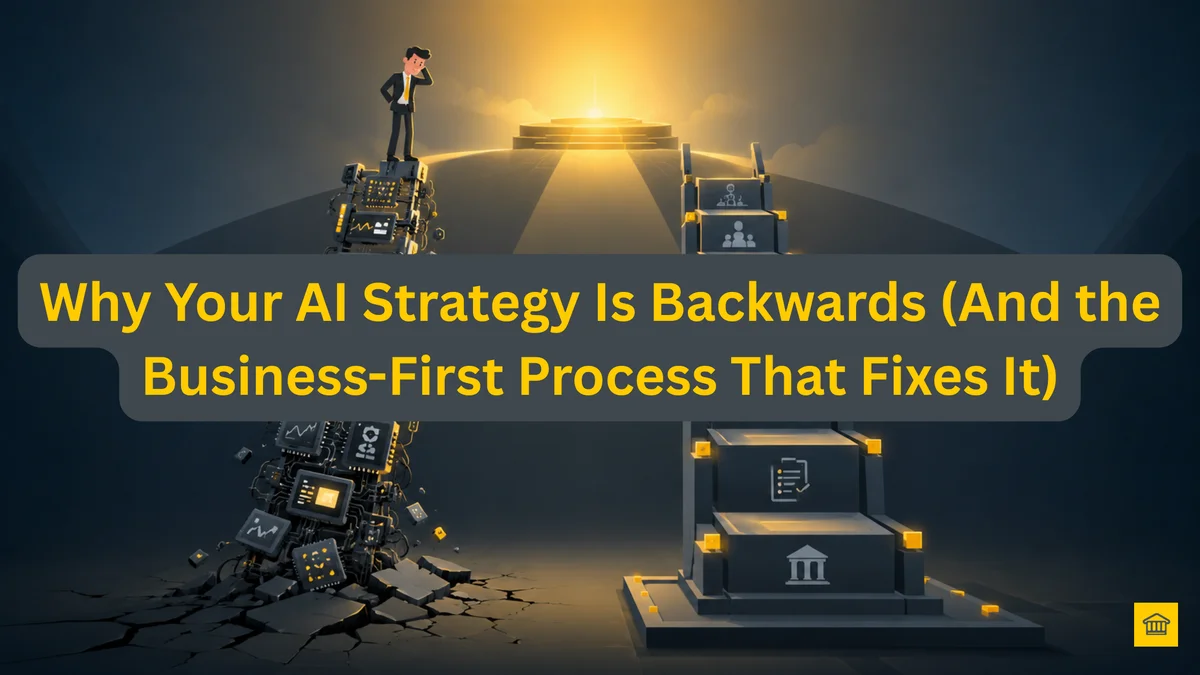
Most AI strategies treat artificial intelligence as the diving board — the thing that launches the transformation. The business climbs up, stands on the edge, and hopes the AI will propel them forward into better performance, lower cost, and competitive advantage.
The problem is that diving boards need support structures. They need foundations. They need a pool with water in it. Without those things, the board is just a plank in mid-air.
AI is not the diving board. AI is the final step — the thing you add after the structure is solid. The diving board itself is your operating model. The foundation is your process architecture. The pool is your business design. If those are missing or weak, AI does not create transformation. It creates acceleration toward a mess that already exists.
 🔍 Click to enlarge
🎯 “You think you need an AI strategy. What you actually need is a business transformation process. AI may or may not be part of it.” #BusinessTransformation #AI #Leadership
What the backwards strategy looks like
The backwards approach is easy to recognise. It usually sounds like this:
- "We need an AI strategy."
- "What AI tools should we buy?"
- "Which processes can we automate?"
- "How do we train people on the new tools?"
These are not bad questions. They are just asked in the wrong order. They assume AI is the starting point. They treat the business as a passive recipient of technology rather than the active designer of value.
The result is predictable. Tools are purchased before use cases are clear. Pilots are launched before processes are understood. Teams are trained on systems that may not survive the next quarter. And the business accumulates a portfolio of AI experiments that look impressive in slides but do not connect to measurable outcomes.
This is not transformation. This is technology adoption without transformation design.
The 4+1 ladder: a better sequence
At HOBA Tech, we use a simple framework to explain the right order. We call it the 4+1 ladder.
Step 1: Eliminate Before you improve anything, remove the mess. Duplicated processes. Redundant steps. Work that exists because of organisational confusion, not customer need. Most businesses are shocked by how much process debt they are carrying. In regulated industries, much of that debt lives in Shadow Processes that never made the official process library — we explored why in The Regulator Didn't Kill Your Transformation. Your Process Debt Did.. Elimination is the fastest form of improvement — and it costs nothing.
Step 2: Standardise Once the mess is gone, create consistency. Standard processes. Clear handoffs. Defined responsibilities. Standardisation does not mean rigidity. It means predictability. It means everyone knows what good looks like.
Step 3: Optimise Now improve quality. Better decisions. Faster cycles. Reduced error. Higher output with the same or fewer resources. Optimisation is where most transformation programmes should spend their time. It is where the bulk of value lives.
Step 4: Automate Only when processes are clean, standard, and optimised do you add automation. Automation multiplies the value of good process. It does not fix bad process. Automating a broken process just creates broken output faster.
Step 5: AI Artificial intelligence sits at the top of the ladder. It is the intelligence layer — pattern recognition, prediction, generation, decision support. But it only works when the rungs below it are solid. AI without elimination, standardisation, optimisation, and automation is like putting a racing engine in a car with no wheels.
 🔍 Click to enlarge
🚀 “Most organisations want to start at step five (AI). We help them discover that steps one through four are where the real value is — and that AI might not even be necessary.” #AIGovernance #DigitalStrategy
The HR case study: zero technology, 70% result
One of the most powerful examples we use comes from a large organisation that thought it needed a technology overhaul.
Leadership believed they had 450 processes that needed fixing. Process mapping revealed 96 actual processes. Of those, only 6 needed meaningful work. The rest were either eliminated or standardised.
The result? Staff turnover dropped from 70% to 15%. Not through AI. Not through automation. Through restructuring the organisation, clarifying governance, and designing the operating model around what the business actually needed.
 🔍 Click to enlarge
🔄 “AI is not the strategy. It is an enabler of the strategy. And if you have not designed the strategy yet, AI cannot enable it.” #BusinessTransformation #AI #EnterpriseAI
This is the point. When the business design is right, technology becomes obvious. When the business design is wrong, technology becomes a distraction.
Why this matters for 2026
The market has shifted. 2026 is being called the "year of truth for AI" — the moment when organisations move from experimentation to execution. That shift exposes a gap. The pilots were easy. The production is hard. The loudest category right now is agentic AI, but autonomy without architecture only scales risk.
Why? Because production requires the operating infrastructure that pilots do not need. Governance. Ownership. Data discipline. Process clarity. Accountability. The things that make AI scalable are the same things that make any business transformation scalable.
The organisations that will succeed are not the ones with the most AI tools. They are the ones with enough business design maturity to know where AI belongs, where it does not, and what needs to happen first.
The HOBA view
We do not sell AI. We sell transformation.
Our methodology — the HOBA 6-step process — is designed to build the diving board before anyone jumps. Focus. Control. Analyze. Evaluate. Design. Implement. Each step creates the structure that makes the next step possible.
AI may appear in the Design step. It may not. That is a business decision, not a technology default. The question is never "how do we use AI?" The question is "what does the business need to perform better?" And sometimes — often — the answer does not require artificial intelligence at all.
What to do next
If your organisation is currently building or reviewing an AI strategy, pause. Ask these five questions before spending another dollar on technology. (For the ROI side of the same problem, see The AI ROI Enigma.)
- What business outcome are we trying to improve?
- Have we mapped the processes that deliver that outcome?
- What can we eliminate, standardise, or optimise before adding technology?
- Do we have the governance and ownership to scale whatever we build?
- If AI turns out not to be the right lever, what is our alternative?
If you cannot answer those questions with confidence, your AI strategy is backwards. And that is fixable — but only if you fix the sequence.
Thank you for reading!
About HOBA Tech
If this resonated with you, discover how to make Business Transformation a reality — with less stress, fewer resources, and faster results. Explore our award-winning agile Business Transformation Framework, trusted by organisations worldwide, from the UK Government and FTSE-100 companies to innovative start-ups. Ready to begin your transformation journey? Start here.
Curious why The Business Transformation Playbook is hailed as the "Business Transformation Bible"? See what readers are saying in the Amazon reviews.
We'd love to hear your thoughts! Let us know in the comments what stood out to you or what topics you'd like us to cover next. If you found this valuable, share it with others who could benefit!
Thank you for reading, and here's to your transformation success!
Sincerely,

Heath Gascoigne
P.S. If you want to join our Business Transformation Community of 2,000+ like-minded Business Transformators, join the HOBA Community here.
P.P.S. If you want to learn more about business transformation, check out The Business Transformation Playbook.

Heath Gascoigne
Hi, I'm Heath, the founder of HOBA TECH and host of The Business Transformation Podcast. I help Business Transformation Consultants, Business Designers and Business Architects transform their and their clients' business and join the 30% club that succeed.
TRANSFORM YOUR
ORGANIZATION
WITH THIS SIMPLE PROCESS
WE OFFER THE TRAINING FOR PEOPLE TO GO AND LEARN THE SKILLS NEEDED TO ACHIEVE THE SAME RESULTS AS ACHIEVED IN THIS CASE STUDY.
ENJOYING THIS POST?
GET THE NEXT ONE
Subscribe to our newsletter and get the latest insights delivered straight to your inbox.

Make HOBA Tech a Google Preferred Source.
One click and Google will start showing our articles in AI search results and AI Overviews when you search.
🚀 “Just read: "Why Your AI Strategy Is Backwards (And the Business-First Process That Fixes It)" — incredible insights on business transformation.” #BusinessTransformation
Other posts you might be interested in.

3 Steps to Quickly Turnaround Your Organisation Transformation (and Why Kotters 8-Step to Change Model Won’t Help)
HOBA Tech's Agile Business Transformation: Debunking Myths with the Power of HOBA Framework