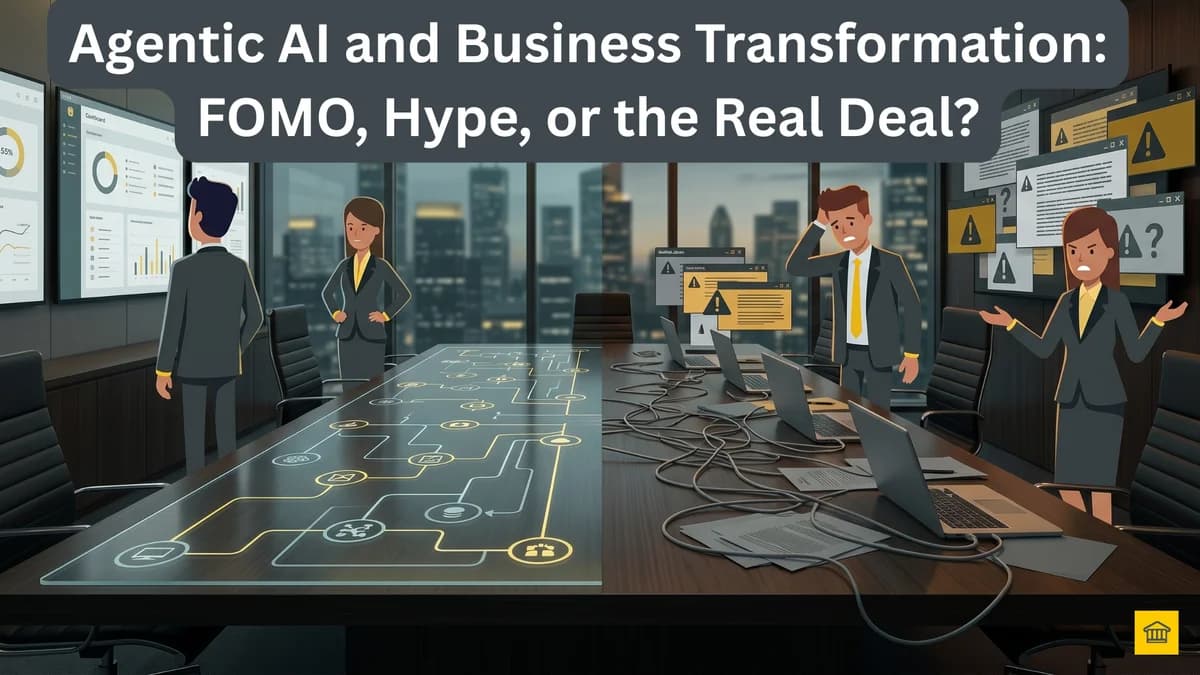
Agentic AI and Business Transformation: FOMO, Hype, or the Real Deal?
SCROLL TO KEEP WATCHING ↓
📷Click on any image to enlarge.
Agentic AI is the newest promise being sold into business transformation. Not just smarter chatbots. Not just copilots. But autonomous or semi-autonomous systems that can interpret intent, make decisions, trigger actions, and coordinate across tools with less human involvement.
That promise is powerful. It is also exactly why the market is filling up with equal parts excitement, confusion, and FOMO.
At HOBA Tech, our view is simple: agentic AI is neither magic nor meaningless. There is real value here. But there is also a very predictable enterprise pattern emerging — one where businesses rush toward a technology category before they have clarified the process, governance, ownership, or commercial logic behind it.
That is where transformation efforts start to wobble. Not because the tools are useless, but because the order of operations is wrong.
🤖 “Agentic AI is not the strategy. It is a capability. If you treat the capability like the strategy, you will end up funding noise instead of outcomes.” #AgenticAI #BusinessTransformation #AI

What Agentic AI Actually Is
Strip away the jargon and agentic AI is fairly straightforward. It refers to AI systems designed to do more than generate content or answer questions. These systems can plan, choose actions, interact with software or data sources, and complete multi-step tasks with some degree of autonomy.
In theory, that makes them highly attractive for business transformation. Leaders look at legacy processes, fragmented systems, overloaded teams, and rising cost pressure and see a shortcut: what if AI agents could connect the gaps, reduce manual work, and accelerate execution?
The attraction is obvious. So is the risk. Because the same autonomy that makes agents look efficient also makes them harder to govern, harder to audit, and more dangerous when embedded into broken processes.
Why Everyone Is Suddenly Talking About It
The rise in interest is not accidental. Vendors need a new enterprise narrative. Copilots alone are no longer enough to sustain attention. Agentic AI offers something bigger: the suggestion that software is evolving from assistant to actor.
That story is commercially irresistible. It promises speed, scale, reduced labour intensity, and always-on execution. It also opens the door to new software categories, new advisory services, new governance tooling, and new budget lines inside the enterprise. For the governance side of that shift, read AI Governance Is Now a Transformation Accelerator. And if you are wondering whether you need a Chief Agent Officer, read our analysis here.
In other words, agentic AI is not only a technical development. It is also a market narrative. That matters because market narratives shape enterprise decisions long before enterprise evidence catches up.
 🔍 Click to enlarge
Where the Real Value Exists
There are legitimate use cases for agentic AI in business transformation. They tend to be narrower and more controlled than the hype suggests, but they are real.
- Service operations: triaging requests, routing cases, summarising histories, and preparing next-best actions
- Knowledge work: retrieving information from multiple systems, synthesising it, and packaging it for human review
- Workflow orchestration: managing structured multi-step tasks across tools where the rules, data, and escalation paths are clear
- Exception handling support: surfacing anomalies, recommending responses, and accelerating operational decision-making
Notice the pattern. These are not "replace the business" use cases. They are bounded, governed, workflow-level interventions. That is where agentic AI starts to look useful rather than theatrical.
🎯 “The strongest use cases for agentic AI are usually the least glamorous ones: defined workflows, clear ownership, good data, human oversight, measurable outcomes.” #AgenticAI #AIGovernance #EnterpriseAI
Where the Hype Starts to Outrun Reality
This is where the conversation becomes more useful. Because most enterprise storytelling around agentic AI jumps straight from possibility to inevitability. It assumes scale before proving control. It assumes value before proving fit. It assumes autonomy before solving design.
The reality is more constrained. Many organisations are still in pilot mode. Many so-called agents are essentially enhanced automation layers or cleverly wrapped assistants. And many teams are talking about orchestration before they have standardised the underlying process.
There are also serious limitations that rarely make it into the keynote version of the story:
- Data pollution: if agents generate or move poor-quality information, they spread bad decisions faster
- Compounding error: small inaccuracies become bigger problems across multi-step actions
- Shadow AI: teams create agents outside central oversight, multiplying risk and inconsistency
- Accountability gaps: when an agent makes a poor decision, ownership becomes murky very quickly
- Security exposure: the more systems an agent can access, the more damaging a mistake or exploit becomes
That does not mean agentic AI is hype only. It means the hype begins the moment businesses forget that autonomy multiplies whatever is already true in the system. If the process is weak, the agent scales weakness. If the data is poor, the agent scales poor data. If the governance is vague, the agent scales ambiguity. We covered the governance gap specifically in Your AI Agents Are Running Amok. Your Governance Is Still Writing Policies. This is also why 29% of organisations are now rebuilding processes from scratch — read Agent-Native Process Redesign.
 🔍 Click to enlarge
How FOMO Distorts Business Transformation
FOMO is rarely discussed as a transformation risk, but it should be. It changes sequencing. It makes organisations buy before they define. It makes leaders ask, "How do we deploy agents?" instead of asking, "Which business problem actually deserves this level of automation?"
That is how companies end up trying to automate uncertainty. They put agentic AI on top of fragmented processes, unclear ownership, duplicated systems, and inconsistent operating models — then act surprised when the output is unreliable.
Bad transformation does not become good because AI is added to it. It usually just becomes faster, harder to audit, and more expensive to unwind.
⚠️ “If your process is unclear, your controls are weak, and your ownership is fuzzy, agentic AI will not fix that. It will operationalise the confusion.” #AgenticAI #BusinessTransformation #AIGovernance #DigitalStrategy
The HOBA Test: How to Evaluate Agentic AI Properly
Our advice is direct: do not evaluate agentic AI as a trend. Evaluate it as a transformation design choice.
That means asking a tougher set of questions:
- What specific business outcome is this meant to improve?
- Is the process already defined, standardised, and measurable?
- What data will the agent rely on, and can that data be trusted?
- Where does human oversight sit when things go wrong?
- How will performance, risk, exceptions, and accountability be monitored?
- Does this use case need an agent, or just better process design and conventional automation?
This is why HOBA's 4+1 thinking matters: Eliminate → Standardise → Optimise → Automate → AI. AI comes last, not first. Agentic AI comes even later, because it introduces greater operational complexity and governance demand than ordinary automation. And if you cannot measure the business value, you are not ready — see The AI ROI Enigma.
Read more about the right sequence: The 4+1 Process to AI Transformation.
 🔍 Click to enlarge
So, Hype or the Real Deal?
The honest answer is both.
Agentic AI is real enough to matter. It will create value in selected use cases. It will shape how some workflows are redesigned. It will almost certainly become part of the transformation toolkit.
But the current market narrative is also inflated. Vendors are pushing the category hard. Enterprise readiness is being overstated. And many leaders are at risk of confusing visibility with viability.
The winners will not be the businesses that move fastest because everyone else is talking about agents. They will be the businesses that move most intelligently — starting with process clarity, governance, business architecture, and measurable outcomes.
That is the real deal. Everything else is theatre with a budget.
Frequently Asked Questions About Agentic AI and Business Transformation
What is agentic AI in the context of business transformation?
Agentic AI refers to AI systems that can plan, make decisions, trigger actions, and complete multi-step tasks with some degree of autonomy. In business transformation, they are most useful in bounded, well-governed workflows rather than as end-to-end replacements for business design.
Is agentic AI just hype?
No, but the current market narrative is significantly inflated. There are real use cases — particularly in service operations, knowledge work, and workflow orchestration. The hype begins when organisations assume scale before proving control.
Why do businesses rush into agentic AI before they are ready?
Enterprise FOMO. When vendors position agentic AI as the next competitive frontier, organisations feel pressure to move before they define the problem, the process, or the governance. That leads to buying before defining, which is one of the most common transformation failure modes.
What is the biggest risk of agentic AI in enterprise settings?
Autonomy multiplies whatever is already true in the system. If processes are weak, agents scale weakness. If data is poor, agents scale bad decisions. If governance is vague, agents scale ambiguity. The biggest risk is deploying agents before the underlying architecture is sound.
How should businesses evaluate whether agentic AI is right for them?
Start with a business outcome, not a technology category. Ask: Is the process already defined? Can the data be trusted? Where does human oversight sit? How will accountability work? If those questions cannot be answered clearly, the organisation is not ready to deploy agents.
What does HOBA recommend before investing in agentic AI?
Follow the 4+1 sequence: Eliminate waste, Standardise processes, Optimise, Automate, then apply AI. Agentic AI is the final step in a chain of deliberate design decisions — not a shortcut around the earlier steps.
About HOBA Tech
If this resonated with you, discover how to make Business Transformation a reality — with less stress, fewer resources, and faster results. Explore our award-winning agile Business Transformation Framework, trusted by organisations worldwide, from the UK Government and FTSE-100 companies to innovative start-ups. Ready to begin your transformation journey? Start here.
Curious why The Business Transformation Playbook is hailed as the "Business Transformation Bible"? See what readers are saying in the Amazon reviews.
We'd love to hear your thoughts! Let us know in the comments what stood out to you or what topics you'd like us to cover next. If you found this valuable, share it with others who could benefit!
Thank you for reading, and here's to your transformation success!
Sincerely,

Heath Gascoigne
P.S. If you want to join our Business Transformation Community of 2,000+ like-minded Business Transformators, join the HOBA Community here.
P.P.S. If you want to learn more about business transformation, check out The Business Transformation Playbook.

Heath Gascoigne
Hi, I'm Heath, the founder of HOBA TECH and host of The Business Transformation Podcast. I help Business Transformation Consultants, Business Designers and Business Architects transform their and their clients' business and join the 30% club that succeed.
TRANSFORM YOUR
ORGANIZATION
WITH THIS SIMPLE PROCESS
WE OFFER THE TRAINING FOR PEOPLE TO GO AND LEARN THE SKILLS NEEDED TO ACHIEVE THE SAME RESULTS AS ACHIEVED IN THIS CASE STUDY.

ENJOYING THIS POST?
GET THE NEXT ONE
Subscribe to our newsletter and get the latest insights delivered straight to your inbox.

Make HOBA Tech a Google Preferred Source.
One click and Google will start showing our articles in AI search results and AI Overviews when you search.
🚀 “Just read: "Agentic AI and Business Transformation: FOMO, Hype, or the Real Deal?" — incredible insights on business transformation.” #BusinessTransformation