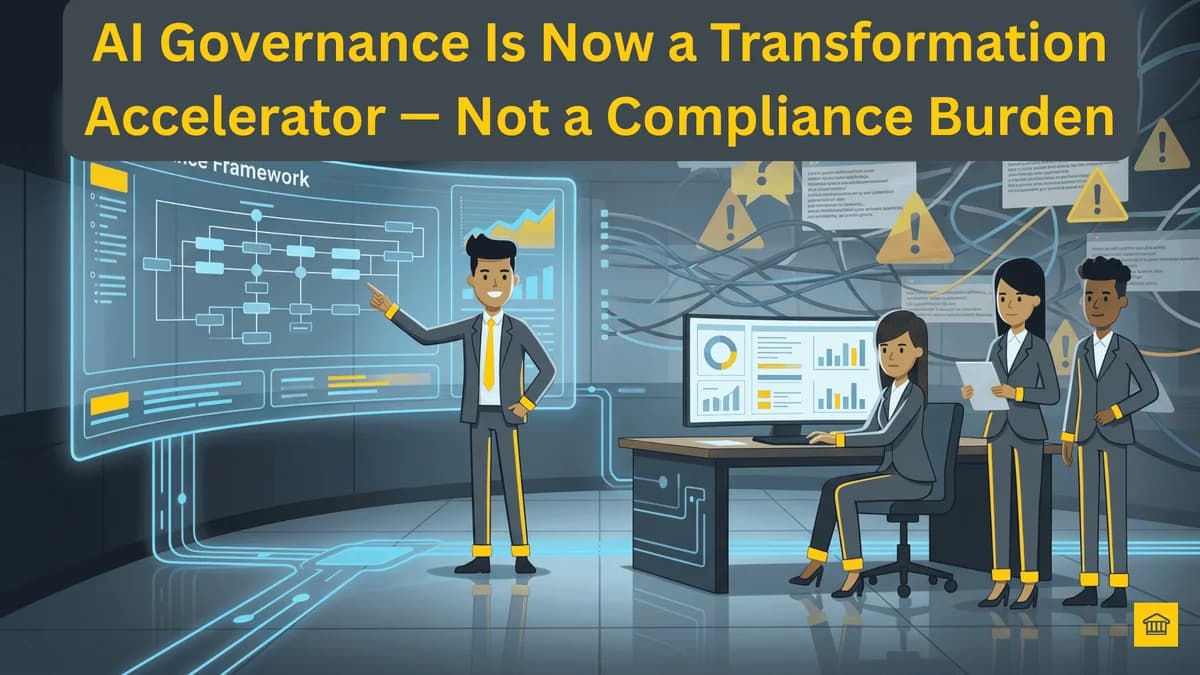
AI Governance Is Now a Transformation Accelerator — Not a Compliance Burden
📷Click on any image to enlarge.
AI governance has a branding problem. For too long, it has been treated as the slow, cautious, procedural part of the AI conversation — the bit that gets mentioned after the strategy deck, after the pilot, and usually after the excitement.
That framing is now breaking down.
Because in 2026, the organisations making real progress with AI are not the ones moving fastest without control. They are the ones building enough control to move with confidence. Governance is no longer the thing that slows transformation down. In many cases, it is the thing that makes transformation possible at all.
At HOBA Tech, our view is straightforward: AI is not the strategy. It is an enabler of the strategy. And if AI is going to enable anything meaningful at enterprise scale, it needs guardrails, clarity, ownership, and operating discipline. That is what governance is.
The businesses still treating governance as a compliance afterthought are likely to discover the same thing the hard way: when AI moves from experimentation to execution, weak governance stops being an abstract risk and starts becoming a practical blocker to value.
Why the conversation has changed
The AI market has matured fast. The discussion is no longer limited to copilots, prompt quality, and experimentation. It is now about AI agents, automated decisions, model orchestration, cross-system workflows, and enterprise scale.
That shift changes the risk profile completely. It also changes the operating question. Once AI is influencing customer journeys, compliance decisions, workflow routing, operational prioritisation, content generation, planning, or service delivery, the issue is no longer "can the tool do it?" It is "who owns it, who monitors it, what data is it using, what happens when it fails, and how do we know?"
This is where governance moves from policy language to business infrastructure.
🧭 “The organisations that scale AI successfully are not the ones that ignore governance. They are the ones that design governance tightly enough to trust the system and move faster with it.” #AIGovernance #BusinessTransformation #AI #DigitalStrategy #Leadership #EnterpriseAI

 🔍 Click to enlarge
The market signal is now impossible to ignore
The data is pointing in the same direction from multiple angles. PwC's 2026 operations research shows a clear ambition-execution gap: most leaders believe they are progressing, but the vast majority also say technology investments have not fully delivered expected results. Poor data quality continues to undermine value. Horizontal operating models are still immature. AI may be rising, but enterprise readiness is uneven.
At the same time, governance itself is becoming more formalised. Regulatory maturity is increasing. Audit expectations are moving from verbal assurances to technical evidence. AI inventories, model cards, data lineage, explainability, monitoring, drift detection, and traceability are becoming operational requirements in more industries and jurisdictions.
That matters because scale and trust are directly connected. If leaders cannot explain how AI systems behave, what data they rely on, where accountability sits, and how quality is continuously monitored, AI adoption will either slow down or quietly create a bigger problem later.
Why governance accelerates transformation
The old view says governance adds friction. The better view is that governance removes hesitation.
When AI governance is designed properly, it does four things that accelerate business transformation:
- It creates trust. Leaders are more willing to scale what they can monitor and explain.
- It reduces rework. Teams make better decisions earlier about tool choice, data usage, roles, and controls.
- It improves adoption. People are more likely to use AI when expectations, guardrails, and escalation paths are clear.
- It protects value. AI that is not governed properly can create hidden cost, hidden risk, and hidden resistance faster than most dashboards reveal.
In other words, governance is not just a risk management layer. It is a scale layer. It gives the organisation enough confidence to move from pilot to production without pretending the risk disappears.
🧭 “Weak governance does not create speed. It creates hesitation, duplication, exceptions, and expensive clean-up work later.” #AIGovernance #BusinessTransformation #AI #DigitalStrategy #Leadership #EnterpriseAI
 🔍 Click to enlarge
What bad governance looks like in practice
Most governance failure does not arrive dramatically. It usually shows up as ambiguity:
- No shared view of which AI tools are actually in use
- Confusion over who owns model approval, outputs, or exceptions
- AI pilots launched without operational controls or data discipline
- Shadow AI spreading faster than leadership visibility
- Teams trying to retrofit accountability after deployment
- Governance handled as documentation rather than decision design
This is why so many AI programmes feel more mature in presentation than in reality. The technology may be visible, but the operating model around it is often still unfinished.
And that is the point HOBA keeps making: if the business design is weak, AI will not rescue it. It will expose it. We explored that in AI Won't Fix Your Broken Transformation. When the issue is specifically agent proliferation and policy-doc governance, the same principle applies — read Your AI Agents Are Running Amok. Your Governance Is Still Writing Policies.
What good governance looks like instead
Good AI governance is practical. It is not a 90-page policy that no one reads. It is a working discipline built into how the business makes decisions about AI.
At a minimum, that means:
- a clear inventory of AI systems, tools, and use cases
- defined ownership across business, technology, risk, and operations
- approval pathways for new use cases and changes
- quality controls around data, output validation, and human oversight
- audit trails and monitoring for drift, exceptions, and behavioural anomalies
- governance that is proportionate to risk, not performative for optics
That is what makes governance usable. It becomes part of delivery, not a legal appendix attached after the real work is finished.
🧭 “If AI is going to sit inside the operating model, governance has to sit there too. Not on the sidelines. Not after the fact. Inside the design.” #AIGovernance #BusinessTransformation #AI #DigitalStrategy #Leadership #EnterpriseAI
 🔍 Click to enlarge
Why this matters for transformation leaders
Transformation leaders are under pressure from both sides. One side is pushing faster AI adoption. The other is warning about risk, trust, regulation, and control. The mistake is thinking these are two separate conversations.
They are the same conversation.
The question is not whether AI should move faster or whether governance should hold it back. The question is whether the business has enough design maturity to scale AI in a way that creates value rather than complexity. That maturity starts with the HOBA 6-step process.
This is exactly why governance belongs in the transformation conversation, not only the compliance conversation. It shapes the order of operations. It decides when AI is ready, where it belongs, how it is monitored, and what the business will tolerate when uncertainty appears.
That is strategic work. Not admin.
The HOBA view
We do not see AI governance as a brake on innovation. We see it as one of the conditions required for innovation to survive contact with reality.
That is especially true for organisations trying to build capability internally rather than simply collect vendors, slides, and pilots. The businesses that will get the most value from AI will be the ones that treat governance as part of business architecture, operating model design, and transformation sequencing — not as a late-stage risk exercise.
AI is not the strategy. It is an enabler of the strategy. Governance is what makes that enablement usable, scalable, and trustworthy.
That is why governance is no longer a compliance burden. It is a transformation accelerator.
🧭 “AI governance is not the brake on transformation. It is the steering system. Without it, AI does not scale with confidence — it scales risk, hesitation, and rework.” #AIGovernance #BusinessTransformation #AI #DigitalStrategy #Leadership
About HOBA Tech
If this resonated with you, discover how to make Business Transformation a reality — with less stress, fewer resources, and faster results. Explore our award-winning agile Business Transformation Framework, trusted by organisations worldwide, from the UK Government and FTSE-100 companies to innovative start-ups. Ready to begin your transformation journey? Start here.
Curious why The Business Transformation Playbook is hailed as the "Business Transformation Bible"? See what readers are saying in the Amazon reviews.
We'd love to hear your thoughts! Let us know in the comments what stood out to you or what topics you'd like us to cover next. If you found this valuable, share it with others who could benefit!
Thank you for reading, and here's to your transformation success!
Sincerely,
Heath Gascoigne
P.S. If you want to join our Business Transformation Community of 2,000+ like-minded Business Transformators, join the HOBA Community here.
P.P.S. If you want to learn more about business transformation, check out The Business Transformation Playbook.

Heath Gascoigne
Hi, I'm Heath, the founder of HOBA TECH and host of The Business Transformation Podcast. I help Business Transformation Consultants, Business Designers and Business Architects transform their and their clients' business and join the 30% club that succeed.
TRANSFORM YOUR
ORGANIZATION
WITH THIS SIMPLE PROCESS
WE OFFER THE TRAINING FOR PEOPLE TO GO AND LEARN THE SKILLS NEEDED TO ACHIEVE THE SAME RESULTS AS ACHIEVED IN THIS CASE STUDY.

ENJOYING THIS POST?
GET THE NEXT ONE
Subscribe to our newsletter and get the latest insights delivered straight to your inbox.

Make HOBA Tech a Google Preferred Source.
One click and Google will start showing our articles in AI search results and AI Overviews when you search.
🚀 “Just read: "AI Governance Is Now a Transformation Accelerator — Not a Compliance Burden" — incredible insights on business transformation.” #BusinessTransformation