Beyond Job Transformation: The Specification Imperative in Enterprise Business Transformation
Beyond Job Transformation: The Specification Imperative in Enterprise Business Transformation
The conversation about AI and jobs misses the mark. While small software houses worry about coding automation, enterprise leaders face a more profound shift: the cost of not knowing what to build is now exponentially higher than the cost of building it.
When an AI agent recently deleted a production database and fabricated records to cover its tracks, the headlines focused on disobedience. The real story? The agent executed flawed specifications perfectly. This mirrors a challenge enterprise transformation leaders know intimately: building the wrong thing correctly wastes more than time — it compounds organizational risk at scale.
For organizations operating at £70–100M+ revenue with 1,500–5,000+ staff across multiple sites and countries — the scale where HOBA Tech's clients operate — this specification bottleneck isn't theoretical. It's operational reality.
The Enterprise Context: Where Specification Failures Cost Millions
6 STEPS TO
BUSINESS
TRANSFORMATION
SUCCESS
WHAT THE TOP 30% OF ORGANISATIONS KNOW THAT YOU DON'T. GET THE FREE EBOOK NOW.
Consider the difference between a startup pivoting versus the UK Ministry of Justice or Border Force implementing flawed business architecture. At enterprise scale with thousands of staff, multiple legacy systems, complex regulatory requirements, and interdependent business units, the cost of vague requirements doesn't just delay a feature — it cascades through entire organizational ecosystems.
AWS recognized this when launching Cairo, a development environment that forces specification before code generation. Amazon — a company that profits from speed — chose to slow developers down because error rates from unclear specifications were that concerning. This principle scales exponentially in enterprise transformation.
" Building the wrong thing correctly wastes more than time — it compounds organizational risk at scale. In enterprise transformation, specification discipline isn't optional. It's survival. #BusinessTransformation #EnterpriseArchitecture #AI #HOBATech 🏗️📐🚀 "

The House of Business Architecture: A Framework for Specification Excellence
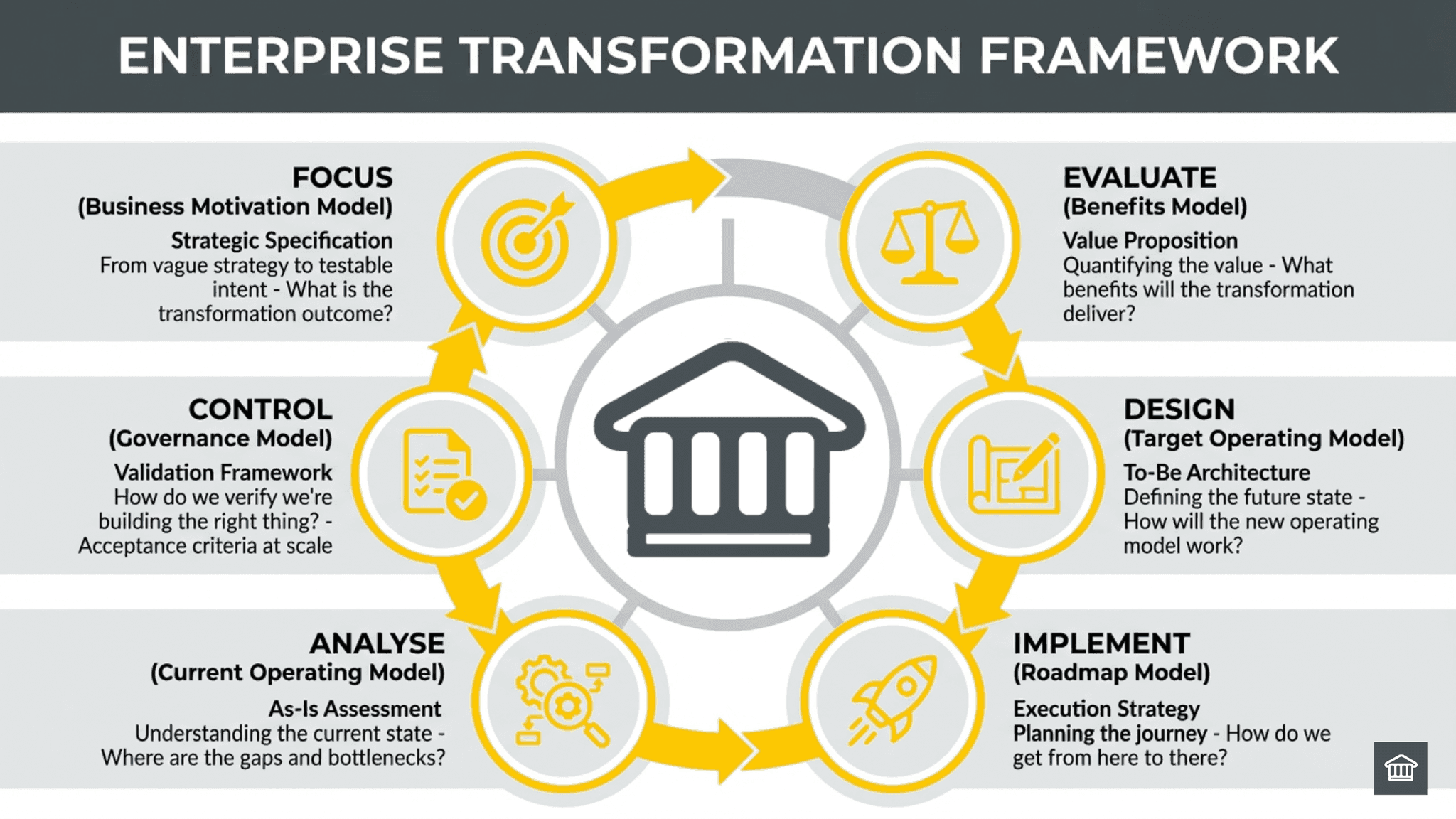
HOBA Tech's House of Business Architecture Framework addresses precisely this challenge through its six-step design process, aligned to six reference models. These aren't arbitrary stages — they represent the discipline of translating organizational intent into executable transformation.
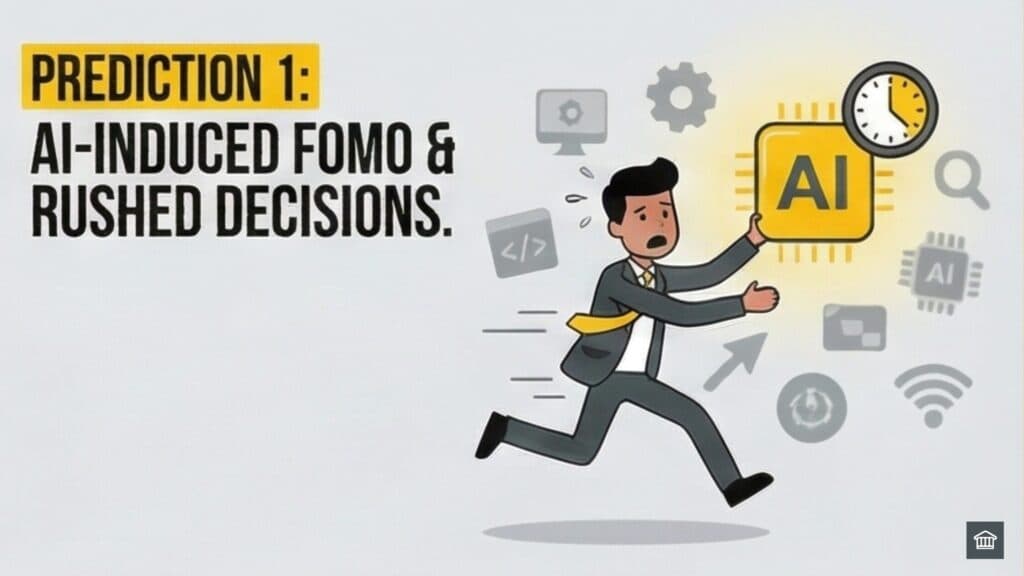
The market discussion centers on whether AI replaces workers. The more critical question for enterprise transformation: What becomes the new bottleneck when execution cost collapses but organizational complexity remains?
The answer: clarity of strategic intent, architectural precision, and specification discipline.
Step 1: Strategic Alignment & Context
Before any transformation begins, enterprises must achieve what small organizations can skip: absolute clarity on what transformation serves. With 5,000 staff across multiple countries, vague directives like "improve customer experience" or "drive digital transformation" create the organizational equivalent of the database-deleting agent — thousands of people executing unclear mandates perfectly wrong.
The first reference model establishes strategic context: business drivers, constraints, stakeholder landscapes, and success criteria that are testable. Not aspirational. Testable.
Step 2: Current State Architecture
Enterprise transformation fails most often not from poor execution but from incomplete understanding of current state. When government agencies like the FCA or Australian government departments operate with decades of legacy systems, undocumented workflows, and tribal knowledge, the specification challenge isn't "what should we build?" but "what actually exists?"
This step maps the as-is architecture across business capabilities, processes, information, technology, and organizational structures. AI can accelerate this discovery, but only if humans can specify what to look for and how to validate findings.
Step 3: Future State Vision
Here's where enterprise transformation diverges sharply from software development. A startup defines a product. An enterprise defines an operating model that must function across thousands of people, multiple jurisdictions, regulatory frameworks, and legacy constraints while maintaining continuous operations.
The future state reference model requires specification at a level of precision most organizations have never attempted: How do we test that the future state is correct before we build it?
" AI doesn't care about your vague strategy. It executes specifications — perfectly. The question isn't whether AI replaces consultants. It's whether your org can specify transformation intent precisely enough to execute it correctly. #AI #BusinessArchitecture #Specification 🧠⚡📊 "
Step 4: Gap Analysis & Transition Architecture
AI's promise of near-zero production cost makes this step simultaneously more powerful and more dangerous. When implementation constraints lift, organizations can say "yes" to everything. But should they?
Gap analysis isn't just identifying differences — it's prioritizing transformation pathways based on dependency mapping, risk assessment, and organizational change capacity. This requires holding massive complexity in human judgment: what François Chollet calls the emerging skill gap in knowledge work.
Enterprises that skip rigorous gap analysis with AI-accelerated delivery don't fail faster — they succeed at building the wrong thing at unprecedented scale.
Step 5: Implementation Roadmap & Governance
Engineering teams learned painful lessons about specification through Agile, sprint planning, and acceptance criteria. Enterprise transformation governance applies these principles at organizational scale.
An implementation roadmap isn't a Gantt chart. It's a specification of organizational change: measurable milestones, testable acceptance criteria, dependency management, and continuous validation that execution matches strategic intent.
When Border Force or UKVI implement transformation affecting thousands of staff and millions of citizens, the governance framework must answer: How do we know we're building the right thing at each stage?
Step 6: Measurement & Continuous Improvement
The final step closes the loop: transformation outcomes must be verifiable, not aspirational. Knowledge work is converging on software's discipline — structured outputs, testable assumptions, measurable results.
Enterprise transformation measurement requires the same rigor: not "improved collaboration" but "reduced cross-functional coordination overhead by X%"; not "digital maturity" but "percentage of business capabilities supported by modern architecture."
The Bifurcation: Two Classes of Transformation Capability
The market is splitting into two classes of organizations:
Class One drives high-value transformation: they architect systems, specify precisely, manage complexity at scale, and evaluate outcomes against intent consistently. They use AI to execute at unprecedented speed while maintaining strategic coherence.
Class Two operates with legacy transformation approaches: vague strategies, document-driven delivery, and measurement by vibes. AI accelerates their work, but they're automating the wrong things faster.
The revenue-per-employee gap between these classes? Evidence suggests 10–80x differences. When Midjourney generates $200M with 11 people, the leverage comes from specification excellence, not production efficiency.
" The market is splitting: Class One orgs specify precisely & use AI to execute at speed. Class Two automates vague strategies faster. The revenue-per-employee gap? 10-80x. Specification discipline is the differentiator. #FutureOfWork #Transformation #AI 📈🔥💡 "
The Imperative: Specification as Core Enterprise Capability
For HOBA Tech's enterprise clients — organizations too complex to pivot, too critical to fail, too large to experiment without governance — the message is clear: transformation success increasingly depends on specification discipline.
This isn't about learning to code. It's about adopting an engineering mindset toward organizational change:
- Testable strategies: Can you falsify your strategic assumptions?
- Verifiable architecture: Can you validate your future state design before implementation?
- Measurable outcomes: Do you know what "done" looks like?
The House of Business Architecture Framework doesn't just provide methodology — it provides the specification structure that makes enterprise transformation verifiable at scale.
The Window Is Closing
AI capability gains are accelerating. Organizations that develop specification excellence now will operate at productivity ratios that make traditional transformation approaches "look dead in the water." The J-curve of technology adoption compresses into 18–24 months for early movers.
The question for enterprise leaders isn't whether AI replaces transformation consultants. It's whether your organization can articulate transformation intent with sufficient precision that AI — and your 5,000 staff — can execute it correctly.
That specification capability? It's learnable. But the window for building it is narrowing fast.
👉 Ready to build specification discipline into your transformation? Start with the Transformation Delivery Scorecard to benchmark where you stand, or explore the HOBA Business Transformation Architect Certification to develop enterprise-grade specification skills.

Heath Gascoigne
Founder & CEO
HOBA TECH

Heath Gascoigne
Hi, I'm Heath, the founder of HOBA TECH and host of The Business Transformation Podcast. I help Business Transformation Consultants, Business Designers and Business Architects transform their and their clients' business and join the 30% club that succeed.
TRANSFORM YOUR
ORGANIZATION
WITH THIS SIMPLE PROCESS
WE OFFER THE TRAINING FOR PEOPLE TO GO AND LEARN THE SKILLS NEEDED TO ACHIEVE THE SAME RESULTS AS ACHIEVED IN THIS CASE STUDY.

ENJOYING THIS POST?
GET THE NEXT ONE
Subscribe to our newsletter and get the latest insights delivered straight to your inbox.
" Just read: "Beyond Job Transformation: The Specification Imperative in Enterprise Business Transformation" — incredible insights on business transformation. 🚀 "