What Is Business Transformation? The Definitive Guide for 2026
📷Click on any image to enlarge.
Business transformation is one of the most overused phrases in leadership, consulting, and technology. Yet for most organisations, the challenge is brutally simple: change fast enough to stay relevant, but not so blindly that you create expensive chaos. This guide explains what business transformation really means, why so many programmes fail, what the evidence says actually works, and how to lead transformation in a way that puts people, process, technology, and data in the right order.
Business transformation is not a software rollout. It is not a rebrand for digital activity. And it is definitely not buying AI tools and hoping value appears later. At its core, business transformation is the deliberate redesign of how an organisation creates value, operates, makes decisions, and delivers outcomes in response to strategic pressure.
McKinsey notes that less than one-third of transformations reach their goals and sustain performance improvements over time. That should stop every executive in their tracks. Transformation is now essential, but success is still rare.
The Real Definition of Business Transformation
Business transformation means making fundamental changes to how a business operates so it can respond to shifts in markets, customer expectations, regulation, competition, cost pressure, and technology. That can include changes to operating models, governance, culture, processes, services, capabilities, and supporting systems. It is bigger than process improvement and broader than digital transformation alone.
A lot of organisations get this wrong because they define transformation through the lens of the solution they want to buy. They say, "We need AI," "We need automation," or "We need a new platform." But none of those is a transformation strategy. They are tools. Real transformation begins with a business problem, a strategic outcome, and a clear view of what must change across the enterprise to achieve it. That is exactly why HOBA frames transformation as business-led, not technology-led.
Put simply: if the operating model, decisions, behaviours, capabilities, and measures do not change, then you have not transformed the business. You have just installed something new into an old environment.
" Business transformation fails when leaders confuse buying technology with changing the business. Strategy first. Architecture second. Technology last. 🚀 #BusinessTransformation #DigitalTransformation #Leadership "

Why Business Transformations Fail 70% of the Time
The uncomfortable truth is that failure is not the exception in transformation. It is the norm. McKinsey says fewer than one in three transformations succeed over time. HOBA argues the commonly quoted failure rate has hovered around 70% for years, and that AI-induced urgency is making things worse, not better.
 🔍 Click to enlarge
1. Leaders choose technology before defining the business problem
This is probably the biggest single cause of failure. Organisations jump straight to products, platforms, dashboards, copilots, and AI tools before they have defined the outcomes they want, the capabilities they lack, or the operating problems they actually need to solve. HOBA's position is blunt and correct: technology is a lever for change, not the change itself.
2. The transformation is not grounded in facts
McKinsey found that successful transformations are far more likely to begin with an objective fact base. That matters because ambition without evidence becomes theatre. Teams need a clear baseline, measurable pain points, quantified opportunities, and real accountability.
3. Leaders communicate activity instead of purpose
Transformation fatigue sets in when people see projects but do not understand the reason behind them. McKinsey identifies a compelling case for change as one of the strongest predictors of success. If the workforce cannot connect the transformation to customer value, performance, risk reduction, or strategic survival, resistance becomes rational.
4. The best people are not assigned to the most critical work
Too many programmes are staffed around availability rather than importance. McKinsey highlights talent allocation as a major success factor: the best people need to be on the most important initiatives, not ring-fenced in "business as usual."
5. Change management is treated as an afterthought
Transformation does not fail because slides were weak. It fails because behaviours did not change, incentives were misaligned, governance was vague, and leaders assumed adoption would just happen. HOBA's methodology explicitly keeps people and process in equal balance with technology and data for this reason.
6. Organisations declare victory too early
McKinsey warns that transformations stall when organisations celebrate early wins and relax discipline before value is embedded. Sustained transformation requires continuous review, ownership, and refinement.
7. AI has amplified FOMO, not judgement
HOBA's 2026 outlook argues that AI-induced FOMO is pushing organisations into rushed, technology-first decisions. That is a dangerous pattern because urgency without architecture only accelerates failure. If you move faster than your process maturity, governance, and workforce readiness allow, you do not become more innovative. You become more fragile.
" If 70% of transformations still fail, the answer is not more hype. It's better architecture, clearer ownership, and a people-first design. 📉➡️📈 #BusinessTransformation #ChangeManagement #AITransformation "
What the Data Says Actually Works
The data is more useful than the hype. McKinsey found that transformations with at least 7% of employees in ownership roles are twice as likely to deliver better total shareholder returns. It also found that companies with top-quartile financial performance typically capture 74% of transformation value in the first 12 months, and that outcome-linked financial incentives can drive an almost fivefold increase in total shareholder returns.
What does that tell us? First, transformation works better when it is distributed, not centralised into a tiny leadership bubble. Second, momentum matters. Third, incentives, ownership, and execution discipline matter far more than slogans. The lesson is not "launch more change." The lesson is "design the change properly, then govern it relentlessly."
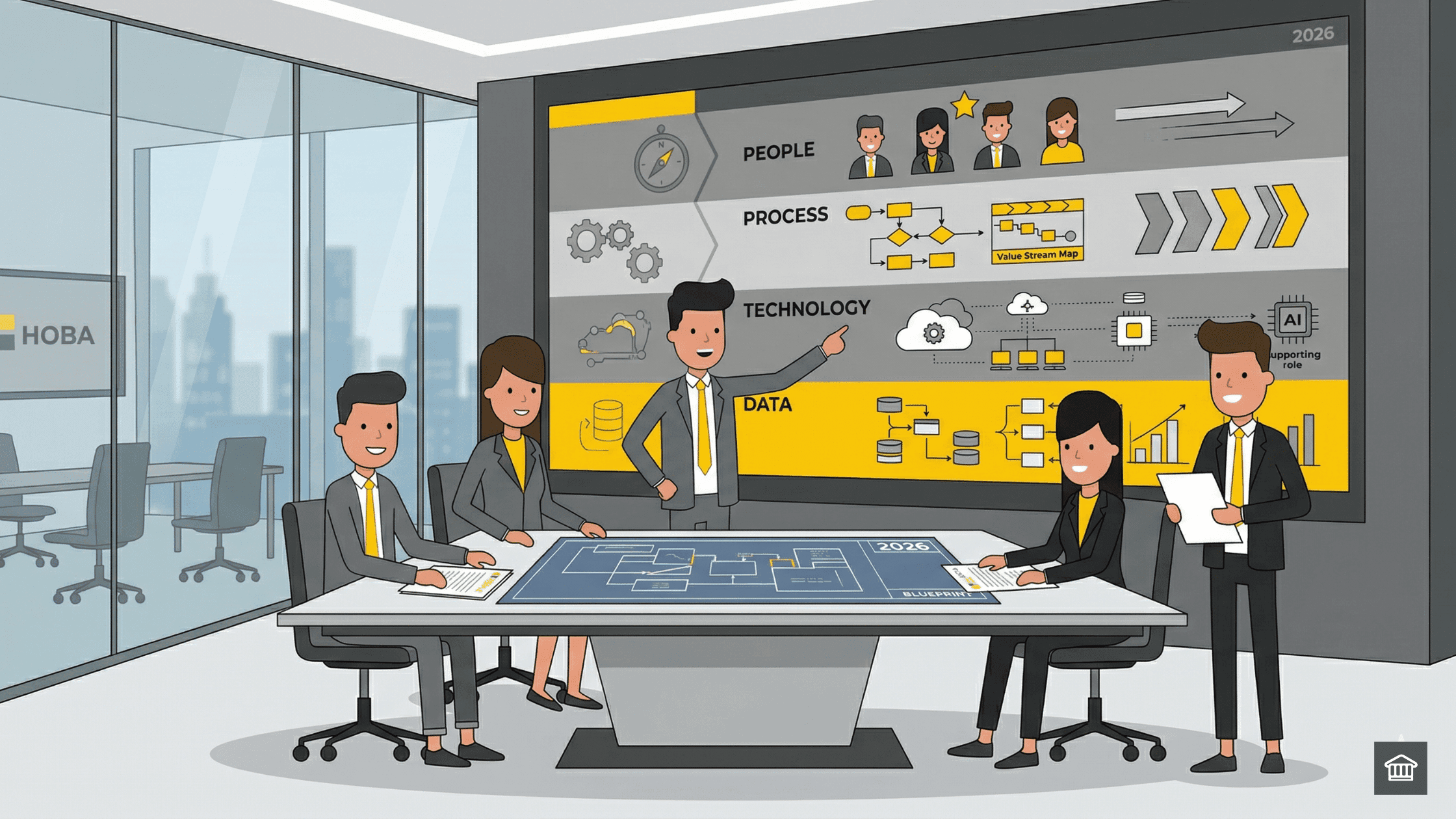
HOBA's view complements that evidence well: successful transformation happens when organisations balance the four levers of people, process, technology, and data instead of overinvesting in one and neglecting the others.
The 5 Types of Business Transformation
Not every transformation is the same. One reason organisations struggle is they use one word to describe five very different kinds of change.
1. Organisational Transformation
This changes structures, decision rights, reporting lines, governance, roles, and operating models. It is about how the business is arranged and led.
2. Process Transformation
This redesigns workflows, handoffs, controls, service delivery, and operational execution. It often targets efficiency, quality, cycle time, and customer experience.
3. Digital and Technology Transformation
This involves platforms, automation, data architecture, systems integration, and modernisation. It is important, but it is only one part of the picture.
4. Cultural Transformation
This focuses on behaviours, leadership norms, collaboration, risk appetite, ways of working, and what gets rewarded. This is often the hardest part because it cannot be installed like software.
5. Management Transformation
This changes how performance is governed, how priorities are set, how resources are allocated, and how execution is measured. Without this layer, many transformations drift into fragmented delivery.
The key point is that most serious programmes touch more than one type at once. A technology initiative that leaves governance, culture, process, and leadership untouched is not transformation. It is an upgrade.
What Drives the Need for Business Transformation?
Businesses do not transform for fun. They transform because the cost of staying the same becomes higher than the cost of change.
Customer expectations have changed
Customers now compare every experience with the best experience they have anywhere. Slow service, fragmented journeys, poor handoffs, and weak communication are no longer tolerated for long.
Competitive pressure is relentless
New entrants can challenge incumbents quickly, especially when they use lean operating models, digital channels, automation, and data effectively. Legacy organisations that move too slowly lose pricing power, loyalty, and strategic relevance.
Regulation and risk are rising
Transformation is often driven by compliance requirements, resilience concerns, governance obligations, and the need to operate safely in more complex environments.
Technology has changed the art of the possible
AI, automation, data platforms, and digital workflows can create major value — but only if deployed into processes and operating models that are ready for them. Otherwise, they simply accelerate inefficiency.
The old operating model no longer fits the strategy
This is the real one. A business transforms when its current way of working can no longer deliver the ambition leadership has set. That is when change moves from "nice to have" to "non-negotiable."
The 7 Stages of a Successful Business Transformation
Most transformations fail because they jump from ambition to activity. What is missing is sequence. A successful transformation usually follows seven broad stages.
1. Define the strategic case for change
Be explicit about what is broken, what opportunity exists, and what the business must achieve.
2. Establish leadership and governance
Name owners, create decision pathways, define measures, and clarify accountability early. McKinsey also points to the value of a central transformation office in many programmes.
3. Analyse the current state
Understand how the business really works today, not how the org chart says it works.
4. Design the target operating model
Define the future state across people, process, technology, and data.
5. Prioritise initiatives and build the roadmap
Sequence the work by value, feasibility, risk, and dependency.
6. Execute with discipline
Transformation requires programme management, delivery cadence, benefits tracking, and adaptation in flight.
7. Embed and sustain the change
This is where many programmes fail. The final stage is not deployment. It is adoption, habit, measurement, and continuous improvement.
The HOBA® Approach: A Business-Led, People-First Framework
HOBA's contribution to this conversation is not just another framework diagram. It is a discipline: start with the business problem, structure the transformation properly, and treat people, process, technology, and data as equal levers.
The six-step HOBA methodology is especially useful because it gives leaders a practical sequence:
Focus
Define the 5W1H. Why are we doing this? What problem are we solving? Who is affected? What does success look like?
Control
Put governance in place early. Transformation without governance becomes drift.
Analyse
Understand the current state across the business, not just the technology stack.
Evaluate
Assess solutions based on fit, evidence, and value — not hype.
Design
Apply the four levers properly: people, process, technology, and data.
Implement
Execute, measure, realise benefits, and sustain the outcomes.
This matters because frameworks do not transform businesses by themselves. People do. The value of a framework is in forcing the right questions in the right order.
 🔍 Click to enlarge
Business Transformation vs Digital Transformation vs Organisational Change
These terms are often used interchangeably, but they are not the same.
Business transformation is the broadest term. It refers to fundamental change in how the enterprise creates value and operates.
Digital transformation is a subset. It focuses on how digital capabilities and technologies reshape business performance.
Organisational change is broader in one sense and narrower in another. It can refer to any structured change initiative, but it does not automatically imply enterprise-wide transformation.
This distinction matters because plenty of organisations claim to be in "business transformation" when they are actually running a digital programme. Equally, some are doing isolated organisational change without changing how the business fundamentally works. Clarity on this improves ROI because it stops leaders from confusing means with ends.
If the strategic model changes, that is business transformation. If the channel, platform, or workflow changes to support it, that may be digital transformation. If the team structure changes to enable it, that is organisational change. Mature leaders know which layer they are actually working on.
The Role of AI in Business Transformation — Without the Hype
AI absolutely belongs in the transformation conversation. But it belongs in the right place.
HOBA's 4+1 model makes this point clearly: eliminate, standardise, optimise, automate, then apply AI. That order is critical because you cannot automate your way out of a broken process. If you apply AI too early, you simply scale inconsistency and poor decision-making faster.
That caution is becoming more important as agentic AI gets louder. IMD warns that AI agents can create data pollution, accountability gaps, uncontrolled "shadow AI," and an expanded attack surface. It cites Gartner's prediction that abuse of AI agents will be responsible for 25% of enterprise security breaches by 2028.
So yes, AI can support transformation. It can improve pattern recognition, summarisation, document handling, forecasting, workflow assistance, and service responsiveness. But no, it is not a transformation strategy. The smarter question is not "Where can we use AI?" It is "Which business outcomes are we trying to improve, and what level of process maturity and governance do we have today?"
HOBA's position is the right one here: AI should support a business-led architecture, not dictate it. That is how you get value without inheriting chaos.
 🔍 Click to enlarge
" AI should strengthen a transformation strategy, not become one. If you automate chaos, you just get faster chaos. 🤖⚠️ #AITransformation #BusinessTransformation #AgenticAI "
Real Business Transformation Examples That Actually Matter
The most useful case studies are not always the flashiest. They are the ones that show what changed and why.
Major shifts such as Netflix moving from DVD rental to streaming, and General Motors restructuring operations to improve viability, show transformation as a change in business model and operating logic — not just technology deployment.
From HOBA's own experience, the methodology has been applied in environments including BP Oil & Gas, MHRA Government, Cigna Healthcare, TFGM Transport, and Beazley Insurance. Notable results include a transport operator reducing planning time by 45% and improving on-time delivery from 67% to 89% through predictive analytics and resource optimisation, as well as an MHRA AI initiative targeting 40% faster document review.
The lesson from all of these examples is consistent: successful transformation is measurable, designed, governed, and anchored in business outcomes. It is not a stack of disconnected initiatives pretending to be strategy.
Business Transformation Best Practices for 2026
If you are leading transformation now, these are the principles worth keeping close.
Start with vision, not vendors
Do not let the market define your roadmap for you. Define the outcome first.
Build your fact base before your business case
Assumptions make fragile transformations. Evidence creates conviction.
Treat people as a design variable, not a communications problem
Capability, adoption, incentives, and ownership are central to transformation success.
Put governance in early
IMD's warning on shadow AI is a reminder that weak governance turns innovation into risk quickly.
Balance the four levers
People, process, technology, and data must move together. Overweight one, and the transformation destabilises.
Keep adapting after launch
A transformation is not complete when the project closes. It is complete when the new way of working performs reliably and value is sustained.
Frequently Asked Questions About Business Transformation
What is business transformation in simple terms?
It is the process of fundamentally changing how a business operates so it can perform better, stay competitive, and deliver better outcomes.
What is the difference between business transformation and digital transformation?
Business transformation is broader. Digital transformation is often one part of it.
Why do so many business transformations fail?
Because organisations often start with technology, underinvest in people and process, communicate poorly, and fail to govern change properly.
How long does business transformation take?
It depends on scope, but meaningful transformation is usually multi-phase and requires sustained governance over time rather than a one-off project.
Is AI necessary for business transformation?
No. It can be useful, but it is not mandatory. The right question is whether AI supports a clearly defined business objective.
What is the first step in business transformation?
Define the problem, the outcome, and the reason to change before selecting tools or solutions.
Final Thought
Business transformation is not about moving fast for the sake of it. It is about moving deliberately enough to change what matters. The winners in 2026 will not be the organisations that buy the most technology or shout the loudest about AI. They will be the ones that understand their business problems clearly, design change properly, involve their people meaningfully, and use technology in service of strategy.
If your transformation starts with hype, it will likely end in rework. If it starts with architecture, evidence, governance, and outcomes, it has a genuine chance of becoming one of the few that succeeds.
About HOBA Tech
If this resonated with you, discover how to make Business Transformation a reality — with less stress, fewer resources, and faster results. Explore our award-winning agile Business Transformation Framework, trusted by organisations worldwide, from the UK Government and FTSE-100 companies to innovative start-ups. Ready to begin your transformation journey? Start here.
Curious why The Business Transformation Playbook is hailed as the "Business Transformation Bible"? See what readers are saying in the Amazon reviews.
We'd love to hear your thoughts! Let us know in the comments what stood out to you or what topics you'd like us to cover next. If you found this valuable, share it with others who could benefit!
Thank you for reading, and here's to your transformation success!
Sincerely,

Heath Gascoigne
P.S. If you want to join our Business Transformator community of 2,000+ like-minded Business Transformators, join the community on the Business Transformator Facebook Group here.
P.P.S. If you want to learn more about business transformation, check out The Business Transformation Playbook.
Further Reading
- The Chief Agent Officer: Necessary Evolution or Vendor-Invented Job Title? — is the CAO real or vendor hype?
Ready to take the next step?
- Take the AI Transformation Readiness Scorecard — find out where you stand today
- Download the 6 Steps to Business Transformation Success eBook — free guide
- Explore HOBA Pro — the platform built for transformation professionals
- Book a transformation strategy call — speak directly with Heath

Heath Gascoigne
Hi, I'm Heath, the founder of HOBA TECH and host of The Business Transformation Podcast. I help Business Transformation Consultants, Business Designers and Business Architects transform their and their clients' business and join the 30% club that succeed.
TRANSFORM YOUR
ORGANIZATION
WITH THIS SIMPLE PROCESS
WE OFFER THE TRAINING FOR PEOPLE TO GO AND LEARN THE SKILLS NEEDED TO ACHIEVE THE SAME RESULTS AS ACHIEVED IN THIS CASE STUDY.
ENJOYING THIS POST?
GET THE NEXT ONE
Subscribe to our newsletter and get the latest insights delivered straight to your inbox.
" Just read: "What Is Business Transformation? The Definitive Guide for 2026" — incredible insights on business transformation. 🚀 "