The Industry Is Finally Waking Up to Transformation Architecture
📷Click on any image to enlarge.
Not long ago, it felt like a new AI tool arrived every month. Now it feels like several arrive every day.
Each one promises to be faster, smarter, cheaper, more autonomous, more human, more powerful. Every week there is another launch, another model, another platform, another vendor claiming to reinvent the future of work.
And yet the core problem remains the same.
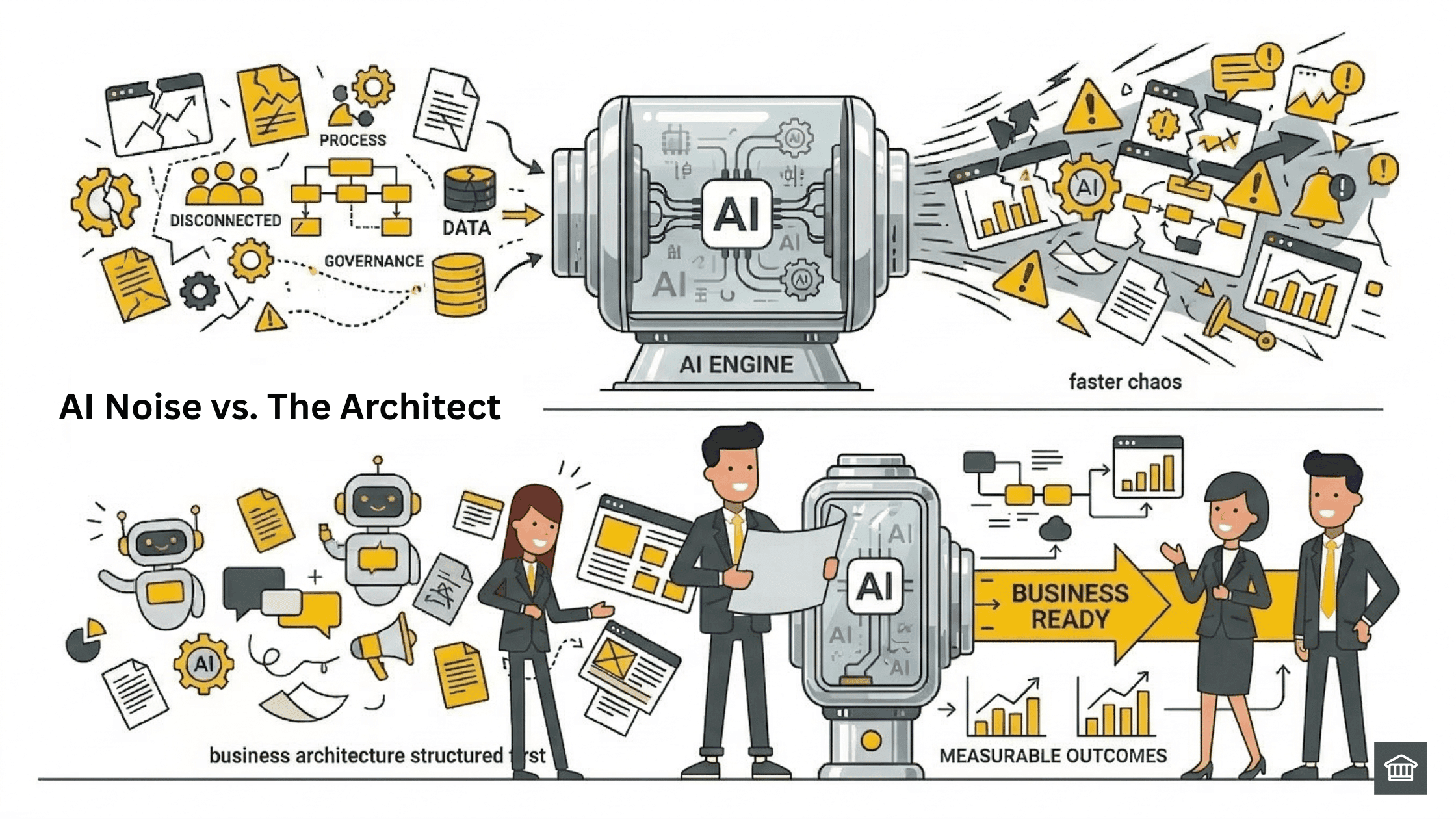
If your business model is unclear, your processes are broken, your governance is weak, and accountability is missing, new technology does not fix that. It scales it.
That is the uncomfortable truth the market is finally starting to confront.
The industry is waking up to something we have been saying for a long time: without transformation architecture, transformation does not scale well. It fragments. It stalls. It becomes expensive. And too often, it fails.
At HOBA, this has always been our position. Transformation must be business-led, not technology-led. It must start with clarity, structure, and design. AI may be the latest accelerator, but it is still only one part of the transformation puzzle.
The tools are changing quickly. The need for architecture is not.
Why the AI boom is exposing an old problem
AI has not created the transformation problem. It has exposed it.
For years, organisations have been jumping into change by starting with solutions before they properly understood the problem. The result has been the same across digital transformation, operating model redesign, large-scale programmes, and now AI adoption: too much activity, not enough clarity.
That is one reason large transformations continue to struggle. McKinsey has long pointed to failure rates of around 70% in major transformation efforts.
AI is now making that weakness more obvious.
When decision cycles get shorter and the pressure to "do something with AI" increases, many organisations fall into the same trap: they move to tools before they define the use case, they launch pilots before they define governance, they approve spend before they define outcomes.
That is not transformation. That is noise disguised as progress.
More technology does not solve broken transformation
There is a persistent belief in the market that enough technology can compensate for weak design.
It cannot.
Technology can automate a bad process. It can accelerate poor decisions. It can amplify fragmented ownership. It can push unclear accountability deeper into the organisation.
In other words, if the architecture is weak, the tool just helps you fail faster.
This is why the conversation cannot begin with AI products, platform demos, or the latest feature release. It has to begin with the fundamentals:
- Why are we doing this?
- Who is involved?
- What problem are we solving?
- What benefit do we expect?
- What changes are actually required?
- How, where, and when will those changes be implemented?
That is the discipline of transformation architecture.
 🔍 Click to enlarge
"AI doesn't fix broken businesses. It scales them. If your process, governance, and accountability are weak, faster technology just gets you to failure faster. That's why transformation needs architecture." — Heath Gascoigne
What transformation architecture actually means
Transformation architecture is the structured design of change across strategy, operations, and implementation so that outcomes, governance, delivery, and benefits are aligned before technology is scaled.
It means transformation is not left to chance. It is not improvised. It is not reduced to a programme plan, a steering committee, or a collection of disconnected workstreams.
It is designed.
At HOBA, this is why we talk about the Business Transformation Architect.
Because successful transformation needs architecture in the same way successful buildings, systems, and enterprises do. Someone has to connect the vision to the operating model, the operating model to delivery, and delivery to measurable business outcomes.
Without that, organisations end up with activity without alignment.
That is why the market is finally waking up to transformation architecture. Not because it is fashionable. Because it is necessary.
 🔍 Click to enlarge
"The industry is finally waking up to what we've been saying for years: without transformation architecture, new technology doesn't transform the business — it scales the chaos." — Heath Gascoigne
The HOBA approach: business-led before technology-led
At HOBA, we use a structured 6-step design process:
Step 1: Focus
Start with the why, who, and what. Why are we doing this? Who is involved? What problem or opportunity are we trying to address? This is where clarity begins.
Step 2: Control
Define governance, scope, ownership, and decision rights. Who is accountable? What is in scope? What are the rules of engagement? Without control, change becomes fragmented quickly.
Step 3: Analyze
Assess the current state. What is broken? Where are the bottlenecks? What processes are underperforming? What data is missing or unreliable? This is where many AI initiatives discover the problem is not the absence of tools, but the absence of design.
Step 4: Evaluate
Review the options. Is there a business case? Is there a use case? Will this change create measurable value? Is now the right time? Not every shiny new tool deserves investment.
Step 5: Design
Design the future state across the four transformation levers:
- People
- Process
- Technology
- Data
AI is one lever within technology. It is not the whole transformation.
Step 6: Implement
Only then should you deploy. Implementation should follow architecture, not replace it. That is how you move from experimentation to structured transformation.
How to approach AI transformation efficiently
Organisations do not need to slow down. But they do need to become more deliberate.
Here are three ways to move faster without creating more chaos.
1. Solve one meaningful business problem first
Do not chase ten AI use cases at once. Pick one with clear ownership, measurable value, and a real operational pain point.
2. Use small expert teams, not oversized programmes
You do not need armies of consultants to design good transformation. Often, smaller expert teams with a strong framework move faster and produce better outcomes.
3. Build capability, not dependency
This is especially important in government and enterprise. Buyers may ask for consulting, but what they usually want is internal capability, predictable outcomes, stronger accountability, and lower long-term dependency on external advisers. OECD's recent work on AI in government also stresses the need for guardrails, enablers, and institutional capability for responsible adoption.
The mistakes organisations keep making
There are a few common mistakes that show up again and again.
Mistake 1: Starting with the tool
The wrong first question is: which AI platform should we buy? The right first question is: what exactly are we trying to change?
Mistake 2: Treating AI as the strategy
AI is not the strategy. It is one enabler within a broader transformation.
Mistake 3: Ignoring governance until later
Later is usually too late. Governance has to come before scale.
Mistake 4: Confusing activity with progress
Pilots, demos, proofs of concept, and workshops are not the same as delivered value.
Mistake 5: Letting vendors define the business problem
The business must define the outcome. The tool should support it, not drive it.
Why this matters so much for government and enterprise
Governments and large organisations say they want consulting.
What they actually want is something more practical:
- transformation capability
- accountability
- predictable outcomes
- lower cost
- less dependency on consultants
That is why the old consulting-heavy model is increasingly under pressure.
The organisations that will succeed are not necessarily the ones that buy the most technology or hire the biggest advisory team. They are the ones that develop the capability to run transformation properly themselves.
That is why our position is simple: We do not just help organisations deliver transformation. We help them build the system to run transformation themselves.
That is the difference.
The tools may be new. The need for architecture is not.
AI will continue to evolve.
There will be more launches, more releases, more hype cycles, more pressure, and more promises.
Some of those tools will be useful. Some will not. But none of them remove the need for clarity, governance, accountability, and structured design.
That is why the industry is finally waking up to transformation architecture. Not as a trend. As a necessity.
At HOBA, we have been calling for this for years.
Because without architecture, new technology does not transform the business. It scales the chaos.
 🔍 Click to enlarge
"AI is only one lever of change. Real transformation happens when people, process, technology, and data are designed to work together. That is the difference between hype and outcomes." — Heath Gascoigne
Ready to take the next step?
If this resonates, here are four ways to go deeper:
- Download the AI-Powered Business Transformation eBook — See how to apply AI in a business-led, structured way.
- Take the AI Readiness Scorecard — Find out where your organisation stands across people, process, technology, and data.
- Join our upcoming webinar — Learn how to approach AI transformation without increasing risk or dependency.
- Join the HOBA Pro AI Beta waitlist — See what a transformation operating system looks like in practice.
Thanks for reading this!
Sincerely,

Heath Gascoigne
Founder & CEO HOBA TECH

Heath Gascoigne
Hi, I'm Heath, the founder of HOBA TECH and host of The Business Transformation Podcast. I help Business Transformation Consultants, Business Designers and Business Architects transform their and their clients' business and join the 30% club that succeed.
TRANSFORM YOUR
ORGANIZATION
WITH THIS SIMPLE PROCESS
WE OFFER THE TRAINING FOR PEOPLE TO GO AND LEARN THE SKILLS NEEDED TO ACHIEVE THE SAME RESULTS AS ACHIEVED IN THIS CASE STUDY.
ENJOYING THIS POST?
GET THE NEXT ONE
Subscribe to our newsletter and get the latest insights delivered straight to your inbox.
" Just read: "The Industry Is Finally Waking Up to Transformation Architecture" — incredible insights on business transformation. 🚀 "