Value vs Benefit. Which is Better?
In this blog post, we will explore the nuanced distinction between "value" and "benefit" in the context of business transformation and customer-centric strategies.
We will delve into the significance of understanding these concepts and their implications for organisational success.
By examining the interplay between business architecture, customer value, and strategic decision-making, we aim to provide clarity on the optimal approach for driving sustainable growth and competitive advantage.
If you're confused about whether your business transformation should be focusing on the business benefits your business plans to realise from the changes it implements, or the value Customers might find in the features you can now offer, then this post is for you.
Before we dive into whether Value is better or benefit is better in terms of business transformations, it would help to briefly define both of them.
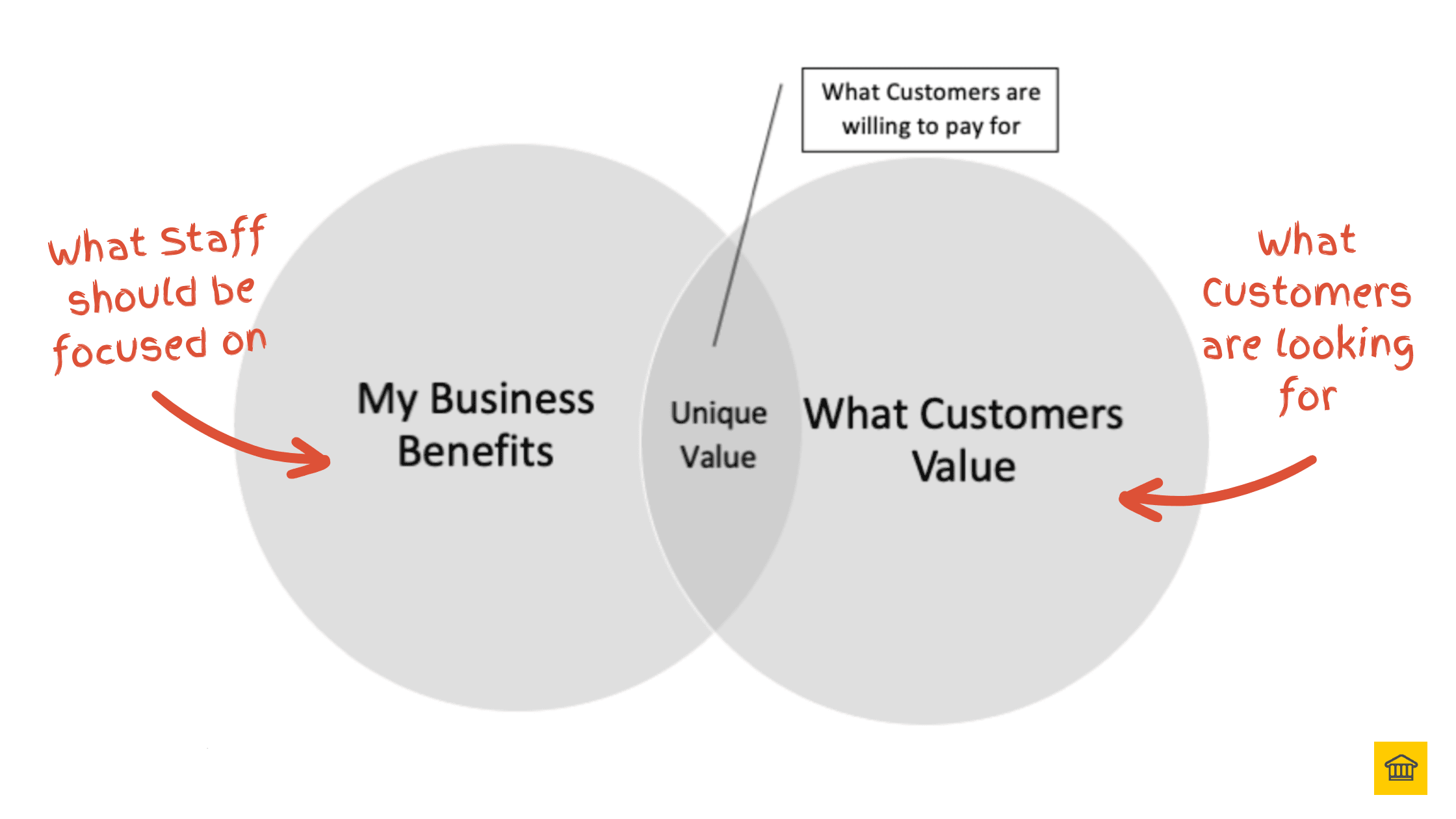
In simple terms, business benefits (or benefits for short) are what the business realises and experiences as a result of the changes that were implemented by an effective transformation. On the other hand, Value is the benefit the Customer will be able to experience, and what they are willing to pay for. This is the important distinction.
In this post, you will learn what are Business Benefits, what are business values, and why focusing on Value can be detrimental for your transformation.
Let's start off with the term 'Value'.
In a hurry? Download our Value vs. Benefit eBook!
We have condensed the key insights from this article into a free eBook. Discover why focusing on "Value" is derailing your transformation, and how shifting to Business Benefits guarantees success.
What is Meant by 'Value'?
6 STEPS TO
BUSINESS
TRANSFORMATION
SUCCESS
WHAT THE TOP 30% OF ORGANISATIONS KNOW THAT YOU DON'T. GET THE FREE EBOOK NOW.
Value is mostly a marketing concept, and the difference between the two can be easily understood better by a simple example:
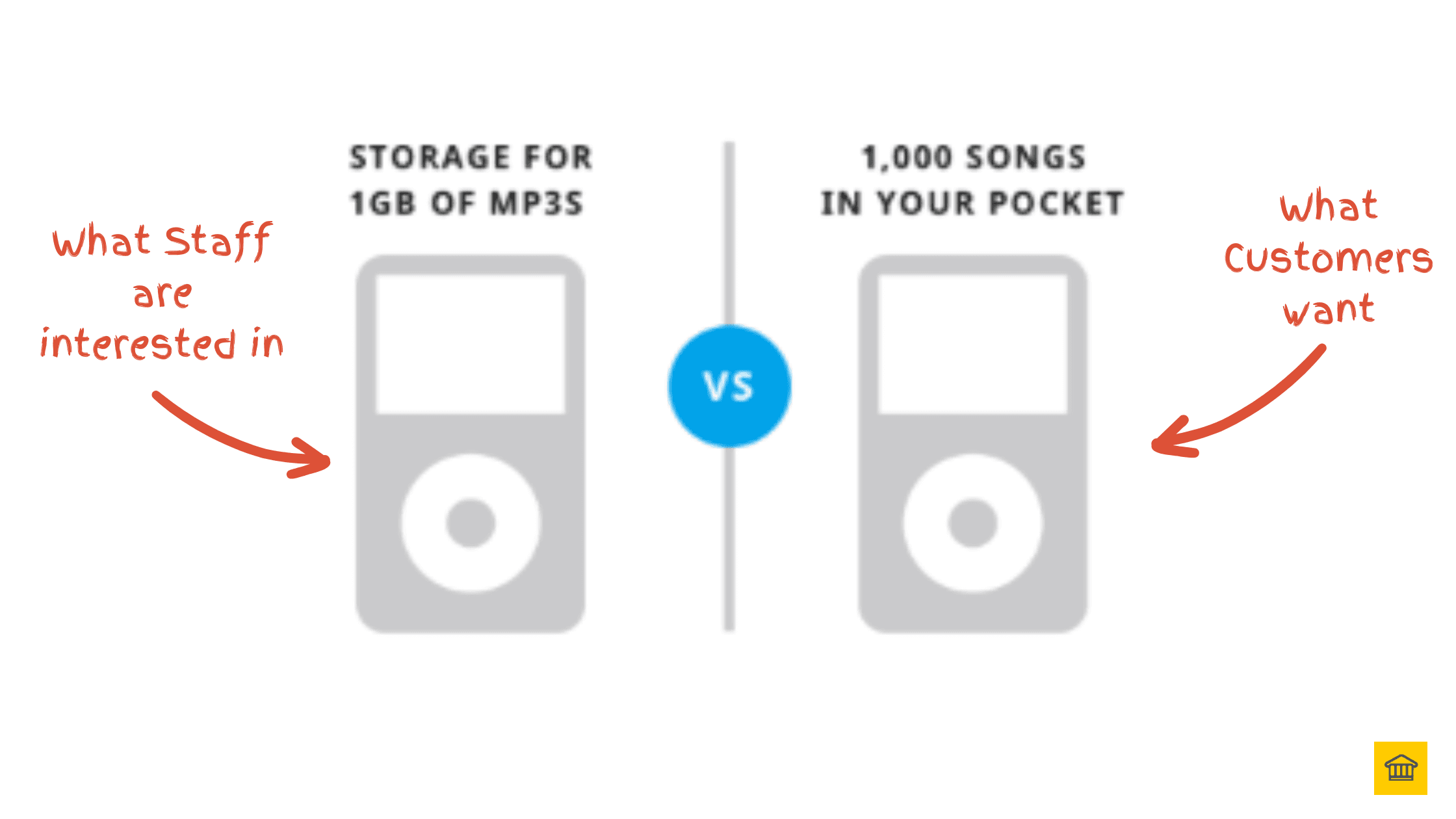
Let's look at this iPod. On one hand, we have a label that states a 1 GB storage capacity. This is a great feature, staff — namely your project and product staff think that's great, after all, that's what they had been working on to deliver. But, here's the catch — it's not something that the Customer can relate to (especially a non tech-savvy Customer), and definitely not one they are willing to pay for (that's the key!).
Instead of mentioning the storage capacity, explain to your Customer how having this feature will allow them to enjoy 1,000 songs in their pocket. From a marketing point of view, your Customer is more likely to respond positively if you give Value to a certain feature.
In the same way, Business Benefits realised through a transformation don't mean much to a Customer. Likewise, Value on its own doesn't mean much to Employees as much as Business Benefits do.
What is Meant by 'Benefit'?
In Business Design, specifically Business Transformation, Benefits have a rather different meaning. They refer to the result achieved from the changes delivered by the transformation that in turn, allow employees to realise Business Benefits.
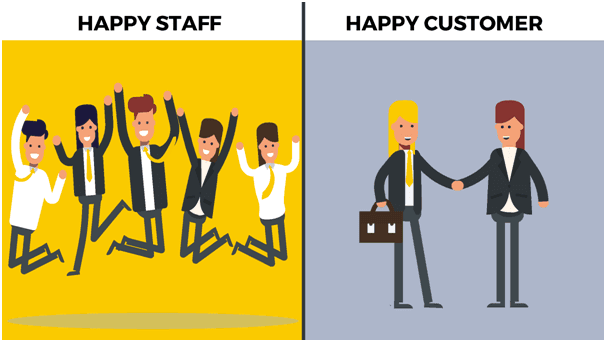
Simply put, Business Transformations should focus on achieving Business Benefits that employees can take advantage of — in order to deliver Value to Customers.
Now, here is where the misconceptions occur.
The Misconceptions
Firstly, Business Transformations wrongly focus on Value, which actually means nothing to the Business and everything to the Customer. As a result, Business Transformators aim on delivering Value, which is the second misconception.
While many stakeholders might be excited by the perceived Value of innovative digital solutions, others such as the CFO and business leaders need to stay focused on business value — or in this case, Business Benefits — that can be measured.
Instead of aiming to deliver Value, Business Transformators need to focus on delivering business changes. This includes any and all enhancements in system processes, technology and even people. It is the business changes that are delivered, that enables the Business to realise its Business Benefits.
For instance, on one client I assisted with their digital transformation, the client upgraded their processes from being paper-based to fully digitalised and made it more agile. As a result, the business was able to process an additional 10,000 applications through automation. When the Customers saw their applications would be approved faster (because now they had the capability to), it was perceived as something of value, value that they were willing to pay for.
In this case, the Business Benefit is the greater number of processed applications. The value derived is the faster approval time. The former is something that is important to staff (both the Business where they would be processing the applications, but also the project staff who delivered the changes), while the latter (faster approval times) is the value Customers are willing to pay for.
The Problem with Focusing on Value
Although Value and Benefits are very similar, they are and need to be treated differently. You could think of them as a balance sheet (assets and liabilities) and a profit and loss statement. Both of them are about money, but are used for different purposes.
It may seem like Value is what Business Transformations should focus on more instead of Benefits, but there are a few problems with that.
Value is simply the perceived benefit of a product or service. Since it's more of a marketing term, it makes it rather subjective, especially in terms of measuring it. ROI (return on investment) is one measure, but Value is subjective, impacted by many factors that pre-exist in a Customer's mind. To borrow the colloquialism "Value is in the eye of the Buyer, not Seller".
Secondly, Value is relative to competition. A Customer will choose a company or product over another if it delivers more relative Value to the alternative. Therefore, for Marketing, in the Marketing (not Business Transformation) department, it makes sense to say that the focus on Value should be placed.
The Ideal Approach to Business Transformations
That being said, it's important to know how Business Transformations can greatly influence Value, if carried out effectively.
There is a relationship between Business Changes and Benefits Realisation, and Benefits Realisation and Strategic Objectives that's missed in the market place today.
A successful transformation carries out Business Changes (enhanced processes and people) and increases the ability of Benefits Realisation (turning planned benefits into reality). As a result of enhanced Benefits Realisation, the organisation has greater opportunities to meet its Strategic Objectives, such as greater market share or a larger client base.
Author's Note
I interject this post, to give you this. You are not going to hear this anywhere else:
We get called in to clean up transformation programs, usually when the Client has exhausted all avenues with the hired help. Senior Management did what a lot of Senior Managers do, they buy a trusted brand. Remember, no one gets fired for hiring IBM, right? Exactly... until you're 2 years deep in your program, it's filled with more consultants than you can shake a stick at, and no transformation in sight.
That's when they call us. So let me save you the time, money and frustration. If you are on a project or program and you are told to focus on "value" as opposed to "benefits", there is a reason. A good reason.
Value is a term that is defined in the eyes of the Customer, not you the Customer of the consultancy, the Customer that is ultimately paying for your organisation's products and services.
So what will happen is you will run your program, to deliver the changes, for the staff to use, for the Customer to get a better, faster, more affordable product or service... but (and here's the news flash), they won't.
The changes will not deliver what were intended, the product will not be quite good enough, not quite fast enough, and not quite affordable enough... essentially, it's a flop. If you got no changes, and therefore wasted time and money, it's a disaster. But guess what? Guess who's to blame? Wait for it... the Customer!
The consultant or consultancy will not take ownership nor responsibility for it. They have absconded from their original responsibility to deliver "changes" to now saying "oh, yes, it was the customer and they changed their mind".
To be absolutely clear — when you spend millions of dollars on your project, and have supposedly the best management consultancy in the business on the job, there are no excuses for not delivering what you asked for.
If however, you focused on Benefits, an element that the Business is able to control, through identifying, defining, agreeing, prioritising, building and implementing the specific business changes (people and process) and enablers (technology and data) to enable the Business to realise the planned benefits and manage and monitor their realisation (or put in course correction) over time, you would have succeeded.
If you want to prevent that, or mitigate the damage, or know what course-correction options are available, then schedule a no-obligation discovery call.
Conclusion
When a Business Transformation focuses on increasing Business Benefits, it creates value for Employees. When processes are innovated, it enhances speed and overall performance of an Organisation.
As a result, Employees understand the planned objectives they are working towards, and work more efficiently into creating value for Customers. Customers will be attracted to this aspect and prioritise it over other competitors.
Therefore, a Benefit-oriented transformation leads to better results for all stakeholders, including Customers, as it indirectly also positively impacts value — value perceived in the eye of the Customer, that the Customer is willing to pay for.
If you're in the transformations industry and are still focused on Value rather than Benefits, it's time you updated to the new model. Here at HOBA Tech, we focus on transformations that bring about maximum Business Benefits.
We turn your Target Operating Model (TOM) into a reality that is loved by all its stakeholders, from the Employees to the Customers.
While we focus on delivering Business Benefits to the organisation, we leave it to the marketing department to come up with campaigns and promotions that show how a 1,000 songs in your pocket is better than the 1GB storage.
If we follow this radical approach to business transformations, it's a win-win for everybody!

Heath Gascoigne
Founder & CEO
HOBA TECH

Heath Gascoigne
Hi, I'm Heath, the founder of HOBA TECH and host of The Business Transformation Podcast. I help Business Transformation Consultants, Business Designers and Business Architects transform their and their clients' business and join the 30% club that succeed.
TRANSFORM YOUR
ORGANIZATION
WITH THIS SIMPLE PROCESS
WE OFFER THE TRAINING FOR PEOPLE TO GO AND LEARN THE SKILLS NEEDED TO ACHIEVE THE SAME RESULTS AS ACHIEVED IN THIS CASE STUDY.

ENJOYING THIS POST?
GET THE NEXT ONE
Subscribe to our newsletter and get the latest insights delivered straight to your inbox.
" Just read: "Value vs Benefit. Which is Better?" — incredible insights on business transformation. 🚀 "