The 4+1 Ladder Has Five Rungs. Most Organisations Stop at Four. | HOBA
📷Click on any image to enlarge.
Here's the lie every transformation programme tells itself: if we get the strategy right, the model clear, the processes mapped and the systems selected, the change will happen.
It's not happening. That's not how this works.
The 4+1 Ladder is HOBA's build sequence for business-led transformation. Five stages, in order:
- Business Strategy — why are we changing?
- Business Model — what must be true for this to work?
- Business Process — how do we redesign the work?
- Systems & Data — what capabilities underpin it?
- +1 Implementation — how do we deliver without the 70% failure rate?
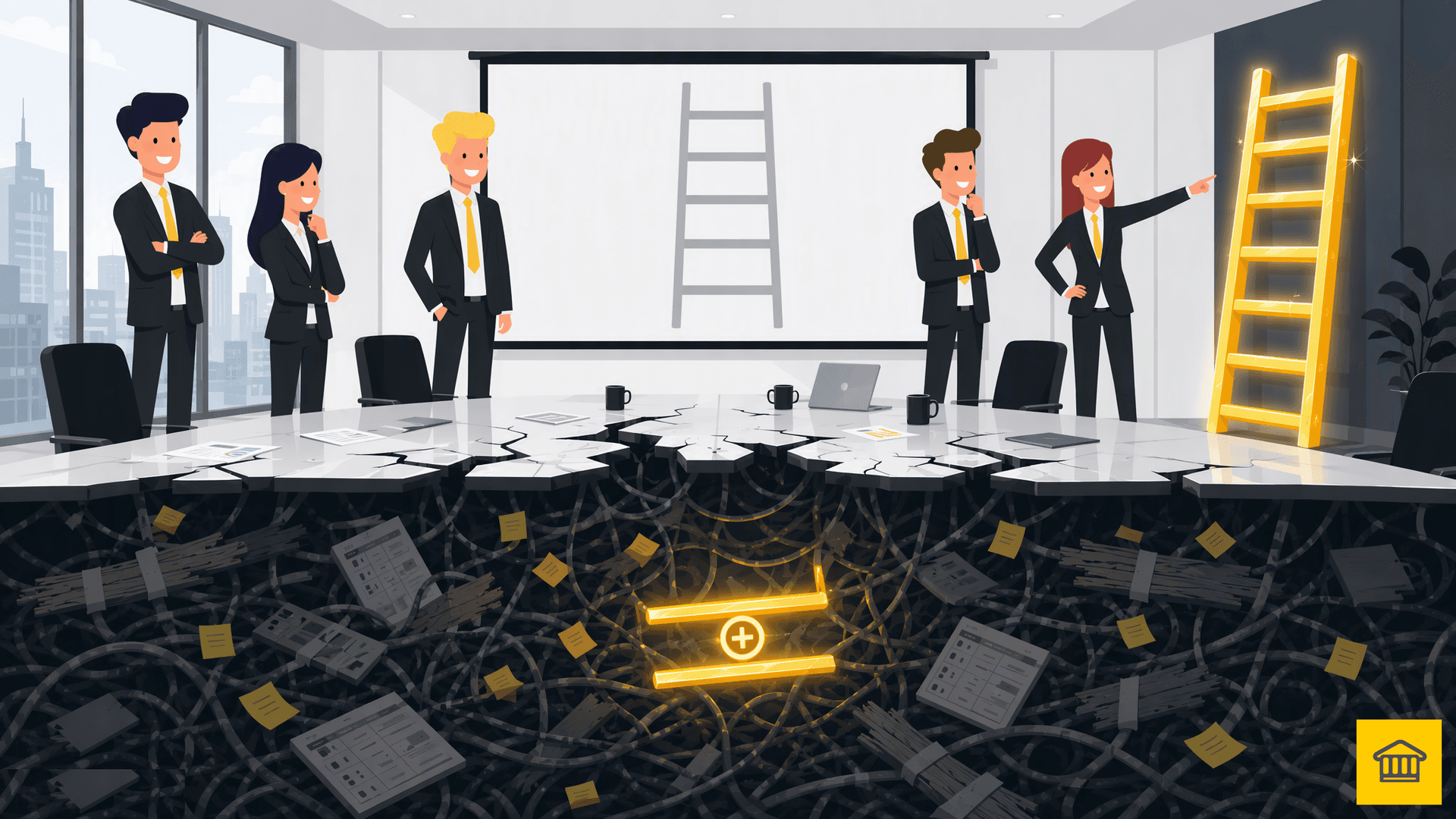
Most organisations climb the first four rungs beautifully. Workshops are energetic. Whiteboards are full. Consultants are paid. The target operating model is printed on glossy paper and pinned to boardroom walls.
Then they stop. They assume the +1 — implementation, governance, assurance, the actual delivery — is a separate phase. Or that it will sort itself out. Or that the same people who designed the poster can now build the building.
They cannot. Design thinking iterates in circles. The 4+1 Ladder builds in ascending stages. One explores. The other constructs. And the +1 is where 70% of transformations die — not because the first four rungs were wrong, but because the fifth one was treated as optional.
The +1 Isn't a Bonus. It's the Run That Holds Everything Up
Every stalled programme has a post-mortem, and almost all of them blame the wrong rung. Here's the honest ledger:
| The Lie | The Reality |
|---|---|
| "We have a clear strategy and target operating model." | You have a picture of a destination. Nobody can build from a picture. |
| "The processes are mapped and the systems are selected." | The design is complete. The architecture of delivery hasn't started. |
| "Implementation is a separate phase." | Implementation isn't a phase. It's the +1. Without it, the first four rungs are a wish list. |
| "Our consultants documented everything." | They documented what people said. Nobody modelled how the change actually gets delivered. |
| "We'll govern it after go-live." | Governance after go-live is called a post-mortem. |
None of this is an argument against the first four rungs. Strategy, model, process and systems matter. But they are inputs. The +1 is the output. And the gap between a beautiful design and a delivered change is where most programmes stall, overspend, or die.
 🔍 Click to enlarge
🪜 “The 4+1 Ladder has five rungs. Most organisations climb four and call it done. The +1 isn't a bonus — it's the run that holds everything up.” #4Plus1Ladder #BusinessArchitecture

The First Four Rungs Get All the Budget. The +1 Gets None
Watch any transformation budget split. Strategy: funded. Operating model design: funded. Process mapping: funded. System selection and licensing: generously funded.
Implementation governance, change assurance, business architecture ownership, and the structured delivery mechanism that actually lands the change? These get the leftovers. If they get a line item at all.
This isn't negligence. It's a category error. The first four rungs produce visible artefacts: decks, diagrams, journey maps, vendor shortlists. The +1 produces invisible architecture: decision rights, traceability, governance loops, and the accountability that survives the first time something goes wrong.
Visible artefacts impress boards. Invisible architecture saves programmes.
The result is predictable. The programme launches with a beautiful design and no delivery engine. Stakeholders who agreed in the workshop disagree in the steering committee. The process that was mapped doesn't match the process that runs. The system that was selected can't handle the exceptions nobody modelled. And the post-mortem — written eighteen months and several million pounds later — blames the technology, the vendor, or the data.
It wasn't the technology. It was the missing rung.
Last month's post took this apart in full — why design-first transformation produces posters, not buildings, and why Business Architecture is what makes a design buildable. The short version: design tells you what good looks like. Architecture tells you how it holds together. And the +1 is where holding together either happens or doesn't.
 🔍 Click to enlarge
💰 “Strategy gets funded. Operating models get funded. The +1 — implementation, governance, assurance — gets the leftovers. Then we act surprised when the programme stalls.” #TransformationGovernance #4Plus1Ladder
In Government and Financial Services, the +1 Is the Audit
If you lead transformation in a regulated environment, the +1 isn't just expensive to skip — it's existentially dangerous.
A regulator does not accept "we had an excellent strategy workshop" as evidence. The National Audit Office does not sign off a target operating model deck. When the FCA asks who authorised a decision, who traced it to an outcome, and who is accountable when the outcome doesn't arrive, you need the +1: governance, assurance, and traceability built into the architecture from the start.
Design artefacts can't give you that. They were never built to.
The +1 gives you:
- Every capability has an owner — named, accountable, traceable.
- Every process has a level of decomposition matched to its regulatory risk.
- Every change is traced from boardroom intent to frontline execution — and back.
In UK Government and Financial Services, the organisations that transform successfully aren't the ones with the most beautiful operating models. They're the ones whose +1 can answer an auditor's question in minutes, not months.
Two weeks ago we covered why regulated organisations can't afford invisible processes — and why Process Debt is a control failure waiting for an audit. The short version: when you skip the +1, you don't just stall. You create findings.
The Ladder Most Organisations Actually Climb
| The Usual Programme (Four Rungs) | The HOBA Way (Five Rungs) | |
|---|---|---|
| What gets delivered | A design. A deck. A poster. | A governed Business Architecture with owners, traceability, and a delivery engine. |
| Budget split | 90% design and tools, 10% delivery (if lucky) | Architecture first; the +1 is resourced like the rung it is. |
| Who owns it after day one | Nobody — the consultants left. | Named business owners, with governance loops. |
| Proof of value | "The workshop had excellent energy." | Every change traced to a decision, an owner, and an outcome. |
| 18 months later | The poster fades; the debt stays. | The model evolves; the change compounds. |
| Outcome | Faster dysfunction. | A transformation the business actually owns. |
Read the budget row again. That's the entire argument. The money was never the problem. The sequence was.
What the +1 Actually Looks Like
The +1 isn't a phase. It's a discipline. Here's what it means in practice:
Map before you automate. Model the business as it actually runs — official processes and Shadow Processes, one shared Language from boardroom to frontline, every process decomposed to the Level of detail its risk demands. That's the 3 Ls: Layers, Language, Levels. You cannot deliver a change you refuse to see.
Eliminate before you buy. The 4+1 Process — Eliminate, Standardise, Optimise, Automate, then apply AI — is the applied version of everything in this post. Most of what your Shadow Processes are working around shouldn't exist at all. Deleting it is the cheapest transformation you'll ever fund.
Govern before you go live. Implementation without governance is just expensive guessing. The +1 includes: decision rights mapped to capabilities, change assurance at every level, and an architecture repository that outlives the programme. Not a document. A structure.
Then — and only then — deliver. AI-enabled change as the final step of a structured strategy, not a substitute for having one. The 4+1 Ladder gives you a governed route from ambition to outcome — no heroic leaps, no ditches.
You don't need a faster horse. You need a proper chassis — and someone who knows how to drive it.
 🔍 Click to enlarge
🏗️ “The +1 isn't a phase. It's a discipline. Map before you automate. Eliminate before you buy. Govern before you go live. Then deliver.” #BusinessArchitecture #StopPatching
What You Actually Get
Let's answer the only question that matters: what does the customer get?
Not a deck. Not a poster. Not another target operating model that gets skimmed once and archived.
You get a Business Architecture your organisation owns: a single, governed model of what your business is, what it needs to become, and the governed steps — the full 4+1 Ladder — to get there. You get named owners, traceable decisions, and an architecture repository that outlives the programme. And you get a transformation that starts with strategy and ends with delivery — instead of starting with ambition and ending with a post-mortem.
The 70% failure rate isn't a law of nature. It's a sequence error. Fix the sequence — climb all five rungs — and you're in the minority that ships.
Stop Patching. Start Architecting.
If your last transformation produced a beautiful target operating model and very little transformation, you don't have an effort problem. You have a structure problem — and the missing rung is the +1.
Take the HOBA Pro Assessment and find out — in plain terms — whether your organisation is climbing four rungs or five.
Stop Patching. Start Architecting.
About HOBA Tech
If this resonated with you, discover how to make Business Transformation a reality — with less stress, fewer resources, and faster results. Explore our award-winning agile Business Transformation Framework, trusted by organisations worldwide, from the UK Government and FTSE-100 companies to innovative start-ups. Ready to begin your transformation journey? Start here.
Curious why The Business Transformation Playbook is hailed as the "Business Transformation Bible"? See what readers are saying in the Amazon reviews.
We'd love to hear your thoughts! Let us know in the comments what stood out to you or what topics you'd like us to cover next. If you found this valuable, share it with others who could benefit!
Thank you for reading, and here's to your transformation success!
Sincerely,
Heath Gascoigne
P.S. If you want to join our Business Transformation Community of 2,000+ like-minded Business Transformators, join the HOBA Community here.
P.P.S. If you want to learn more about business transformation, check out The Business Transformation Playbook.

Heath Gascoigne
Hi, I'm Heath, the founder of HOBA TECH and host of The Business Transformation Podcast. I help Business Transformation Consultants, Business Designers and Business Architects transform their and their clients' business and join the 30% club that succeed.
TRANSFORM YOUR
ORGANIZATION
WITH THIS SIMPLE PROCESS
WE OFFER THE TRAINING FOR PEOPLE TO GO AND LEARN THE SKILLS NEEDED TO ACHIEVE THE SAME RESULTS AS ACHIEVED IN THIS CASE STUDY.
ENJOYING THIS POST?
GET THE NEXT ONE
Subscribe to our newsletter and get the latest insights delivered straight to your inbox.

Make HOBA Tech a Google Preferred Source.
One click and Google will start showing our articles in AI search results and AI Overviews when you search.
🚀 “Just read: "The 4+1 Ladder Has Five Rungs. Most Organisations Stop at Four. | HOBA" — incredible insights on business transformation.” #BusinessTransformation

![Top 4 mistakes companies make when they hire a consultant to manage their business transformation [Part 2]?](/_next/image/?url=%2Fimages%2Fassets%2FTop-4-mistakes-companies-make-when-they-hire-a-consultant-to-manage-their-business-transformation.png&w=1920&q=75&dpl=dpl_FzdBy9JXwVpsF6sX7P6fRhLVBszE "Top 4 mistakes companies make when they hire a consultant to manage their business transformation [Part 2]?")