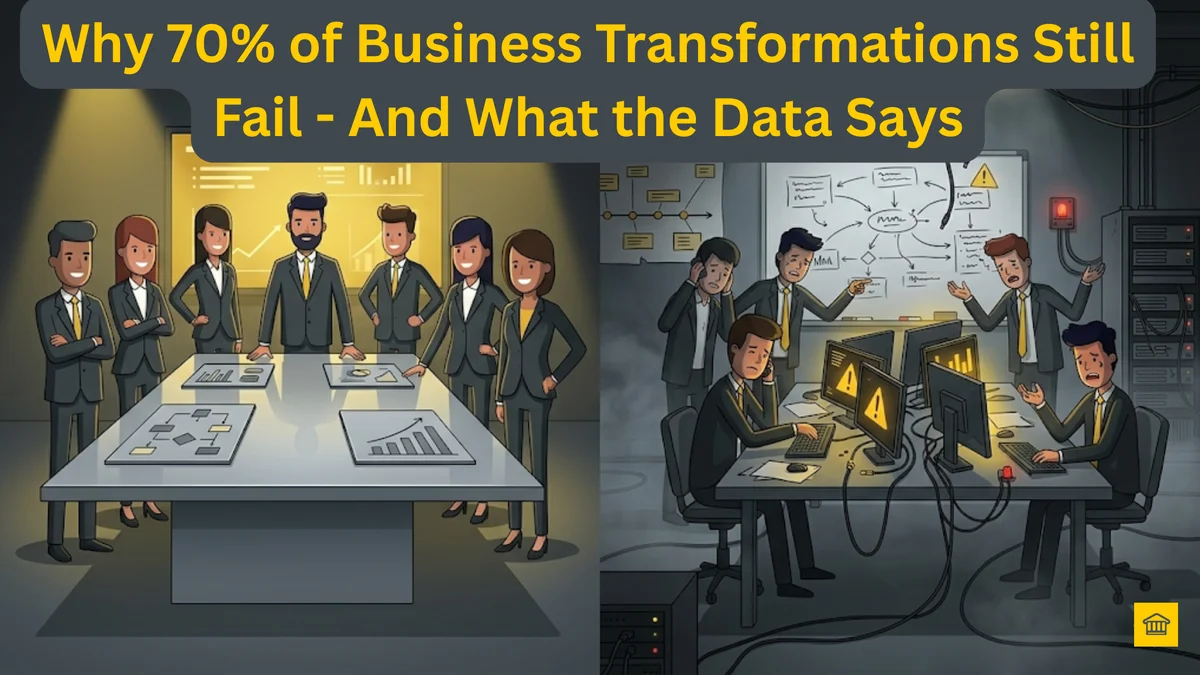
Why 70% of Business Transformations Still Fail — And What the Data Says
SCROLL TO KEEP WATCHING ↓
📷Click on any image to enlarge.
Business transformation has a failure problem. Not a small one. A structural one.
For years, leaders have heard some version of the same message: most transformations fail. The percentage varies depending on the study, the sector, and how success is measured, but the pattern is stubbornly consistent. A large majority of transformation programmes underperform, stall, drift, or collapse under the weight of their own ambition.
 🔍 Click to enlarge
At HOBA Tech, we have used the 70% figure for years not because it is dramatic, but because it captures a truth the market still resists: transformation failure is not the exception. It is the default outcome when the fundamentals are weak. For a complete definition of what business transformation actually means today, see What Is Business Transformation? The Definitive Guide for 2026.
That matters more than ever now, because AI has entered the conversation like an accelerant. Instead of reducing failure risk, it is often making failure faster, more expensive, and harder to reverse.
The good news is that failure is not random. Patterns exist. Causes repeat. And once you understand them properly, you can design against them.
The uncomfortable truth
Most transformation programmes do not fail because leaders are lazy or because teams do not care. They fail because the transformation itself is built on weak sequencing, vague ownership, poor architecture, and a mismatch between what the business needs and what the programme is actually doing.
That is why so many initiatives look busy on the outside while quietly underperforming underneath. There are steering groups. Workstreams. Programme dashboards. Vendor relationships. Progress updates. Launches. Workshops. Even early wins.
And still, the transformation does not land.
Why? Because activity is not the same as outcome. Motion is not the same as transformation. And transformation theatre is far more common than most organisations are willing to admit.
⚠️ “Most business transformations do not fail because people are not working hard enough. They fail because the design is wrong long before the delivery starts.”

IS YOUR
ORGANISATION
READY TO TRANSFORM?
FIND OUT BEFORE YOU START — NOT AFTER YOU FAIL. ASSESS YOUR READINESS ACROSS 6 KEY AREAS — STRATEGY, PEOPLE, PROCESSES, TECHNOLOGY, GOVERNANCE, AND CULTURE — AND GET A FREE PERSONALISED SCORECARD REPORT WITH PRACTICAL RECOMMENDATIONS.
What the data actually says
The exact percentage varies, but the message does not. McKinsey has repeatedly pointed out that fewer than one-third of enterprise-wide transformations fully achieve and sustain their intended performance improvements. That alone should force a strategic pause.
It also points to something useful: the difference between success and failure is not mystical. Research shows that certain factors meaningfully improve the odds. McKinsey, for example, has highlighted that organisations with broader employee ownership of the transformation can materially improve shareholder outcomes. It has also shown that top-performing businesses capture value earlier, match their strongest talent to their most important initiatives, and link incentives to real outcomes rather than generic participation.
So the issue is not whether transformation can work. It can. The issue is that most businesses still approach it in ways that make failure highly probable.
The 8 root causes of failure
Across failing programmes, the same root causes appear again and again.
 🔍 Click to enlarge
- No clear vision before technology selection. Tools get chosen before outcomes are defined.
- Business architecture is missing. The current state, target state, and operating model are not properly mapped.
- Change management is treated as an add-on. Human adoption is assumed rather than designed.
- Executive sponsorship lacks accountability. Leaders endorse the programme without owning the hard trade-offs.
- Delivery is siloed. IT, operations, and business teams run in parallel rather than as one system.
- Metrics measure activity, not value. Teams report movement instead of outcomes.
- Culture is underestimated. Resistance is treated as a communication issue instead of a design issue.
- AI and automation are introduced too early. New technology is layered onto unstable processes.
None of these are rare. None of these are surprising. That is exactly why the failure rate remains so high.
📉 “Technology-first transformation fails for the same reason technology-first strategy fails: it mistakes enablement for direction.”
6 STEPS TO
BUSINESS
TRANSFORMATION
SUCCESS
WHAT THE TOP 30% OF ORGANISATIONS KNOW THAT YOU DON'T. GET THE FREE EBOOK NOW.
How AI is making the failure rate worse
AI is not the enemy here. But it is making an old problem more dangerous.
Too many organisations are now adding AI into transformations that were already under-designed. They are using it as a signal of ambition rather than a disciplined capability choice. That creates three immediate risks.
- It accelerates bad process. If the workflow is unclear, AI moves unclear work faster.
- It creates FOMO-led decisions. Teams buy categories before proving need.
- It increases complexity before governance is ready. More automation, more data movement, more exceptions, more risk.
 🔍 Click to enlarge
This is why HOBA's position remains consistent: AI does not come first. It comes after eliminate, standardise, optimise, and automate. Otherwise, you are not transforming intelligently. You are scaling instability. Read more about why AI won't fix a broken transformation.
What successful transformations have in common
Successful transformation programmes do not succeed by luck. They tend to share a clearer logic.
- They start with business outcomes, not platform features
- They define the current and target state properly
- They align leadership, delivery, and operating model decisions
- They build ownership beyond the central programme office
- They measure realised value, not just programme motion
- They sequence technology after design, not before it
In other words, they behave like transformations rather than technology rollouts with better branding.
🚀 “If you cannot explain why the transformation exists, how value will be measured, and who owns the operating model changes, you do not have a transformation. You have a programme in search of a justification.”
The HOBA alternative
At HOBA Tech, we do not treat failure as a motivational issue. We treat it as a design issue.
That is why the HOBA method starts with business architecture, clarity, and sequence. Before technology. Before AI. Before delivery theatre.
 🔍 Click to enlarge
Our six-step approach is deliberately practical:
- Why are we transforming? Define the business drivers, outcomes, and strategic intent.
- Where are we today? Understand the current state architecture.
- Where do we need to be? Define the future operating model and target state.
- How do we get there? Build the transformation roadmap.
- How do we deliver it? Align programme architecture, governance, and delivery.
- How do we sustain it? Embed measurement, ownership, and continuous oversight.
The point is not to make transformation feel slower. It is to make success more likely.
So why do 70% still fail?
Because too many businesses are still trying to transform through energy rather than architecture.
They launch before they define. They automate before they standardise. They delegate without true accountability. They measure activity instead of value. And increasingly, they add AI as a signal of progress when the fundamentals are not yet stable enough to support it.
The result is predictable: delay, drift, cost, fatigue, and under-delivery.
But it is not inevitable.
The businesses that break the pattern will be the ones that stop treating transformation as a burst of activity and start treating it as a disciplined system of design, delivery, and governance. For where this is heading, read the 2026 Business Transformation Predictions.
That is what the data says. And that is what leaders need to act on.
📉 “70% of business transformations still fail — not because change is impossible, but because design, ownership, sequencing, and governance are too often weak from the start.” #BusinessTransformation #ChangeManagement #AI #DigitalTransformation #Leadership
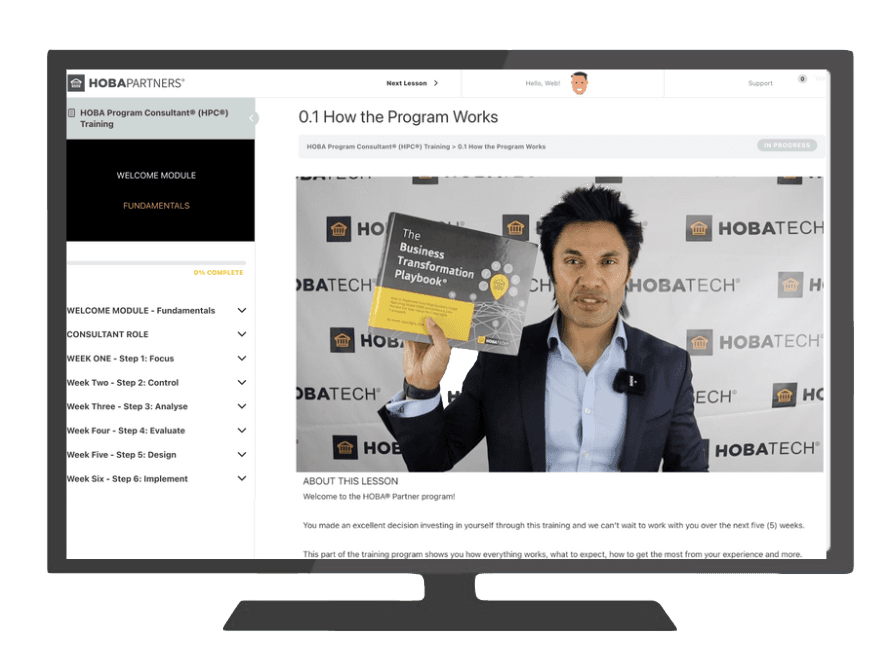
LOOKING
FOR THE
BEST
TRAINING?
DELIVER YOUR BUSINESS TRANSFORMATION.
Thank you for reading this!
About HOBA Tech
If this resonated with you, discover how to make Business Transformation a reality — with less stress, fewer resources, and faster results. Explore our award-winning agile Business Transformation Framework, trusted by organisations worldwide, from the UK Government and FTSE-100 companies to innovative start-ups. Ready to begin your transformation journey? Start here.
Curious why The Business Transformation Playbook is hailed as the "Business Transformation Bible"? See what readers are saying in the Amazon reviews.
We'd love to hear your thoughts! Let us know in the comments what stood out to you or what topics you'd like us to cover next. If you found this valuable, share it with others who could benefit!
Thank you for reading, and here's to your transformation success!
Sincerely,

Heath Gascoigne
P.S. If you want to join our Business Transformation Community of 2,000+ like-minded Business Transformators, join the HOBA Community here.
P.P.S. If you want to learn more about the world's only business-led business transformation framework, check out The Business Transformation Playbook here.

Heath Gascoigne
Hi, I'm Heath, the founder of HOBA TECH and host of The Business Transformation Podcast. I help Business Transformation Consultants, Business Designers and Business Architects transform their and their clients' business and join the 30% club that succeed.
TRANSFORM YOUR
ORGANIZATION
WITH THIS SIMPLE PROCESS
WE OFFER THE TRAINING FOR PEOPLE TO GO AND LEARN THE SKILLS NEEDED TO ACHIEVE THE SAME RESULTS AS ACHIEVED IN THIS CASE STUDY.

ENJOYING THIS POST?
GET THE NEXT ONE
Subscribe to our newsletter and get the latest insights delivered straight to your inbox.

Make HOBA Tech a Google Preferred Source.
One click and Google will start showing our articles in AI search results and AI Overviews when you search.
🚀 “Just read: "Why 70% of Business Transformations Still Fail — And What the Data Says" — incredible insights on business transformation.” #BusinessTransformation