
Download Vision Map Blueprint for Agile Business Transformation | HOBA Tech
Free Vision Map Blueprint for Agile Transformation
Download the Vision Map Blueprint (VSOM) to define and agree on your business transformation vision, strategy, objectives, and measures. Streamline your transformation process with clear and measurable outcomes.
Get Your Free Vision Map Blueprint Instantly
Download this Blueprint For Free!
Make your Vision meaningful and measurable for all parties involved in and impacted by the business transformation. The Vision Map Blueprint helps define clear, actionable steps to achieve your transformation goals.
Steps to Implement the Vision Map Blueprint
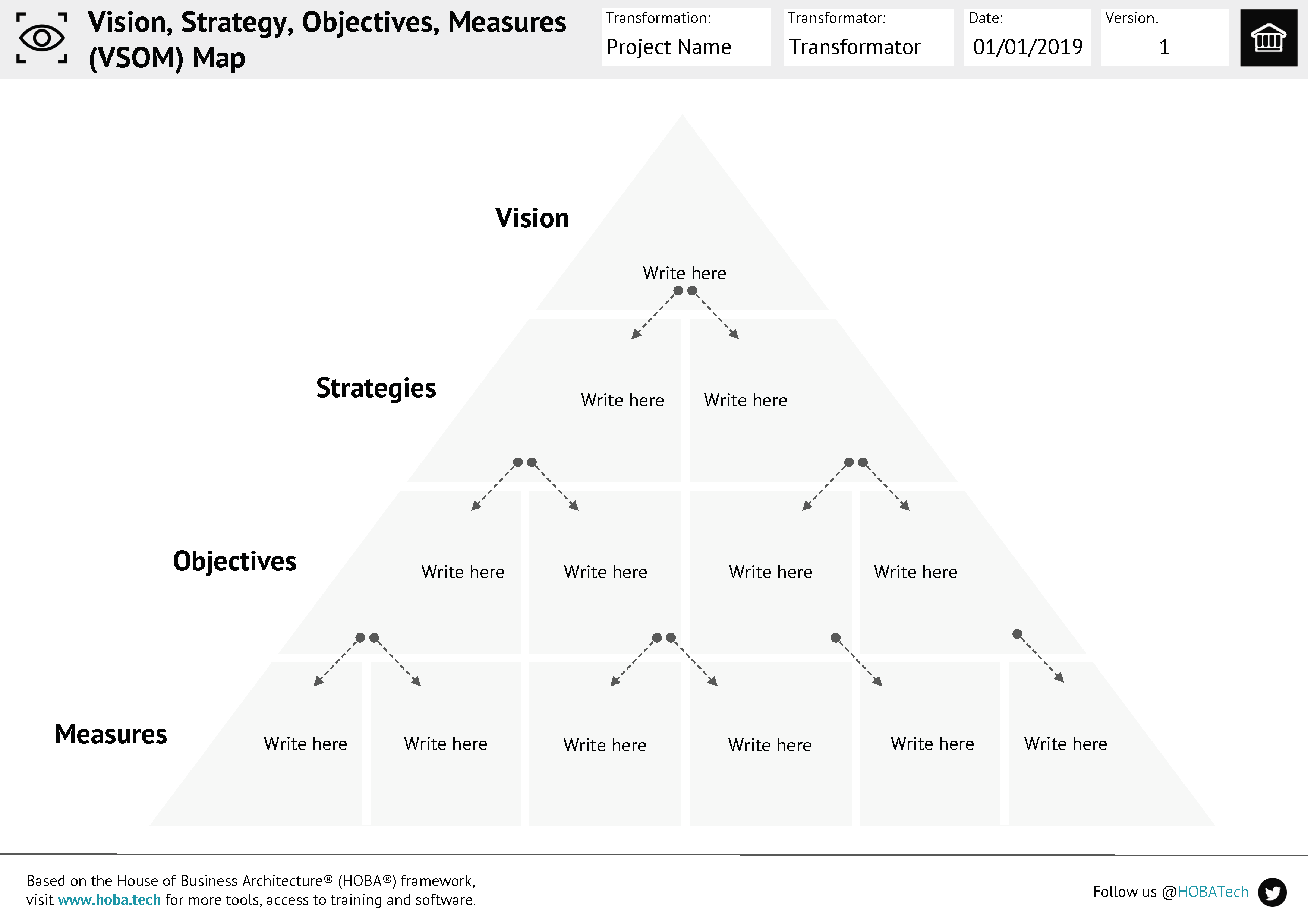
The VSOM Blueprint provides the view of the Vision decomposed into the Strategy(ies), Objectives and then Measures. Creating the VSOM Blueprint is a practical planning process that helps define the Vision, and the criteria that is used to measure success.
Each of the components of the VSOM Blueprint is as follows:
Vision
The single focus of the Organisation and Business Transformation. It is described in terms of what the 'end state' looks like. It is often an aspirational statement of what the Organisation would like to be in the future. It addresses the 'Why is the Business in business? question
Strategy
The options available to achieve the Vision. It is the ‘means’ or ‘method’ by which the Organisation will seek to achieve the Vision e.g. ‘Re-engineer business processes; replace legacy IT systems with a flexible technology solution & data platform'
Objective
This describes how the Business plans to achieve its objectives. Goals should be specific, time-bound, achievable, and realistic, following the S.T.A.R goal format. Examples include legacy system decommissioning (by end of Q1 2017) or IT component sharing (by end of Q1 2017).
Measures
Quantitative measures, such as KPIs or metrics, are used to accurately track progress towards the vision and determine whether objectives are being met. Examples include system switch-offs, data migration with no errors, and component sharing at project close.