Agent Confusion Is What Happens When AI Meets Invisible Architecture | HOBA
📷Click on any image to enlarge.
Agent Confusion Is What Happens When AI Meets Invisible Architecture
AI Doesn't Create Chaos. Missing Architecture Does.
Here's the lie every organisation tells itself before deploying AI-enabled tools: "The AI will figure it out."
It's not happening. And it was never going to.
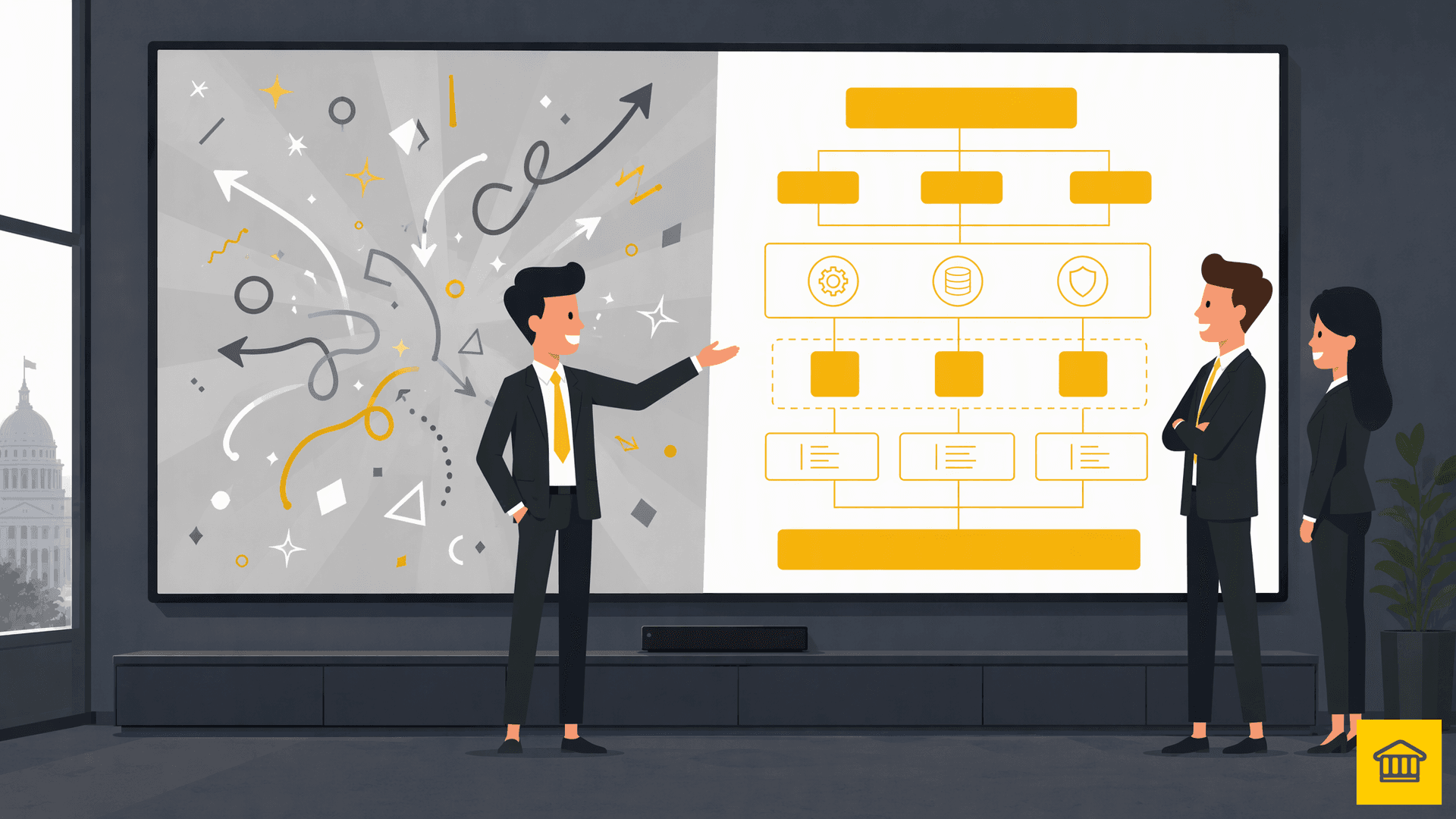
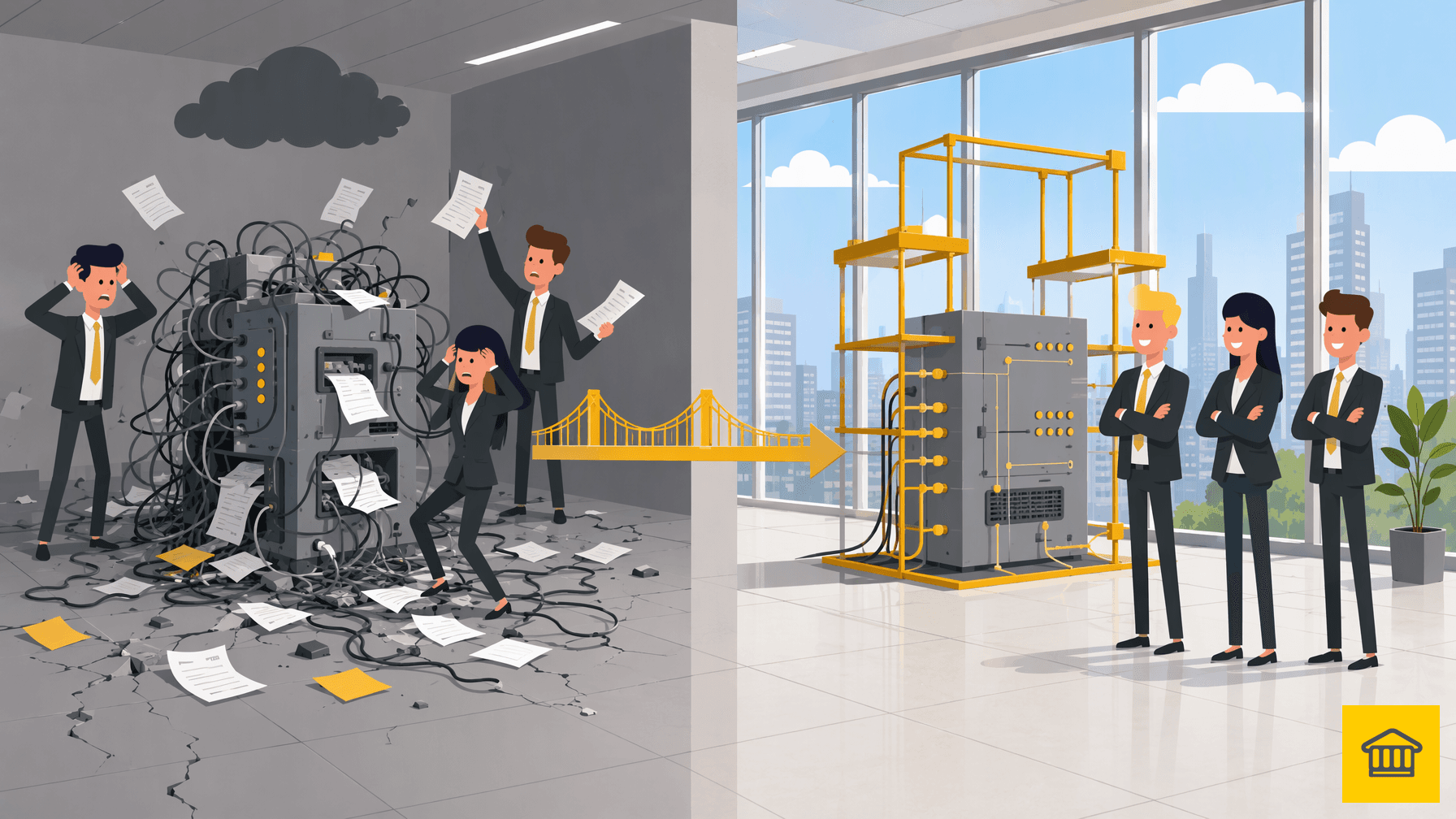
AI doesn't create order out of chaos. It scales whatever it touches. If it touches a mapped process with named owners and clear decisions, it scales the structure. If it touches invisible processes, shadow workarounds, and unowned decisions, it scales the chaos. And it scales it faster than any human process ever could.
That's Agent Confusion. Not the science-fiction kind — not robots gone rogue. The real kind: AI-enabled tools making decisions at a speed and scale that no human can supervise, inside a structure that nobody mapped, with outcomes nobody can trace. The AI isn't confused. The architecture is missing.
Last month we covered why Shadow Processes kill AI-enabled transformation — the invisible workarounds that most AI projects never map. Agent Confusion is what happens next. The AI has been deployed. It's running. And it's making thousands of micro-decisions inside a business that was never architected to answer the only questions that matter: Who owns this process? What's the decision path? What happens when it goes wrong?
The HOBA way fixes this at the structure. Map the business as it actually runs — official processes and Shadow Processes, one shared Language from boardroom to frontline, every process decomposed to the Level of detail its risk demands. That's the 3 Ls: Layers, Language, Levels. Only when the architecture is visible can AI-enabled change do what it's meant to do: scale a structure, not a mess.
The Lie vs. The Reality
Every stalled AI-enabled programme has a post-mortem, and almost all of them blame the wrong thing. Here's the honest ledger:
| The Lie | The Reality |
|---|---|
| "The AI will learn and adapt to our processes." | The AI learns from what you show it. If you show it shadow processes and workarounds, it learns shadow processes and workarounds — at scale. |
| "We have guardrails in place." | Guardrails on an invisible road don't prevent crashes. They just define where the crash happens. |
| "Our AI vendor handles the governance." | Your vendor sells tools. Governance requires Business Architecture — your business, your processes, your owners. Not a vendor template. |
| "The AI's decisions are explainable." | The AI's logic may be explainable. Your business's decision path isn't — because it was never mapped. |
| "We'll add oversight after go-live." | Post-go-live oversight of AI-enabled chaos is called a post-mortem. And it produces more findings than outcomes. |
None of this is an argument against AI-enabled change. AI is a powerful capability. But it is an amplifier, not an architect. And the gap between what AI can do and what your business is structured to handle is where Agent Confusion lives.
 🔍 Click to enlarge
🤖 “Agent Confusion Is What Happens When AI Meets Invisible Architecture. The AI isn't confused. The architecture is missing.” #AIEnabled

Why Agent Confusion Grows Faster Than Shadow Processes
Shadow Processes took decades to accumulate. The workaround in accounts payable. The spreadsheet in compliance. The manual check in onboarding. Each one small, each one justified, each one invisible to the process map. By the time most organisations discovered them, they had become the majority of the real work.
Agent Confusion doesn't take decades. It takes months.
Here's why: AI scales. That's the entire selling point. But scaling doesn't discriminate between structure and chaos. When you deploy AI-enabled tools onto a business with invisible architecture, you are not fixing the Shadow Processes. You are accelerating them.
- A shadow process in procurement becomes an AI agent buying the wrong things at 100x speed.
- A workaround in compliance becomes an AI-enabled control that passes the wrong transactions.
- An undocumented exception in customer service becomes an AI response that frustrates customers at scale.
Three weeks ago we covered why the 3 Ls — Layers, Language, Levels — are the architecture that makes communication possible — and why boardroom strategy and frontline reality can't connect without a shared structure. The short version: if your AI-enabled tool can't tell which Level of the business it's operating at, it can't make the right decision. It will guess. And it will guess wrong at scale.
The fix isn't more AI. It's Business Architecture. Map the real process first. Name the owners. Decompose to the right Level. Build the 4+1 Ladder — all five rungs. Only then apply AI as the amplifier of a structure, not the amplifier of a mess.
 🔍 Click to enlarge
⚡ “Agent Confusion grows faster than Shadow Processes because AI scales whatever it touches — including the chaos.” #AgentConfusion
In Government and Financial Services, Agent Confusion Is a Control Failure
If you lead transformation in a regulated environment, Agent Confusion isn't just inefficient — it's a regulatory time bomb with a very short fuse.
A regulator does not accept "the AI made the decision" as an answer. The FCA does not accept "the vendor's algorithm approved it" as evidence of control. The National Audit Office does not sign off a transformation because an AI-enabled tool processed transactions quickly. When the regulator asks who authorised a decision, how it was traced to an outcome, and what happens when the outcome doesn't arrive, Agent Confusion is not an explanation — it's a finding.
In regulated industries, the gap between AI-enabled capability and architectural governance is called a control failure. And control failures scale faster than any technology deployment.
This is why Business Architecture matters more in Government and Financial Services than anywhere else. Not because the AI is different — because the consequences are more severe. When your AI-enabled tool makes a decision inside a structure that nobody mapped, you are not just creating inefficiency. You are creating findings that will surface in the next audit, the next review, the next regulatory examination.
Last month we covered why more governance won't save a transformation with no architecture — and why committees on top of invisible structure just produce more minutes. The short version: governance on top of Agent Confusion doesn't create control. It creates the appearance of control while the AI scales the chaos underneath.
AI-Enabled Without Architecture vs. AI-Enabled With Architecture
| AI-Enabled Without Architecture | AI-Enabled With Architecture | |
|---|---|---|
| What the AI scales | Shadow Processes, workarounds, invisible decisions. | Mapped processes, named owners, traceable decisions. |
| Decision accountability | "The AI made the decision." Nobody owns it. | Every AI-enabled decision traces to a named owner and a governed process. |
| When something goes wrong | Post-mortem. Then another committee. | The architecture catches it — because the process was mapped, the owner was named, and the Level was decomposed. |
| Regulatory standing | Findings. Control failures. Audit questions nobody can answer. | Full traceability from AI-enabled decision to business outcome — and back. |
| Proof of value | "The AI processed 10,000 transactions." | Every transaction traced to a decision, an owner, and a business outcome. |
| 18 months later | The chaos has scaled. The findings have multiplied. | The architecture has evolved; the AI-enabled change has compounded. |
| Outcome | Agent Confusion at scale. | Agent governance that delivers. |
Read the accountability row again. That's the entire argument. The AI was never the problem. The architecture was.
What Agent Governance Actually Looks Like
Agent governance isn't more guardrails. It's the Business Architecture that tells every AI-enabled decision: who owns this, what's the process, and what happens when it goes wrong. Here's what it means in practice:
Map before you deploy. Use the 3 Ls — Layers, Language, Levels — to build a single, governed view of how the business actually runs. Not how it should run. How it runs. That means official processes and Shadow Processes, mapped, owned, and decomposed to the Level of detail the AI's risk demands. You cannot govern an AI-enabled decision inside a process you refuse to see.
Own before you automate. Every AI-enabled decision has a named business owner. Not a vendor. Not an algorithm. A person whose name appears in the architecture and whose accountability survives the go-live. If your AI-enabled tool can't tell you who owns its decisions, you don't have agent governance. You have Agent Confusion with a deployment date.
Decompose before you scale. Every AI-enabled process is decomposed to the Level of detail its risk demands. A low-risk document classifier needs a different Level of governance than a high-risk credit decision. The architecture tells you which is which. The 4+1 Ladder tells you how to build it — Strategy, Model, Process, Systems, +1 Implementation. All five rungs. No shortcuts.
Govern before you grow. Implementation without governance is expensive guessing at machine speed. Agent governance includes: decision rights mapped to capabilities, change assurance at every Level, and an architecture repository that outlives the vendor contract. Not a document. A structure. A building that the AI can scale inside — safely, traceably, and accountably.
You don't need a faster AI. You need an architecture that can hold what the AI delivers.
 🔍 Click to enlarge
🏗️ “Agent governance isn't more guardrails. It's the Business Architecture that tells every AI-enabled decision: who owns this, what's the process, what happens when it goes wrong.” #StopPatching
What You Actually Get
Let's answer the only question that matters: what does the customer get?
Not another AI tool. Not another guardrail. Not another vendor dashboard that shows you what the AI did after it did it.
You get a Business Architecture your organisation owns: a single, governed model of what your business actually is — official processes and Shadow Processes, mapped, owned, and decomposed to the Level of detail your AI-enabled risk demands. You get named owners for every AI-enabled decision. You get traceability from algorithmic intent to business outcome — and back. You get the 3 Ls — Layers, Language, Levels — as the structure that tells your AI which Level of the business it's operating at. And you get an AI-enabled transformation that scales inside a visible architecture — instead of scaling invisible chaos.
Agent Confusion isn't a law of nature. It's a visibility problem. Map the architecture first — own it, decompose it, govern it — and your AI-enabled change scales structure, not mess.
Stop Patching. Start Architecting.
If your last AI-enabled project produced faster transactions and bigger compliance gaps, you don't have an AI problem. You have an architecture problem — and the fix isn't more tools. It's structure.
Take the HOBA assessment and find out — in plain terms — whether your organisation is ready for agent governance, or already deep in Agent Confusion.
Stop Patching. Start Architecting.

Heath Gascoigne
Hi, I'm Heath, the founder of HOBA TECH and host of The Business Transformation Podcast. I help Business Transformation Consultants, Business Designers and Business Architects transform their and their clients' business and join the 30% club that succeed.
TRANSFORM YOUR
ORGANIZATION
WITH THIS SIMPLE PROCESS
WE OFFER THE TRAINING FOR PEOPLE TO GO AND LEARN THE SKILLS NEEDED TO ACHIEVE THE SAME RESULTS AS ACHIEVED IN THIS CASE STUDY.

ENJOYING THIS POST?
GET THE NEXT ONE
Subscribe to our newsletter and get the latest insights delivered straight to your inbox.

Make HOBA Tech a Google Preferred Source.
One click and Google will start showing our articles in AI search results and AI Overviews when you search.
🚀 “Just read: "Agent Confusion Is What Happens When AI Meets Invisible Architecture | HOBA" — incredible insights on business transformation.” #BusinessTransformation